Table of Contents
If you talk to anyone who has taken a cloud certification recently, they will probably tell you the same thing: the easy days are over. You can no longer just memorize a few definitions, watch a ten-hour video course on double speed, and walk out of the testing center with an Azure Administrator badge.
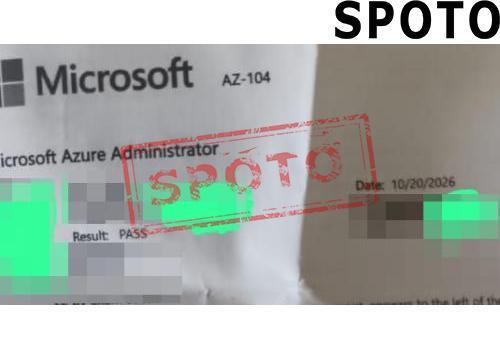
The Microsoft AZ-104 is notoriously tough. Microsoft does not want "paper administrators" who only know how to click around the Azure Portal. They want engineers who can fix a broken routing table, write a clean deployment template, and manage complex permissions without accidentally blowing up the company's budget.
If you are aiming to build a career in cloud infrastructure, this certification remains the most respected associate-level credential on the market. Here is a realistic look at why it is so valued, what has changed in the latest updates, what it pays, and how to actually prepare for it.
1. Why This Badge Matters to Employers
Many entry-level cloud certifications focus strictly on high-level overviews. They ask you to define what a resource group is or pick a basic storage tier. The AZ-104 does not do that. It is an implementation-focused exam.
When a hiring manager sees the AZ-104 on your resume, they know you can log into a tenant and actually do the work. It proves you have hands-on experience with command-line interfaces like the Azure CLI and PowerShell, and that you understand how different cloud resources connect to each other.
Additionally, if you ever plan to climb higher up the Microsoft ladder—like targeting the AZ-305 Solutions Architect or the AZ-400 DevOps Expert—this administrator foundation is mandatory. Trying to design complex cloud architectures without knowing how to administer them is a recipe for disaster.
2. The 2026 Updates: What Changed Recently?
Microsoft updates its exams constantly to keep up with its fast-moving cloud platform. The most recent major update to the AZ-104 syllabus rolled out earlier this year in April 2026.
If you are studying from books or video courses created in 2024 or 2025, you are going to run into some surprises. The core weight of the domains did not change, but Microsoft cleaned up the specific tasks to reflect how modern cloud environments are managed.
Automation and Policy as Code: You are no longer just creating resources manually. You are expected to understand Azure Policy as Code and deploy infrastructure using ARM templates or Bicep.
Modern Container Management: Basic administrative tasks for containerized workloads—specifically Azure Container Apps and Container Registry lifecycle management—now take up a larger slice of the compute domain.
Hybrid and Security Integration: Identity governance via Microsoft Entra ID (formerly Azure AD) and zero-trust hybrid networking using Azure Arc are now heavily woven throughout the entire test.
3. What You'll Actually Face on the Exam
You will get anywhere from 40 to 60 questions, and you will have 120 minutes to finish them. To pass, you need a scaled score of 700.
The layout is a mix of standard multiple-choice, drag-and-drop scenarios, and detailed case studies. You will also run into interactive questions where you have to look at a graphic of a network topology and diagnose why two subnets cannot communicate.
4. The exam is split into five main areas:
(1)Identity and Governance (20–25%)
This is all about managing access and tracking cloud spend. You will need to master Microsoft Entra ID users, group structures, and administrative units. You also have to know how to set up Role-Based Access Control (RBAC), configure Azure Policies, and set up budgets and cost alerts.
(2)Storage Solutions (15–20%)
You need to know how to configure Azure Storage Accounts, manage blob lifecycle rules, and set up secure Azure Files. Pay close attention to storage security, like configuring network firewalls and managing Shared Access Signatures (SAS).
(3)Compute Resources (20–25%)
This is the largest section of the test. You must be comfortable provisioning and scaling virtual machines (VMs), setting up scale sets, managing container apps, and configuring App Service plans.
(4)Virtual Networking (15–20%)
This is where most candidates fail. You have to understand virtual networks (VNets), subnetting, and peering. You will need to know how to route traffic using User-Defined Routes (UDRs), configure Network Security Groups (NSGs), and set up hybrid connections like Azure VPN Gateways.
(5)Monitoring and Backups (10–15%)
The final section covers ongoing maintenance. You must know how to monitor resources using Azure Monitor and Log Analytics workspaces, set up alerts, and configure system recovery using Recovery Services Vaults.
5. The Financial Payoff: What's the Salary Potential?
Because the AZ-104 is widely known for being difficult, passing it gives you immediate leverage. It separates you from the crowd of people who only have basic cloud fundamentals badges.
In the current market, an administrator with an active AZ-104 can expect a very solid return:
Associate Cloud Engineers and Azure Admins typically start around $85,000 to $105,000 annually.
If you combine this credential with a couple of years of practical infrastructure experience, moving into Senior Systems Administrator or Cloud Architect roles easily pushes your compensation into the $115,000 to $145,000 range.
For those who use this as a stepping stone to DevOps or Cloud Security Engineering, salaries often climb past $160,000.
6. How to Prepare and Pass on Your First Attempt
Because the exam is practical, reading documentation or skimming slides won't get you a pass. You need to get your hands dirty. Set up a free Azure account, write some CLI scripts, and practice building VNets and configuring routing tables. You need to see what happens when configurations fail.
When you are ready to test your readiness before booking your exam, you need practice materials that actually match the difficulty of the real test. SPOTO offers highly accurate AZ-104 practice questions and realistic exam simulators that are fully updated to align with the latest 2026 objectives. Instead of just memorizing answers, their platform helps you understand the scenario logic behind the questions, find your weak spots in networking or storage, and build the pacing you need to clear the exam on your first try.