Latest Cisco, PMP, AWS, CompTIA, Microsoft Materials on SALE Get Now Get Now
Home/
Blog/
Master the Enterprise Network: A Ground-Level Guide to the CCNP 200-301 (350-401 ENCOR v1.2)
SPOTO 2 2026-07-31 10:50:51
Master the Enterprise Network: A Ground-Level Guide to the CCNP 200-301 (350-401 ENCOR v1.2)

Managing an enterprise network used to mean sitting in a server closet, console cable in hand, manually configuring routing protocols line by line. While solid routing logic is still fundamental, the scope of a senior engineer's job has expanded dramatically.

Today, enterprise environments run on software-defined overlays, zero-trust access models, and automated deployment pipelines. When a multi-site network experiences latency or a policy failure, leadership expects engineers to analyze telemetry data, adjust SD-WAN policies, or run automation scripts to fix the issue at scale.

This is where Cisco's Cisco Certified Network Professional (CCNP) Enterprise track comes into play. Positioned as the industry standard for mid-to-senior network engineers, the CCNP proves you can design, execute, and troubleshoot complex enterprise architectures.

If you are preparing to tackle the CCNP Enterprise, here is a detailed, ground-level breakdown of the latest exam updates, syllabus changes, career value, salary benchmarks, and preparation strategies.


1. Major Structural Shifts: The ENCOR v1.2 Blueprint Update

Cisco continually updates its exam blueprints to keep pace with operational realities. The core exam for the CCNP Enterprise track, 350-401 ENCOR, moved to the v1.2 blueprint. Understanding what changed in this refresh is critical so you don't waste hours studying retired topics:

Wireless Content Migration: The most significant structural change in v1.2 is the complete removal of wireless content from the ENCOR core exam. Wireless technologies have matured so much—with Wi-Fi 6E, Wi-Fi 7, and complex cloud-managed WLANs—that Cisco spun wireless off into its own dedicated CCNP Wireless track (anchored by the 350-101 WLCOR core exam).

Expanded SD-WAN and Automation: With wireless removed, ENCOR reallocated exam weight toward modern enterprise priorities. Expect deeper testing on Catalyst SD-WAN architecture, RESTCONF/NETCONF APIs, model-driven telemetry, and Infrastructure as Code (IaC) tools like Ansible and Terraform.

Zero Trust and AI Operations: The refreshed blueprint places explicit focus on Zero Trust Network Access (ZTNA), micro-segmentation using Cisco ISE, Secure Access Service Edge (SASE), and AI-assisted network monitoring tools used for anomaly detection and predictive health checks.


2. Certification Framework: Core + Concentration

To earn the full CCNP Enterprise credential, candidates must pass two exams: one mandatory core exam and one specialized concentration exam of their choice.

Step 1: The Core Exam (350-401 ENCOR v1.2)

The ENCOR exam lasts 120 minutes and consists of 90 to 110 questions, including multiple-choice, drag-and-drop, and heavy performance-based lab simulations. It covers six primary domains:

Architecture (15%): Dual-stack (IPv4/IPv6) design, high availability concepts, SD-WAN architecture, and SD-Access control plane and data plane operations.

Virtualization (10%): Hypervisors, virtual machines, virtual switching, path isolation mechanisms (VRF, GRE, IPsec), and network virtualization concepts.

Infrastructure (30%): The heaviest technical section. Covers Layer 2 concepts (Spanning Tree, EtherChannel), Layer 3 routing protocols (EIGRP, OSPFv2/v3, BGP path selection), and IP SLA configurations.

Network Assurance (10%): Diagnostic tools like SPAN/RSPAN, NetFlow/IPFIX, Syslog, SNMP, model-driven telemetry, and Cisco Catalyst Center assurance workflows.

Security (20%): Device access controls, REST API security, Infrastructure ACLs, Wired security using 802.1X, MACsec encryption, and Zero Trust framework integration.

Automation (15%): Interpreting Python scripts, working with JSON and XML data payloads, constructing RESTCONF and NETCONF requests, and evaluating configuration management playbooks using Ansible and Terraform.

Step 2: Selecting a Concentration Exam

After clearing ENCOR, candidates choose one concentration exam to tailor their certification toward their daily role. The most popular options include:

300-410 ENARSI (Advanced Routing): Deep-dive troubleshooting on BGP, OSPF, EIGRP, MPLS Layer 3 VPNs, and DMVPN.

300-415 ENSDWI (SD-WAN Implementation): Configuring, deploying, and managing Cisco Catalyst SD-WAN controllers and edge routers.

300-435 ENAUTO (Enterprise Automation): Advanced network programmability, custom Python scripting, and API integrations.


3. Real-World Value and Compensation Expectations

Because the CCNP Enterprise validates advanced troubleshooting and architectural capability, certified engineers command strong market demand across enterprise IT departments, managed service providers (MSPs), and cloud advisory firms. Compensation varies based on geography, industry, and total experience, but typical salary benchmarks for CCNP-certified professionals include:

Network Operations Center (NOC) Lead / Senior Network Technician: Engineers managing day-to-day escalation tickets, complex VLAN routing, and firewall adjustments earn base salaries between $85,000 and $105,000.

Senior Network Engineer / Infrastructure Specialist: Professionals designing multi-site OSPF/BGP routing, implementing SD-WAN migrations, and managing enterprise switches earn between $110,000 and $138,000.

Enterprise Network Architect / Network Manager: Principal leaders directing corporate network infrastructure, cloud connectivity, zero-trust security integrations, and automation roadmaps command total compensation packages ranging from $140,000 to $175,000+.


4. Practical Preparation and Exam Strategies

Passing ENCOR v1.2 requires moving past basic definition memorization. Cisco's exam items put heavy weight on performance-based simulations where you must interact directly with topology interfaces, read complex outputs, and fix configuration errors under strict time constraints. To build exam readiness, consider these practical study habits:

Dedicate Time to Hands-On Lab Work: Command-line fluency is non-negotiable. Build multi-area OSPF networks, configure BGP neighbor relationships, set up GRE tunnels, and test VRF instances in a lab environment until the syntax becomes second nature.

Get Comfortable with APIs and Data Structures: You don't need to be a full-stack software developer, but you must know how to read JSON blobs, structure API calls (GET, POST, PUT, DELETE), and understand how Ansible playbooks structure network tasks.

Practice Scenario-Based Problem Solving: Questions frequently present long show command outputs or topology maps and ask you to identify why an adjacency failed or why traffic took a sub-optimal path. Working through updated scenario pools and lab exercises—such as the CCNP review modules and practice sets provided by SPOTO—helps you adapt to Cisco's question phrasing, manage your time across long simulation items, and identify weak spots across the blueprint before test day. To streamline your journey, SPOTO offers expert-guided training courses and 100% authentic, up-to-date exam dumps designed to mirror real exam conditions closely. With their proven prep materials and dedicated learning support, candidates can significantly boost their study efficiency and pass the CCNP exam on their very first attempt.

 

Latest Passing Reports from SPOTO Candidates
350-601

350-601

350-701

350-701

350-401-P

350-401-P

300-410

300-410

350-501-P

350-501-P

300-415

300-415

350-401-P

350-401-P

350-401-P

350-401-P

300-415-P

300-415-P

350-701-P

350-701-P

Write a Reply or Comment
Don't Risk Your Certification Exam Success – Take Real Exam Questions
Eligible to sit for Exam? 100% Exam Pass Guarantee
SPOTO Ebooks
Recent Posts
Excellent
5.0
Based on 5236 reviews
Request more information
I would like to receive email communications about product & offerings from SPOTO & its Affiliates.
I understand I can unsubscribe at any time.
Home/Blog/Master the Enterprise Network: A Ground-Level Guide to the CCNP 200-301 (350-401 ENCOR v1.2)
Master the Enterprise Network: A Ground-Level Guide to the CCNP 200-301 (350-401 ENCOR v1.2)
SPOTO 2 2026-07-31 10:50:51
Master the Enterprise Network: A Ground-Level Guide to the CCNP 200-301 (350-401 ENCOR v1.2)

Managing an enterprise network used to mean sitting in a server closet, console cable in hand, manually configuring routing protocols line by line. While solid routing logic is still fundamental, the scope of a senior engineer's job has expanded dramatically.

Today, enterprise environments run on software-defined overlays, zero-trust access models, and automated deployment pipelines. When a multi-site network experiences latency or a policy failure, leadership expects engineers to analyze telemetry data, adjust SD-WAN policies, or run automation scripts to fix the issue at scale.

This is where Cisco's Cisco Certified Network Professional (CCNP) Enterprise track comes into play. Positioned as the industry standard for mid-to-senior network engineers, the CCNP proves you can design, execute, and troubleshoot complex enterprise architectures.

If you are preparing to tackle the CCNP Enterprise, here is a detailed, ground-level breakdown of the latest exam updates, syllabus changes, career value, salary benchmarks, and preparation strategies.


1. Major Structural Shifts: The ENCOR v1.2 Blueprint Update

Cisco continually updates its exam blueprints to keep pace with operational realities. The core exam for the CCNP Enterprise track, 350-401 ENCOR, moved to the v1.2 blueprint. Understanding what changed in this refresh is critical so you don't waste hours studying retired topics:

Wireless Content Migration: The most significant structural change in v1.2 is the complete removal of wireless content from the ENCOR core exam. Wireless technologies have matured so much—with Wi-Fi 6E, Wi-Fi 7, and complex cloud-managed WLANs—that Cisco spun wireless off into its own dedicated CCNP Wireless track (anchored by the 350-101 WLCOR core exam).

Expanded SD-WAN and Automation: With wireless removed, ENCOR reallocated exam weight toward modern enterprise priorities. Expect deeper testing on Catalyst SD-WAN architecture, RESTCONF/NETCONF APIs, model-driven telemetry, and Infrastructure as Code (IaC) tools like Ansible and Terraform.

Zero Trust and AI Operations: The refreshed blueprint places explicit focus on Zero Trust Network Access (ZTNA), micro-segmentation using Cisco ISE, Secure Access Service Edge (SASE), and AI-assisted network monitoring tools used for anomaly detection and predictive health checks.


2. Certification Framework: Core + Concentration

To earn the full CCNP Enterprise credential, candidates must pass two exams: one mandatory core exam and one specialized concentration exam of their choice.

Step 1: The Core Exam (350-401 ENCOR v1.2)

The ENCOR exam lasts 120 minutes and consists of 90 to 110 questions, including multiple-choice, drag-and-drop, and heavy performance-based lab simulations. It covers six primary domains:

Architecture (15%): Dual-stack (IPv4/IPv6) design, high availability concepts, SD-WAN architecture, and SD-Access control plane and data plane operations.

Virtualization (10%): Hypervisors, virtual machines, virtual switching, path isolation mechanisms (VRF, GRE, IPsec), and network virtualization concepts.

Infrastructure (30%): The heaviest technical section. Covers Layer 2 concepts (Spanning Tree, EtherChannel), Layer 3 routing protocols (EIGRP, OSPFv2/v3, BGP path selection), and IP SLA configurations.

Network Assurance (10%): Diagnostic tools like SPAN/RSPAN, NetFlow/IPFIX, Syslog, SNMP, model-driven telemetry, and Cisco Catalyst Center assurance workflows.

Security (20%): Device access controls, REST API security, Infrastructure ACLs, Wired security using 802.1X, MACsec encryption, and Zero Trust framework integration.

Automation (15%): Interpreting Python scripts, working with JSON and XML data payloads, constructing RESTCONF and NETCONF requests, and evaluating configuration management playbooks using Ansible and Terraform.

Step 2: Selecting a Concentration Exam

After clearing ENCOR, candidates choose one concentration exam to tailor their certification toward their daily role. The most popular options include:

300-410 ENARSI (Advanced Routing): Deep-dive troubleshooting on BGP, OSPF, EIGRP, MPLS Layer 3 VPNs, and DMVPN.

300-415 ENSDWI (SD-WAN Implementation): Configuring, deploying, and managing Cisco Catalyst SD-WAN controllers and edge routers.

300-435 ENAUTO (Enterprise Automation): Advanced network programmability, custom Python scripting, and API integrations.


3. Real-World Value and Compensation Expectations

Because the CCNP Enterprise validates advanced troubleshooting and architectural capability, certified engineers command strong market demand across enterprise IT departments, managed service providers (MSPs), and cloud advisory firms. Compensation varies based on geography, industry, and total experience, but typical salary benchmarks for CCNP-certified professionals include:

Network Operations Center (NOC) Lead / Senior Network Technician: Engineers managing day-to-day escalation tickets, complex VLAN routing, and firewall adjustments earn base salaries between $85,000 and $105,000.

Senior Network Engineer / Infrastructure Specialist: Professionals designing multi-site OSPF/BGP routing, implementing SD-WAN migrations, and managing enterprise switches earn between $110,000 and $138,000.

Enterprise Network Architect / Network Manager: Principal leaders directing corporate network infrastructure, cloud connectivity, zero-trust security integrations, and automation roadmaps command total compensation packages ranging from $140,000 to $175,000+.


4. Practical Preparation and Exam Strategies

Passing ENCOR v1.2 requires moving past basic definition memorization. Cisco's exam items put heavy weight on performance-based simulations where you must interact directly with topology interfaces, read complex outputs, and fix configuration errors under strict time constraints. To build exam readiness, consider these practical study habits:

Dedicate Time to Hands-On Lab Work: Command-line fluency is non-negotiable. Build multi-area OSPF networks, configure BGP neighbor relationships, set up GRE tunnels, and test VRF instances in a lab environment until the syntax becomes second nature.

Get Comfortable with APIs and Data Structures: You don't need to be a full-stack software developer, but you must know how to read JSON blobs, structure API calls (GET, POST, PUT, DELETE), and understand how Ansible playbooks structure network tasks.

Practice Scenario-Based Problem Solving: Questions frequently present long show command outputs or topology maps and ask you to identify why an adjacency failed or why traffic took a sub-optimal path. Working through updated scenario pools and lab exercises—such as the CCNP review modules and practice sets provided by SPOTO—helps you adapt to Cisco's question phrasing, manage your time across long simulation items, and identify weak spots across the blueprint before test day. To streamline your journey, SPOTO offers expert-guided training courses and 100% authentic, up-to-date exam dumps designed to mirror real exam conditions closely. With their proven prep materials and dedicated learning support, candidates can significantly boost their study efficiency and pass the CCNP exam on their very first attempt.
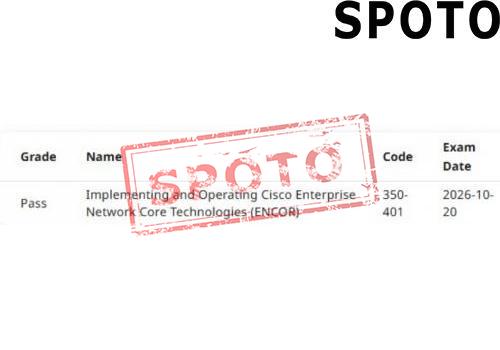
 

Latest Passing Reports from SPOTO Candidates
350-601
350-701
350-401-P
300-410
350-501-P
300-415
350-401-P
350-401-P
300-415-P
350-701-P
Write a Reply or Comment
Don't Risk Your Certification Exam Success – Take Real Exam Questions
Eligible to sit for Exam? 100% Exam Pass GuaranteeEligible to sit for Exam? 100% Exam Pass Guarantee
SPOTO Ebooks
Recent Posts
Cisco Automation Certification: Your Roadmap From Zero to Certified
Cisco REST API: A Practical Guide to Network Automation
Cisco HSRP Configuration: From First-Time Setup to Advanced Troubleshooting
MPLS LDP Neighbor Down: A Complete Troubleshooting Playbook
OSPF Stuck in EXSTART: Root Causes, Diagnosis, and the Fix
Advanced OSPF for the CCIE Lab: Multi-Area Design, Network Types, and Troubleshooting
Cisco Trunk Ports Explained: 802.1Q Mechanics, DTP Modes, and Troubleshooting
Advanced VLAN Configuration for the CCIE Lab: PVLANs, QinQ, VTPv3, and Troubleshooting
Master the Enterprise Network: A Ground-Level Guide to the CCNP 200-301 (350-401 ENCOR v1.2)
The Latest CCNA 2026 Exam Success Guide (What Real-World Network Engineers Need in 2026)
Excellent
5.0
Based on 5236 reviews
Request more information
I would like to receive email communications about product & offerings from SPOTO & its Affiliates.
I understand I can unsubscribe at any time.