Table of Contents
Financial audits and IT controls used to be handled in completely different corners of an organization. Accountants looked at spreadsheets and ledgers, while IT teams handled user access and firewall logs.
That separation barely exists anymore. When companies run financial reporting on automated cloud platforms, auditing a balance sheet means auditing the technology behind it.
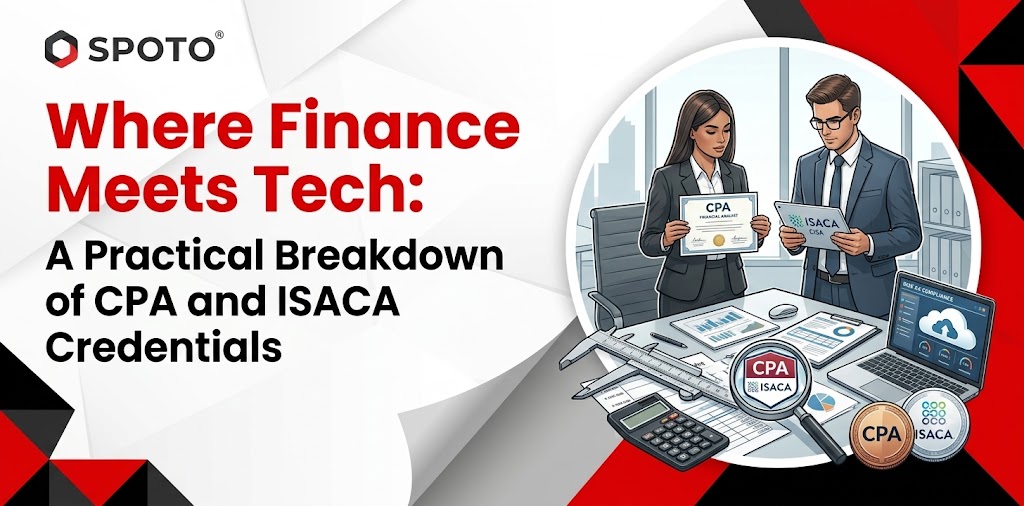
This shift is why so many finance and risk professionals look at combining the Certified Public Accountant (CPA) license with ISACA certifications like CISA or CRISC.
(To clear up a common misconception: ISACA manages IT-focused credentials like CISA and CRISC, whereas CPA licenses are granted by state accountancy boards using the AICPA exam. However, pairing a CPA with an ISACA credential creates one of the most versatile skill sets in risk advisory and IT audit.)
Here is a practical look at how the CPA exam has adapted to technology, what it covers, realistic salary outcomes, and how it aligns with ISACA standards.
1. Why Mixing CPA and IT Governance Credentials Pays Off
In the past, an auditor might focus purely on internal controls or purely on network security. Today, major companies and advisory firms want people who can bridge both worlds.
Key benefits of holding both accounting and IT audit credentials include:
Full-spectrum coverage: You can evaluate financial statements (SOX compliance) alongside IT general controls (ITGCs) and SOC engagements (SOC 1, SOC 2, and SOC 3).
High market demand: Advisory firms, Big Four agencies, and enterprise risk departments compete heavily for auditors who understand both balance sheets and database access controls.
Faster career trajectory: Having dual expertise makes it easier to step into senior roles like Risk Advisory Lead, IT Audit Director, or Chief Compliance Officer.
2. Syllabus Updates: The CPA Evolution Model
To make sure new CPAs understand tech risk and data analytics, the CPA exam went through its largest overhaul in decades under the CPA Evolution model.
The exam structure uses a core-plus-discipline format:
Three mandatory Core sections: Every CPA candidate takes Core exams in auditing, accounting, and tax.
One specialized Discipline section: Candidates choose one discipline to demonstrate deeper technical knowledge.
The Information Systems and Controls (ISC) discipline: For anyone leaning toward IT audit, GRC, or systems advisory, the ISC discipline is the obvious choice. Its content aligns directly with ISACA’s core audit domains, focusing on system controls, data privacy, and vendor risk.
3. Exam Content and Structure Breakdown
Earning the CPA license requires passing four sections in total, combining multiple-choice questions with complex task-based simulations:
Core Section 1: Auditing and Attestation (AUD)
Focuses on audit planning, evaluating internal controls, gathering evidence, ethics, and reporting standards under AICPA and PCAOB guidelines.
Core Section 2: Financial Accounting and Reporting (FAR)
Covers financial statement preparation, GAAP compliance, revenue recognition, and reporting for corporate and non-profit entities.
Core Section 3: Regulation (REG)
Evaluates business law, federal tax compliance, ethics, and professional responsibility.
Discipline Choice: Information Systems and Controls (ISC)
IT Governance & Service Management: Aligning IT strategy with business goals, third-party vendor risks, and change management controls.
Data Management & Security: Database structures, data privacy regulations, logical access controls, and encryption standards.
SOC Reporting: Planning, executing, and reviewing SOC 1, SOC 2, and SOC 3 engagement reports.
(If you plan to add ISACA credentials like the CISA later, studying for the CPA ISC discipline gives you a huge head start on ISACA's testing logic.)
4. Licensure Steps and Study Approach
Getting a CPA license requires clearing state board requirements alongside passing the exam:
150 Education Credits: Most states require 150 college semester hours (usually a bachelor's degree plus 30 extra credits in accounting or business).
Supervised Experience: You will need 1 to 2 years of accounting, audit, or risk advisory experience verified by an active CPA holder.
Targeted Exam Preparation: The CPA exam relies heavily on multi-step task simulations rather than simple recall. Working through structured practice platforms—such as the study modules from SPOTO—helps you master simulation formats, identify weak spots, and manage your pacing across long exam sections.
Annual CPE Credits: Active CPAs must complete 40 Continuing Professional Education (CPE) hours each year to keep their license active.
5. Real-World Pay and Salary Growth
Because professionals who understand both financial accounting and IT security controls are in short supply, compensation across these roles remains strong.
While pay varies based on location and company size, typical salary ranges include:
Staff Accountant / IT Audit Associate: Professionals starting out in routine audits and control testing usually earn base salaries between $70,000 and $90,000.
Senior Audit Consultant / Risk Manager: Experienced auditors managing engagement teams, evaluating SOC reports, and reviewing cloud controls earn between $105,000 and $138,000.
Audit Partner / Chief Audit Executive (CAE): Senior leaders overseeing corporate audit departments or managing firm practices command total compensation packages from $150,000 to $220,000+.
6. ISACA Certifications to Pair with a CPA
If your long-term goal is to build a career in technology governance or cybersecurity risk, these ISACA credentials pair exceptionally well with a CPA license:
Certified Information Systems Auditor (CISA): ISACA's premier credential for auditing IT infrastructure, controls, and technology systems.
Certified in Risk and Information Systems Control (CRISC): Focuses on enterprise risk management, risk quantification, and control design.
Certified Information Security Manager (CISM): Aimed at professionals managing and designing enterprise cybersecurity programs.