Table of Contents
The modern software development lifecycle has evolved far beyond simply writing functional code. Today, developers must understand how their applications live, scale, and interact within cloud-native environments. Containerization and orchestration have become core competencies, and Kubernetes has established itself as the underlying standard for managing these workloads at scale.
However, running raw Kubernetes in an enterprise setting requires significant operational overhead. This is why Red Hat OpenShift has emerged as a dominant force in the corporate world. It provides a hardened, enterprise-grade Kubernetes platform that streamlines development workflows.
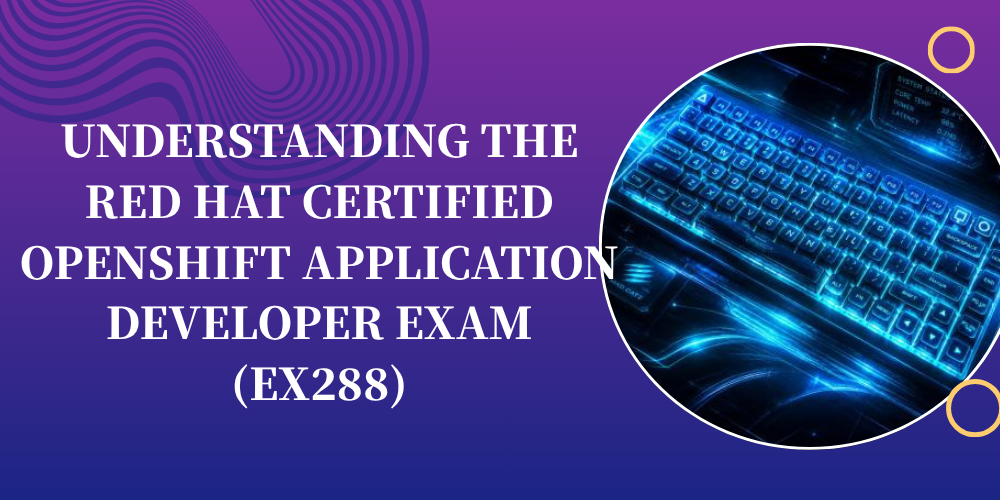
For developers looking to validate their ability to build, deploy, and manage containerized applications directly on this platform, the Red Hat Certified OpenShift Application Developer exam (EX288) stands as a highly respected benchmark. Unlike many industry certifications that rely on multiple-choice memory drills, the EX288 exam is entirely performance-based, making it a true test of a developer's practical engineering skills.
1. The Nature of a Performance-Based Exam
To approach the EX288 exam successfully, you must first understand its unique format. Red Hat does not use standard question-and-answer templates. Instead, candidates are dropped into a live, fully functional Red Hat OpenShift Container Platform environment.
You are presented with a series of real-world development tasks and problem scenarios. Your goal is to use the environment to configure, build, and deploy applications according to strict technical specifications. The grading engine does not check how you studied or look at your theoretical methodology; it evaluates your live configurations and running workloads to verify if they meet the exact operational criteria.
Because of this hands-on setup, navigating the OpenShift web console, mastering the command-line interface (CLI), and understanding container mechanics under time pressure are critical requirements for passing.
2. Core Technical Objectives and Knowledge Domains
The EX288 syllabus focuses on the practical tasks an application developer performs day-to-day when working with OpenShift. The exam evaluates competencies across several critical pillars of cloud-native development.
(1) Working with Container Images and Registries
At its foundation, OpenShift runs containerized microservices. You must understand how to take existing source code or pre-built container images and prepare them for deployment. This domain tests your ability to configure the internal OpenShift image registry, manage application dependencies, and work with specialized image creation workflows.
(2) Customizing Deployments with Advanced Tools
Modern deployment strategies require flexibility. The exam checks your proficiency with advanced packaging and customization tools that allow developers to deploy applications consistently across development, testing, and production environments. You will need a strong grasp of how to build and implement Helm charts, as well as how to use Kustomize to modify resource manifests without altering the original source files.
(3) Implementing the Source-to-Image (S2I) Framework
One of OpenShift’s standout features is its Source-to-Image (S2I) framework, which allows developers to point the platform directly at a Git repository and let OpenShift automatically build a reproducible container image. To demonstrate mastery, you must know how to use the S2I toolset efficiently, leverage existing builder images, and customize S2I builder templates to accommodate unique application stacks or enterprise compliance standards.
(4) Application Configuration, Secrets, and Storage Injection
Applications rarely run in isolation; they require configuration parameters, database credentials, and persistent storage. This segment evaluates your ability to manage externalized configurations without baking sensitive data directly into your code. You must know how to create and manage ConfigMaps for standard environment variables and leverage Secret resources to safely inject passwords, API keys, and cryptographic certificates into your active application pods.
(5) Managing Hooks, Triggers, and Automated Updates
To achieve true operational agility, software pipelines should be automated. The EX288 exam evaluates your capability to set up build hooks that execute automated testing scripts during the build pipeline. Additionally, you must understand how to configure deployment triggers, ensuring that your application automatically updates and redeploys the moment a new container image stream updates or changes are pushed to an upstream Git repository.
(6) Diagnosing and Troubleshooting Application Issues
Things often go wrong during application deployment. True development mastery involves finding and fixing those flaws efficiently. A substantial portion of your practical evaluation will involve diagnostics. You must be able to inspect broken builds, analyze container logs, debug runtime failures, and correct minor misconfigurations within your deployment manifests to restore application health.
3. Exam Logistics and Timing Parameters
Planning your test session requires a clear understanding of the administrative constraints set by Red Hat.
The Testing Window: You are given exactly three hours to complete all practical tasks within the live environment. Managing your time across different deployment scenarios is vital.
Platform Baseline: Red Hat updates its exams regularly to match its active software versions. The exam is typically tailored around the core operational features of the Red Hat OpenShift Container Platform 4 series.
4. Tactical Preparation Strategies for Developers
Because the EX288 exam measures active capability rather than rote memorization, your preparation strategy must emphasize muscle memory and problem-solving agility.
Move Beyond the GUI: While the OpenShift Web Console is highly intuitive and useful for monitoring, relying entirely on it can slow you down. Focus on mastering the oc command-line utility. Being able to quickly create projects, inspect pods, and apply YAML manifests via the CLI saves valuable minutes.
Practice Manifest Writing and Manipulation: You will spend a significant amount of time reading and editing configuration files. Get comfortable working with YAML structures. Learn how to quickly identify syntax alignment issues, resource limits, and environment variable mappings.
Leverage the Built-In Documentation: Since you cannot access external search engines during the exam, you must learn to navigate the internal platform help documentation. Understanding how to use command-line flags like oc explain can instantly help you find the exact field names or structures needed for your resources.
5. Structuring Your Path to Success with SPOTO
Navigating the transition from traditional programming to enterprise container orchestration can feel overwhelming. Practicing blindly without clear validation often results in missed configurations and lost momentum. This is why having an experienced preparation partner like SPOTO can make all the difference.
With over two decades of excellence in technical and professional certification training, SPOTO provides developers with the specific resources required to bridge theory and practical execution.
SPOTO offers meticulously curated study pools and practice scenarios that mirror the structural complexity, technical environments, and operational goals of the real EX288 evaluation. Our online resources are engineered to help you adapt to the pacing constraints of a live lab. This setup allows you to train your analytical clock, learn how to prioritize deployment tasks, and remove test-day pressure.
Summary: Earning the Red Hat Certified OpenShift Application Developer title is a powerful statement to the IT industry. It tells prospective employers that you possess the hands-on engineering skills required to build resilient, automated, and scalable cloud-native architectures that keep enterprise operations running smoothly.
What are you waiting for? Invest in your technical toolkit, master enterprise container deployment, and unlock your next major professional breakthrough with SPOTO today!