)
Table of Contents
In the cybersecurity universe, technical brilliance will only get you so far. Knowing how to configure a firewalled perimeter or dissect a malware strain is incredibly valuable, but organizations face a much bigger challenge: aligning those technical fixes with broader business objectives. Boardrooms don't look at lines of code; they look at risk exposure, financial impact, and business continuity.
If you are ready to pivot from the technical trenches into strategic leadership, the ISACA Certified Information Security Manager (CISM) designation is your definitive golden ticket. Recognized worldwide, it proves you possess the business acumen required to lead enterprise security initiatives.
However, passing the CISM exam requires a complete mental shift. It isn't a test of how hard you can engineer a solution; it's a test of how effectively you can manage it.
1. What Makes CISM Different from Technical Certifications?
Many highly experienced security engineers fail their first attempt at the CISM exam because they answer questions from the perspective of a systems administrator or incident responder.
When a question asks how to address an active system vulnerability, a technician's instinct is to patch the server immediately. An analyst's instinct is to run a deep scan. But the CISM mindset demands that you look at the bigger picture first: What is the financial and operational impact of this vulnerability on our core business operations?
ISACA designs this exam specifically for professionals who manage, design, and oversee enterprise information security programs. It evaluates your decision-making framework, assessing whether you can balance strict regulatory mandates and evolving threat matrices against the company's bottom-line profitability and risk appetite.
2. The Four Structural Pillars of the CISM Syllabus
The evaluation process measures your administrative capabilities across four foundational domains. To build an efficient study strategy, you must understand what each pillar truly values.
Domain 1: Information Security Governance
Governance establishes the ultimate direction, expectations, and guardrails for the entire organization. This domain focuses on developing an information security strategy that integrates seamlessly with corporate objectives. You must master the creation of organizational structures, information security policies, and reporting metrics. The core objective here is ensuring that security functions as a business enabler rather than an operational bottleneck.
Domain 2: Information Security Risk Management
You cannot protect an organization from every single threat, nor does it make financial sense to try. Risk management is about making calculated, prioritized choices. This domain evaluates your ability to identify emerging vulnerabilities, analyze potential asset loss, and select appropriate risk response options—whether that means accepting, mitigating, transferring, or avoiding the risk. You must thoroughly understand concepts like risk appetite, risk tolerance, and key risk indicators (KRIs).
Domain 3: Information Security Program
Accounting for a massive chunk of the exam weight, this domain covers the practical execution of your security strategy. It shifts focus to program design, resource allocation, and control implementation. You will face scenarios regarding control selection, integrating security directly into the System Development Life Cycle (SDLC), delivering enterprise-wide security awareness training, and managing third-party vendor risks.
Domain 4: Incident Management
True leadership is defined by how you command an organization during an active crisis. This final domain measures your operational readiness and response agility. It requires deep knowledge of Business Impact Analysis (BIA), Incident Response Plans (IRPs), and Disaster Recovery Plans (DRPs). You will be tested on containment methods, post-incident forensic investigations, root-cause analyses, and communication protocols for internal and external stakeholders during an outage.
3. Crucial Exam Logistics and Scheduling Details
Achieving a pass requires an absolute awareness of the testing environment and scheduling parameters set by ISACA.
Exam Volume and Timing: You will face exactly 150 multiple-choice questions within a strict four-hour (240 minutes) testing window. While there are no complex hands-on simulations, the scenarios are long, text-heavy, and conceptually deep.
The Scoring Engine: ISACA uses a scaled scoring system ranging from 200 to 800 points. To successfully claim your credential, you must secure a passing score of 450 or higher.
The Registration Window: Once you register and pay for your exam voucher, your testing eligibility window is open for exactly six months. Keep in mind that exam appointments can only be booked up to 90 days in advance.
4. Tactical Preparation Tips to Outsmart the Exam
Adopt the "Senior Executive" Perspective: When analyzing ambiguous scenarios where multiple answers seem technically correct, choose the option that focuses on governance, cost-efficiency, business alignment, or risk assessment. Look for keywords like "Ensure," "Define," "Align," and "Assess."
Read the Whole Question for Modifiers: ISACA loves to use qualifying words like FIRST, MOST, BEST, or LEAST. A question might list four excellent operational steps, but only one can be the very first action a manager must take.
Do Not Skip the Official Review Manual: While vendor-neutral resources are excellent, the ISACA CISM Review Manual is the ultimate blueprint. It outlines the exact vocabulary, ethical principles, and structural philosophy that the exam writers use to construct the question database.
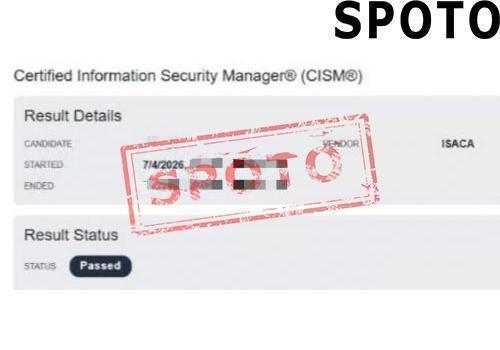
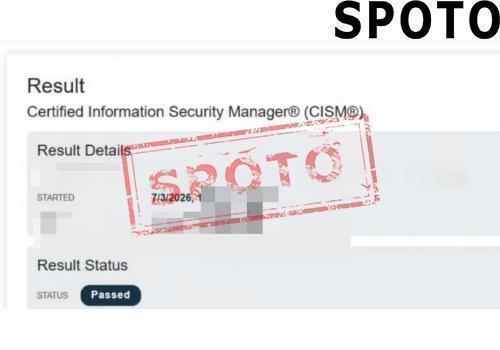
5. Guarantee Your Path to Leadership Success with SPOTO
The vast operational scope, corporate governance frameworks, and unique logic built into the CISM syllabus can easily lead to study fatigue. For professionals who want to eliminate the guesswork, optimize their study hours, and avoid expensive retake registration costs, SPOTO is the ultimate strategic ally.
With over twenty years of dedicated excellence in professional IT and security certification training, SPOTO streamlines your path to a passing score through a high-fidelity educational approach.
100% Authentic, Monitored Practice Pools: SPOTO provides meticulously updated practice questions that precisely replicate the tone, structural logic, and difficulty of the active ISACA CISM exam pool. This helps you build familiarity with the nuanced "managerial perspective" before your real test.
Immersive Interface Simulators: Our online practice exams recreate the pacing constraints and layout of the real test environment, allowing you to train your internal clock and eliminate test-day text anxiety.
Direct Guidance from Industry Experts: When an intricate governance framework or an ambiguous risk-treatment scenario halts your learning momentum, SPOTO's dedicated support experts are ready to step in. Our certified tutors break down the complex management principles behind each correct option.
A Highly Efficient, Fast-Track Path: SPOTO's proven methodology is designed to minimize study friction, letting you convert your practical background into an elite management title smoothly and cost-effectively.
Summary: The modern threat landscape demands cybersecurity professionals who can translate risk into business language. Earning your ISACA CISM certification proves to global recruiters and executive boards that you possess the leadership vision, operational strategy, and analytical power required to steer enterprise infrastructure through turbulent waters.
Combine your drive with SPOTO's premium, up-to-date study resources to transform your career goals into real-world breakthroughs. Invest in your professional development, master the management mindset, and unlock your next major career milestone with SPOTO today!