Table of Contents
If you are a network security architect planning to skate through your next Fortinet certification by studying a single product guide, you are about to receive a very expensive wake-up call. On July 15, 2026, the Fortinet Training Institute is executing a massive structural reset. They are completely retiring the brief experiment with role-based titles (like FCP and FCSS) and returning to an expanded 8-level numbered hierarchy running from NSE 1 straight to NSE 8. The backend migration is so complex that Pearson VUE is completely freezing all Fortinet exam deliveries for a multi-day window in mid-July just to cut over to the new system.
But the real architectural earthquake is happening at the advanced tier. If you are targeting the core infrastructure certification—NSE 7: Secure Networking—the entire testing format has changed.
Fortinet has officially killed off the old method where you could choose separate specialized sub-exams. In their place stands a single, highly demanding comprehensive exam that unifies multiple enterprise domains into one testing sandbox. If you want to survive this consolidated blueprint, you need to understand exactly what is being merged under the hood.
1. The Big Consolidation: Enterprise Firewall Meets SD-WAN
Previously, an engineer looking to prove advanced secure networking competency could cherry-pick their path. You could take an exam focused entirely on core firewall administration, or you could take a completely separate test centered on SD-WAN deployment.
The active blueprint demolishes that division. The updated NSE 7 Secure Networking exam is a unified, comprehensive gauntlet that forces you to prove mastery over both disciplines simultaneously during the same testing session. The blueprint explicitly merges the full architectural weight of two massive deployment frameworks:
The Enterprise Firewall Administration Domain
The SD-WAN Enterprise Administration Domain
To make matters more challenging, Fortinet's official documentation notes that these new comprehensive exams will actively feature real-world scenarios and infrastructure variables not covered in the standard training courses. They are deliberately testing whether you have actual engineering intuition or if you just memorized a student workbook.
2. Technical Deep Dive: The Core Pillars of the Comprehensive Blueprint
The consolidated testing matrix requires an advanced infrastructure specialist to seamlessly bridge high-scale security policies with complex transport routing. The syllabus isolates your evaluation into two heavy technological pillars.
(1)High-Scale Enterprise Routing & FortiOS Core Mechanics
This segment leaves simple perimeter setups behind to evaluate your ability to manage infrastructure under intense enterprise load. Expect heavy, scenario-driven questions evaluating:
Advanced BGP Architectures: Configuring and troubleshooting complex Border Gateway Protocol (BGP) routing strategies directly over multi-site IPsec VPN tunnels.
Multi-Tenant VDOM Topologies: Segmenting large-scale enterprise networks using Virtual Domains (VDOMs) and ensuring secure inter-VDOM link communication without leaking data.
High Availability (HA) Clustering: Optimizing session synchronization, managing asymmetric routing traps during failovers, and configuring cluster units across distributed data centers.
(2)Complex SD-WAN Orchestration & Path Steering
You cannot pass this exam by treating SD-WAN as an afterthought. You must demonstrate a flawless understanding of how to build a dynamic, self-healing network edge. The exam tests your hands-on mastery over:
Performance SLA Rules: Designing link quality measurements that actively monitor latency, jitter, and packet loss across multiple transport channels simultaneously.
Dynamic Traffic Steering: Building intelligent rules that automatically route critical cloud workloads (like Microsoft 365 or enterprise ERP pipelines) over the cleanest path while dumping non-essential traffic onto backup links.
Hub-and-Spoke Topologies: Deploying Auto-Discovery VPN (ADVPN) architectures to allow direct spoke-to-spoke communication dynamically, cutting down latency and removing the backplane bottleneck at the central corporate hub.
3. The Strategic Traps of the 2026 Testing Framework
The primary reason veteran network engineers fail the comprehensive NSE 7 exam isn't a lack of technical capability—it's a failure to adapt to the structure of the exam itself.
First, the grading logic remains strictly binary. Fortinet relies heavily on multi-select questions. If a diagnostic prompt displays a raw console log of an OSPF path failure across an SD-WAN overlay and asks you to select the three correct troubleshooting steps, you must identify all three perfectly. Selecting two correct answers and one incorrect option nets you zero points for the entire item. There is no partial credit.
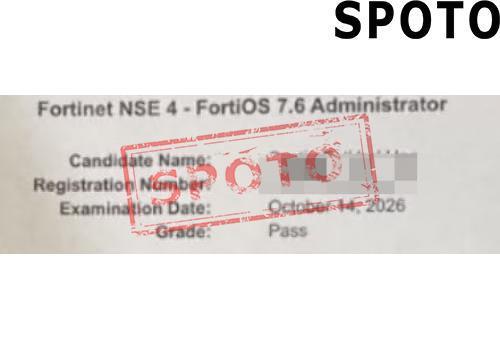
Second, you must track your prerequisites. You can no longer challenge the NSE 7 out of nowhere. The active 2026 guidelines mandate that you must hold a verified, active NSE 4: FortiOS Administrator credential on the day you pass your NSE 7, or the testing engine will refuse to issue your advanced certification badge.
4. Transforming Blueprint Theory Into a Passing Score
Because the comprehensive NSE 7 Secure Networking blueprint demands that you simultaneously parse advanced firewall debugging logs and intricate SD-WAN performance steering rules under a ticking clock, traditional, single-topic study habits will fail you. You need to develop deep pattern recognition for how these two frameworks interact under real-world corporate pressure.
When you are ready to transition out of the documentation and see if your diagnostic skills can survive the consolidated testing parameters, leveraging high-fidelity mock environments is your most efficient operational strategy. SPOTO provides meticulously updated NSE 7 Secure Networking practice question pools and advanced exam simulators fully aligned with the unified firewall and SD-WAN curriculum. Refining your time management, mastering the binary multi-select format, and eliminating your configuration blind spots beforehand guarantees you can enter the Pearson VUE center with total clarity and secure your certification on your very first try.