Table of Contents
In the enterprise landscape, the data center is where all components—compute clusters, high-speed storage matrices, virtualization layers, and automated overlays—collide under massive pressure. For senior tech professionals, there is no greater badge of technical mastery in this environment than earning the Cisco Certified Internetwork Expert (CCIE) Data Center credential.
Moving through 2026, passing has become an even sharper challenge. Cisco has officially refreshed the operational sandbox to align with modern multi-fabric environments and Infrastructure as Code (IaC) standards. If you are aiming to conquer this expert credential over the coming months, here is your definitive, rigorous blueprint to navigating the exam structure, mastering the latest updates, and walking out of the testing center victorious on day one.
1. The Certification Blueprint: Codes, Clocks, and Question Formats
Phase 1:
Before you can step foot into the practical lab, you must pass the qualifying written exam: Implementing and Operating Cisco Data Center Core Technologies, universally known as 350-601 DCCOR.
Exam Duration: 120 minutes.
Question Formats: You will face a rapid-fire mix of 90 to 110 questions consisting of traditional multiple-choice items, multiple-answer selections, and interactive drag-and-drop mapping exercises.
The Strategy: The written gatekeeper tests your theoretical understanding of network architecture, storage protocol baselines, and compute profiles. Treat this as the structural foundation for your lab preparation.
Phase 2:
Once the DCCOR hurdle is cleared, you earn the right to schedule the CCIE Data Center Practical Exam. This is an intense, eight-hour, hands-on evaluation delivered entirely in an isolated, virtualized testing environment at a Cisco proctored facility. The lab uses a progressive storyline format, testing your skills across two distinct, strictly timed phases:
Module 1: Design (3 Hours): In this opening block, you act as an executive systems consultant. You have zero device terminal access. Instead, you are presented with dense corporate case studies, email threads, topology diagrams, and business constraints. Your task is to analyze the data and answer scenario-based multiple-choice or drag-and-drop questions to choose the optimal architectural solution.
Module 2: Deploy, Operate, and Optimize (5 Hours): Once Module 1 closes, you are dropped into the terminal. Here, you get full access to live, virtualized infrastructure controllers and command lines. You must configure multi-tenant fabrics, correct broken storage paths, optimize server templates, and write programmatic scripts to validate system performance. It is a pure performance-based environment where only functional output matters after a hard system reboot.
2. The 2026 Reset: What Has Changed in the CCIE DC v3.1 Blueprint?
If you are walking into the testing center using study guides, topologies, or command matrices compiled a couple of years ago, you are preparing to fail. Cisco has officially transitioned the lab track to the CCIE Data Center v3.1 blueprint, completely restructuring the technology mix to match modern software-defined enterprise footprints.
The Technology Deletions
Cisco has systematically cleaned the testing pool of aging legacy protocols. You will no longer face tasks or diagnostic scenarios involving:
- Traditional Spanning Tree Protocol (STP) parameters within the core infrastructure.
- Overlay Transport Virtualization (OTV) multi-site configuration models.
- Legacy Puppet automation scripts.
- Outdated Fibre Channel over Ethernet (FCoE) commands running on legacy hardware controllers.
The Modern Heavyweights
By clearing away older platforms, Cisco has re-centered the exam around modern, automated fabrics:
The ACI Domination: Cisco Application Centric Infrastructure (ACI) now runs natively on version 5.2 or newer, commanding more than 40% of the core testing logic. The scenarios heavily evaluate your ability to configure Multi-Pod and Multi-Site architectures, manage Inter-VRF leaking, and manipulate Multi-Protocol BGP (MP-BGP) control plane distributions across complex multi-tenant environments.
The EVPN-VXLAN Standard: Outside of ACI, traditional data center fabrics now place a high premium on setting up OSPFv3 and multi-instance BGP running natively inside EVPN-VXLAN environments to handle scalable, low-latency East-West data pipelines.
Compute and Storage Consolidation: The virtualization stack uses UCS Manager 4.0+ as the standard, focusing heavily on automated service templates and direct fabric interlocking. Storage protocols have narrowed their scope to high-performance Fibre Channel (FC) and IP-based storage systems (NFS and iSCSI) managed via the MDS 9000 switching platform.
The Automation Trifecta: The Automation and Orchestration domain holds a firm 15% scoring weight, but its footprint is felt across the entire lab exam. Legacy scripting languages are gone; you must prove production-level fluency in Python 3.9, Ansible 2.14, and Terraform 1.5 to provision and maintain stateful infrastructure across both NX-OS and ACI environments.
3. Tactical Execution: How to Pass on Your First Attempt
Surviving the eight-hour practical matrix requires developing a strict operational strategy before your testing date.
Avoid the Debugging Trap
The absolute number-one killer of CCIE candidates is a lack of time management. In Module 2, you will encounter a configuration step that fails to validate. If you lose your composure and spend 45 minutes manually debugging a single interface or parsing an obscure script error, you will run out of time before completing the later high-value sections. You must learn to implement a strict cutoff time for troubleshooting individual tasks. If a task is stuck, document your current state, move on to secure points in other domains, and return to the issue at the end of the module.
Master the Local Documentation
The CCIE exam is entirely closed-book, and you do not have access to the public internet. However, you do have access to the local Cisco documentation product pages during the exam. Do not try to memorize every obscure command line or API payload structure. Instead, practice navigating the native Cisco documentation tree until you can locate specific syntax models, feature guides, and configuration examples in under thirty seconds.
Train Until Configuration is Muscle Memory
Because the v3.1 blueprint depends so heavily on the interaction between multiple complex systems—such as connecting a UCS profile to an ACI leaf while maintaining a storage path across an MDS switch—you cannot pass through passive reading. You must build, break, and rebuild these multi-tier topologies until your configuration steps become natural muscle memory.
4. Choosing Your Practice Environment: Why the Rack Matters
Everything in Section 3 depends on one thing: having a practice environment that behaves like the real exam.
Many candidates start with software emulators or home labs, and these are useful for learning concepts. But the v3.1 lab spans ACI fabrics, NX-OS EVPN-VXLAN, UCS, MDS, and automation tooling working together, and that is hard to reproduce at home:
- Cost and footprint: A full-scale DC lab (spines, leaves, APICs, fabric interconnects, MDS switches, storage) is expensive to buy and power.
- Feature gaps: Emulators often can't run the full ACI, UCS, or MDS feature set, so you get false confidence or misleading behavior.
- Setup overhead: Hours spent bringing up and repairing your own lab are hours not spent practicing exam tasks.
- Pacing: Without a realistic environment, you can't properly rehearse the eight-hour timing.
A hosted lab rack solves most of these. When evaluating any rack provider, check the following:
- Hardware and version match. Does it cover ACI 5.2+, NX-OS EVPN-VXLAN, UCS Manager 4.0+, and MDS 9000, in line with the v3.1 blueprint?
- Topology fidelity. Are the topologies and task flows structured like the real lab, so cross-domain dependencies are exercised?
- Availability and scheduling. Can you book long sessions around your work schedule, and how do you handle time zones?
- Reset and recovery. Can you quickly restore a clean baseline after you break things (which you should be doing)?
- Automation readiness. Are Python, Ansible, and Terraform tooling and controller API access available?
- Support. Is there responsive technical help when a device misbehaves, so you don't lose a session to infrastructure problems?
- Transparency. Are the hardware list, access method, and terms clearly published?
5. Recommended: SPOTO CCIE DC Lab Racks
For candidates who want a ready-to-use environment aligned with the current blueprint, we recommend the SPOTO CCIE DC Lab racks. They are designed so you can spend your time on exam-style practice rather than building infrastructure.
What SPOTO's DC Lab racks offer:
- Blueprint alignment: Topologies and tasks aligned with the CCIE Data Center v3.1 update, covering ACI, EVPN-VXLAN, UCS, MDS, and automation.
- 100% Real Exam Environment: Real, integrated components so you can practice cross-domain tasks such as UCS-to-ACI-to-MDS connectivity.
- Smart Study Framework with Progress Tracking
- 1v1 Online Expert Tutor Support
- Application & Scheduling Guidance Included
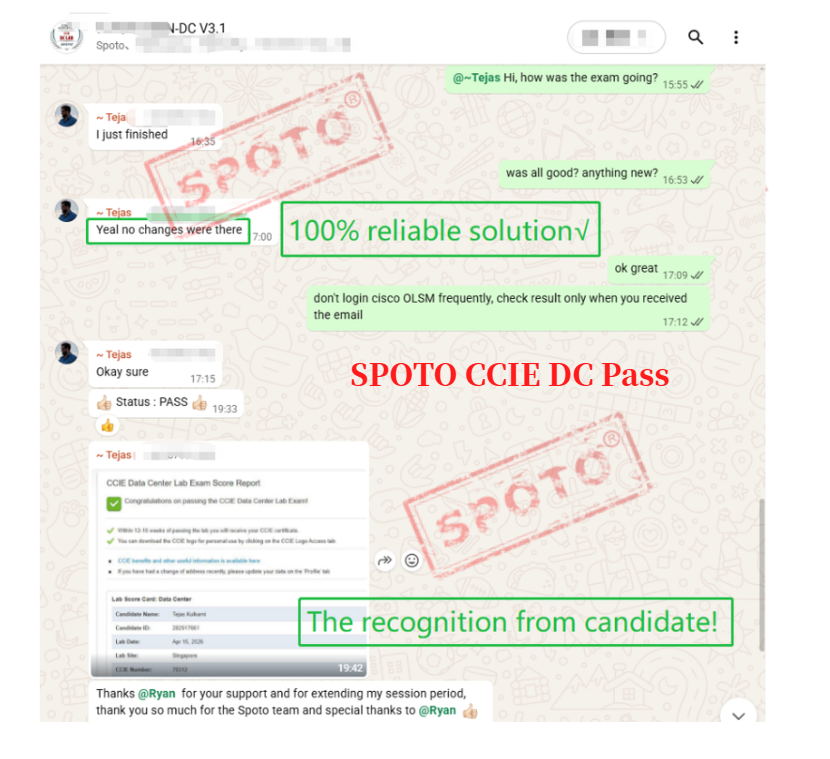
- Proven Student Success Stories
See more introductions on our vlog: