Table of Contents
The traditional role of the systems administrator has structurally collapsed. For years, keeping a cloud environment stable meant logging into a web console, manually inspecting server health logs, and writing custom scripts to clear disk space or patch an operating system. That reactive model simply cannot keep pace with ephemeral container lifecycles, complex microservice dependencies, and highly distributed multi-region topologies.
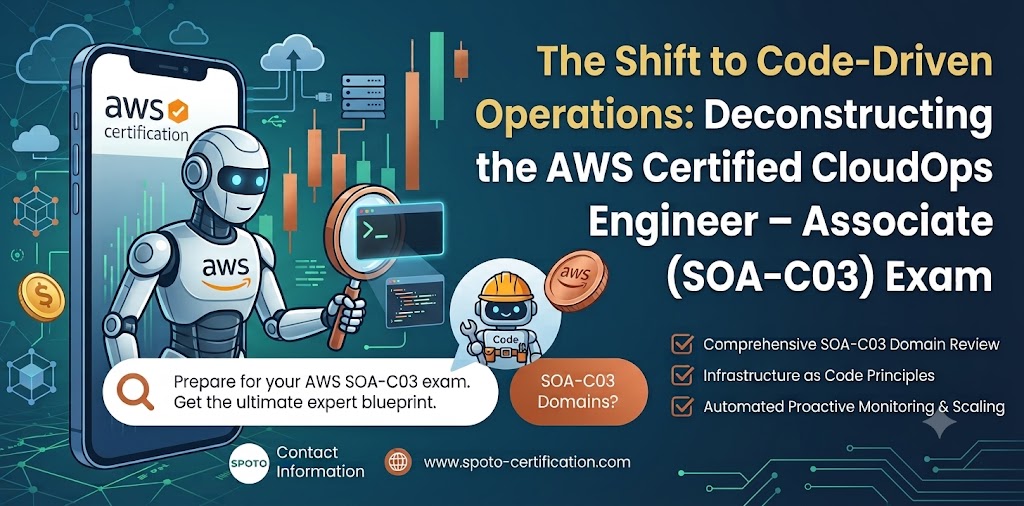
Recognizing this operational evolution, AWS executed a major restructuring of its operations track, retiring the legacy SysOps Administrator designation in favor of the AWS Certified CloudOps Engineer – Associate (SOA-C03) credential. This shift reflects a fundamental truth in engineering: modern cloud operations are no longer about passive administration; they are about programmatic infrastructure engineering. If you are an operations specialist, cloud engineer, or systems integrator navigating the ecosystem, clearing this exam requires mastering an automation-first, highly technical blueprint.
1. Exam Architecture: Testing Windows and Passing Thresholds
The SOA-C03 blueprint is widely regarded by infrastructure professionals as the most practically demanding of the core Associate-level tracks. It forces you to look at cloud infrastructure through the strict lens of systems stability, continuous compliance, and automated failure recovery.
The technical framework of the testing center matrix follows a structured model:
Testing Window: Exactly 130 minutes of allocation time.
Question Volume: 65 individual validation items.
Question Formats: Multiple-choice (one structurally optimal answer paired with three plausible distractors) and multiple-response (requiring you to isolate two or three correct configuration steps from a larger list).
Scoring Metrics: 50 items are actively scored, while 15 act as hidden experimental queries used to gather statistical telemetry for future syllabus updates. Performance is mapped onto a scaled scoring spectrum from 100 to 1,000 points.
Passing Threshold: A minimum scaled score of 720 is required to earn the certification.
Crucially, the exam does not feature live terminal labs, meaning your hands-on production experience is verified entirely through complex, scenario-based logic designed to trap anyone relying on superficial definitions.
2. Core Technical Deep Dive: The Four Structural Domains
The official curriculum divides its engineering assessment into four functional pillars. Passing the exam consistently requires understanding exactly how services interface under stress.
(1)Monitoring, Logging, Analysis, Remediation, and Performance Optimization (33%)
This is the heaviest section of the exam. Operations live and die by system observability, and you must know how to build comprehensive telemetry pipelines that detect structural degradation before it impacts production workloads.
The blueprint evaluates your deep command of Amazon CloudWatch and related observability tools. You must know how to construct advanced metric filters, parse raw logging payloads with CloudWatch Logs Insights, and configure composite alarms that combine multiple operational states to prevent alert fatigue. With containerization fully in-scope for the SOA-C03 version, you must show proficiency in deploying CloudWatch Container Insights across Amazon ECS and EKS clusters.
Furthermore, the exam tests your ability to close the loop on infrastructure anomalies. You must know how to route specific event signatures through Amazon EventBridge to trigger automated remediation workflows, such as executing AWS Systems Manager (SSM) Automation documents or launching targeted Lambda functions to self-heal a failing node.
(2)Reliability and Business Continuity (20%)
An engineer's primary mandate is keeping data durable and application endpoints available during physical hardware drops or localized facility outages. This domain tests your control over high-availability architectures and disaster recovery (DR) execution patterns.
Expect intricate scenario questions regarding Amazon Route 53 health checking and routing policies, requiring you to configure multi-region active-active or active-passive failover models. The database criteria heavily emphasize scalable, modern storage engines. You must demonstrate an understanding of Amazon Aurora Serverless v2 scaling profiles, know how to position an Amazon RDS Proxy to safely pool high-frequency application connections, and utilize DynamoDB Accelerator (DAX) to resolve microsecond read latency bottlenecks. For business continuity, you must show competence in orchestrating enterprise-wide backup schedules across multiple organizational accounts using AWS Backup, establishing precise Recovery Point Objectives (RPO) and Recovery Time Objectives (RTO).
(3)Deployment, Provisioning, and Automation (24%)
The curriculum heavily penalizes manual infrastructure creation, rewarding predictable, code-driven patterns. You must prove you can build, scale, and update environments safely through automation.
This requires a fluid understanding of AWS CloudFormation mechanics. You must know how to troubleshoot stack deployment failures, configure precise rollback behaviors, utilize drift detection to isolate manual infrastructure alterations, and build safe deployment steps using CloudFormation Change Sets. The curriculum also evaluates the AWS Cloud Development Kit (CDK), testing your conceptual ability to interpret how high-level programmatic code constructs compile down into raw infrastructure templates. Additionally, you are evaluated on container orchestration, requiring a strong understanding of how to manage image lifecycles inside Amazon ECR and coordinate blue/green or rolling deployment strategies across running task pools.
(4)Security and Compliance (23%)
Securing an enterprise cloud footprint requires establishing centralized governance, isolating networks, and enforcing strict least-privilege principles across a multi-tenant footprint.
A massive focus area in this domain is multi-account governance. You will face scenarios testing your ability to deploy AWS Control Tower and orchestrate accounts via AWS Organizations, utilizing Service Control Policies (SCPs) to set hard runtime boundaries that even root administrators cannot override. At the workload layer, the blueprint evaluates your knowledge of securely authenticating non-AWS resources via AWS IAM Roles Anywhere, managing and automatically rotating database credentials with AWS Secrets Manager, and continuously auditing infrastructure configurations using AWS Config rules to flag non-compliant resources in real time.
3. Mastering Constraint Analysis: Spotting the Exam Traps
The primary factor that causes prepared systems engineers to fail the SOA-C03 exam is missing the dominant constraint embedded inside the scenario text. AWS question designers intentionally draft multiple-choice options where three out of the four responses represent completely functional, valid AWS architectures.
The secret to isolating the single correct answer lies in matching options against the priority keyword highlighted in the prompt. If a question describes an unexpected infrastructure outage and requests a remediation path that achieves the "lowest possible RTO," a manual snapshot restoration plan is automatically a distractor—even if it is highly cost-effective. Your response must pivot toward automated multi-region replication. Conversely, if the prompt focuses entirely on minimizing costs for non-critical developer environments, expensive cross-region clustering solutions must be discarded immediately, regardless of how resilient they are.
4. Transitioning From Theory to Production-Ready Execution
Because the modern CloudOps blueprint relies heavily on granular service interactions, real-world error logs, and precise AWS CLI syntax, passive reading or watching high-level summaries will not prepare you to clear the 720-point passing threshold. True readiness requires building analytical pattern recognition—knowing exactly how services behave under pressure and identifying configuration flaws instantly.
When you are ready to shift out of theoretical study loops and verify your engineering skills against true testing parameters, practicing with high-fidelity simulations is an essential step. SPOTO provides accurate, up-to-date SOA-C03 exam simulations, verified question matrices, and comprehensive review modules engineered to match the depth and tone of the official AWS CloudOps blueprint. Using these targeted validation tools to hone your question-parsing speed, isolate your blind spots in automated remediation routing, and build testing stamina ensures you can walk into the proctored environment with absolute confidence and secure your certification on your very first attempt.