Table of Contents
The Cisco Certified Network Professional (CCNP) is an intermediate core certification within the Cisco certification system. The 2026 exam syllabus continues the "core + specialization" modular architecture while emphasizing new technologies such as cloud integration, network automation, SD-WAN, and AI operations, making it more aligned with the network technology needs of enterprise digital transformation.
1. 2026 CCNP Certification Exam Positioning
The CCNP focuses on independent design, deployment, operation, optimization, and complex troubleshooting capabilities for enterprise-level networks. Starting in 2026, there will be no mandatory prerequisite certifications, but the official recommendation is to have 1-3 years of hands-on network experience or a solid foundation in CCNA-level routing, switching, and network security. Attempting the exam without foundational knowledge would be extremely challenging.
2. Exam Structure
In 2026, the CCNP exam will adopt a "1+1" model, consisting of one core exam and one specialization exam, both conducted via computer-based testing. Passing both exams will grant the corresponding CCNP certification.
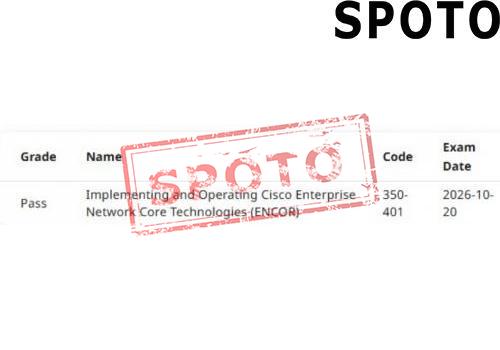
Core Exam: Mandatory for all tracks, lasting 120 minutes, with a total score of 1000 points and a passing threshold of 825 points. The fee is $400, and it also serves as the written qualification exam for CCIE. The mainstream core exam is the Enterprise Track 350-401 ENCOR (Enterprise Network Core Technologies), updated to version 1.2 in March 2026. Some wireless content has been removed, while SD-WAN and automation have been strengthened.
Professional Direction Examination: Choose one from six major categories, with a duration of 90 minutes, a full score of 1000 points, a passing score of 825 points, and a fee of 300 USD. The main categories in 2026 include:
CCNP Enterprise: Optional ENARSI, ENSDWI, ENSLD, ENAUTO
CCNP Security: Focusing on Firewalls, ISE, Zero Trust, and Cloud Security
CCNP Data Center: Covers Nexus, ACI, UCS, storage networks, AI infrastructure, with the addition of the DCAI exam in 2026
CCNP Collaboration: Updated in February 2026, v2.0, with 50% cloud and 50% on-premise content, including new Webex Cloud Customer Support exam topics
CCNP Service Provider: Focused on Carrier Backbone, MPLS, and VPN Technologies
CCNP Automation (formerly DevNet): Enhancing the Application of Python, IaC, and AI in Network Automation
3. Exam Format and Question Types
The entire exam is conducted via computer, with question types including single-choice questions, multiple-choice questions, drag-and-drop questions, scenario analysis questions, and simulated operational questions. There are no purely theoretical memorization questions, and all assessments are based on practical scenarios. In 2026, scenario-based questions will account for over 60%, focusing on network troubleshooting, solution selection, strategy configuration, and hybrid cloud interoperation analysis.
4. Certification Validity and Value
The validity period is 3 years, and it can be maintained by passing recertification exams, upgrading to a higher-level certification, or completing specified continuing education credits.
Professional Value: Certified individuals earn 30%-40% higher salaries on average than their uncertified peers. This qualification is essential for advancing to roles such as Network Supervisor and Architect. It is highly recognized across global government, enterprise, financial, and internet industries, serving as a universal credential for cross-border network technology positions.
5. Core knowledge modules in 2026
(1) Core Exam ENCOR (350-401) Six Modules
Network architecture (20%): enterprise layered design, SDN and DNA Center, integration of traditional networks and SD-WAN, virtualization and network services
Advanced routing (25%): OSPFv3/EIGRP optimization, BGP neighbor and routing strategy, route redistribution, IPv6 deployment, MPLS infrastructure
Advanced Switching (20%): VLAN/Trunk/STP/RSTP/MSTP Advanced Configuration, VxLAN, NIC Combination, Port Security, QoS Mechanism
Network security (15%): ACL, AAA authentication, 802.1X, IPsec VPN, firewall infrastructure, threat protection, cloud security access
Network Services (10%): DHCP/DNS/NTP Advanced Configuration, High Availability Services (HSRP/VRRP/GLBP), Network Monitoring and Logging
Network Automation (10%): REST API, Python scripting, Ansible basics NETCONF/RESTCONF、 Automated troubleshooting tool
(2) Core examination points for directional exams (taking ENARSI as an example)
Advanced routing troubleshooting: OSPF neighbor anomalies, BGP route missing, EIGRP aggregation issues, route filtering policy errors
Network service optimization: MPLS VPN, IPv6 transition technology, high availability gateway failure, QoS congestion management
Hybrid network integration: local and Azure/AWS cloud network linkage, SD-WAN routing strategy, branch network access troubleshooting
6. Efficient Preparation Strategies for 2026
Phase 1: Foundation consolidation period (1 month)
Complete CCNA core: TCP/IP, routing and switching basics ACL、VPN、Network device command, those without foundation should complete this step first
Core exam theory learning: Read the official certification guide carefully, master the principles of ENCOR's six major modules, and focus on understanding BGP, OSPF, SD-WAN logic
Basic practical operation: Use Cisco Packet Tracer to complete VLAN, OSPF, HSRP, ACL basic configuration, familiar with command line logic
Phase 2: Core Breakthrough Period (1.5 months)
Core Exam Deepening: Focus on BGP routing, route redistribution, SD-WAN architecture, network automation tools, and use GNS3 to build complex topology for practical operation
Direction selection and learning: Choose according to career direction, such as ENARSI specializing in routing and troubleshooting, ENSDWI specializing in SD-WAN deployment
Special practical operation: Complete enterprise level scenario experiments, such as dual data center OSPF+BGP interconnection, branch SD-WAN access, firewall policy configuration, Python automated distribution configuration
Phase 3: Model Exam Sprint Period (0.5 months)
Full simulation: timed practice based on exam duration, with a 120 minute core exam and a 90 minute directional exam, achieving a stable accuracy rate of over 90% for the target
Error review: Classify and organize troubleshooting, scheme selection, configuration strategy errors, regression principles and experimental verification
Exam skills: Focus on the keywords of "fault phenomenon, device type, network topology" in situational questions, and eliminate non Cisco native solutions; Multiple Choice Question: It's better to choose fewer but better options.
Summary: The core of CCNP certification in 2026 is based on traditional routing and switching, with cloud integration SD-WAN、 Network automation is the core point of scoring, and the ability to provide practical solutions is assessed throughout the process rather than rote memorization.
The key to preparing for SPOTO lies in focusing on the direction, strengthening practical operations, understanding the logic of situational questions, and avoiding the pitfalls of integrating traditional and new technologies. By following the "Basic Core Sprint" system for 3-4 months, you can efficiently clear the level!