Table of Contents
We have officially arrived at the edge of a massive structural shift. On July 15, 2026, the Fortinet Training Institute will turn off the lights on its short-lived role-based credential system (FCP, FCSS, FCX). In its place stands the return of a heavily fortified, strictly sequential 8-level numbered framework ranging from NSE 1 up to the elite NSE 8. The backend data migration is so complex that Pearson VUE has temporarily paused all Fortinet exam deliveries to clean up the scheduling system for the new blueprint layout.
If you are currently studying for a Fortinet exam or planning your engineering roadmap for the latter half of 2026, you cannot simply carry your old study habits forward. The structural reset has fundamentally changed how exams are weighted, how prerequisites are verified, and how technical competence is evaluated.
To protect your training investment and ensure a passing score on your first attempt, you must align your preparation with four key operational aspects of the updated ecosystem.
1. Navigating the Hard Prerequisite Lock (The NSE 4 Mandate)
The single biggest strategic mistake an engineer can make in the post-update landscape is trying to leapfrog the foundational layers. Previously, a senior security architect could bypass lower-tier badges and challenge specialized advanced or expert exams directly.
The updated framework aggressively kills off these shortcuts. Fortinet has implemented an automated backend verification engine that enforces strict multi-tier dependencies.
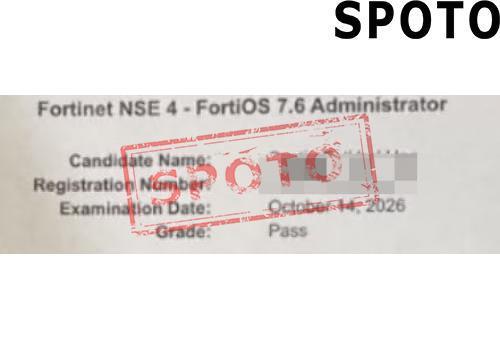
The Dependency Rules: If you pass a specialized security operations exam (NSE 5 or 6) or an advanced architectural exam (NSE 7), the testing engine will completely withhold your certification badge unless you hold a verified, active NSE 4: FortiOS Administrator credential on that exact day.
The Takeaway: Your primary technical objective must be securing and maintaining a flawless command of core FortiOS administration. Treat the NSE 4 blueprint not as an optional introductory milestone, but as the mandatory gatekeeper of your entire downstream engineering portfolio.
2. Synthesizing Unified, Multi-Domain Blueprints
For engineers targeting the advanced tiers—specifically the NSE 7: Secure Networking track—the strategy of hyper-focusing on a single product guide will no longer clear the bar.
The core of the update is the massive consolidation of previously distinct syllabi. Instead of allowing candidates to choose isolated exams for enterprise firewalls or standalone SD-WAN deployments, Fortinet has merged these deep technical tracks into highly demanding comprehensive examinations.
Your study plan must pivot toward high-scale platform integration. You will face complex, scenario-based prompts that force you to troubleshoot advanced Border Gateway Protocol (BGP) routing over multi-site IPsec VPN tunnels, configure Virtual Domain (VDOM) topologies, and design dynamic SD-WAN performance SLA steering rules within the exact same testing session. Furthermore, official documentation explicitly states that these comprehensive sandboxes will feature infrastructural variables that push past basic student workbooks, actively testing your real-world engineering intuition.
3. Mastering Command-Line Diagnostics and Raw Code Parsing
The examiners are executing an aggressive technical push to eliminate "paper certified" professionals who rely on memorizing clean Graphical User Interface (GUI) dashboards. Across all active tracks—from core administration to the cutting-edge NSE 5/6 FortiAI Analyst and automated SecOps pipelines—the blueprints place an unprecedented premium on raw command-line interface (CLI) fluency.
To survive the time-constrained testing environment, your preparation must focus heavily on interpreting live diagnostic readouts. You must be entirely capable of:
Parsing raw console dumps to isolate why an IPsec tunnel is failing Phase 1 or Phase 2 negotiations.
Evaluating packet flow trace logs to pinpoint Network Address Translation (NAT) bottlenecks or explicit firewall policy drops.
Analyzing structural JSON payloads and debugging automated API authentication loops inside complex automation playbooks (FortiSIEM and FortiSOAR).
4. Defeating the "Zero Partial Credit" Multi-Select Grading Logic
The physical mechanics of the testing interface remain a primary pain point for brilliant network security professionals. Fortinet's updated evaluation engine leans incredibly heavily on complex multi-select, drag-and-drop, and matching prompts.
The scoring logic built into the Pearson VUE testing delivery system is strictly binary: there is absolutely no partial credit awarded. > If an intricate diagnostic prompt requires you to select three precise syntax corrections to fix a high-availability (HA) cluster synchronization failure, and you pick two perfect answers but slip up on the third, the testing engine scores that entire item as a zero.
Because you cannot rely on a process of elimination or close-enough guesswork, your study methodology must focus on absolute architectural precision. You must understand exactly how minor global configuration variables dynamically alter explicit security policies across the broader Security Fabric ecosystem.
5. Your Strategy for First-Attempt Success
Because the updated framework demands a highly precise mix of deep platform synthesis, rapid CLI diagnostic capabilities, and flawless execution under strict binary grading logic, passive reading paths or static textbooks are fundamentally insufficient. Success requires actively training your technical reflexes against the exact formats and pressures utilized by the live testing center.
When you are ready to transition out of administration guides and baseline your operational readiness against the updated technical standards, leveraging high-fidelity prep environments is your most efficient move. SPOTO provides meticulously structured practice question modules and comprehensive exam simulators fully aligned with Fortinet's active 8-level numbered blueprints and consolidated multi-select question formats. Refining your console-parsing speed, mastering your pacing under a ticking clock, and eliminating your configuration blind spots beforehand guarantees you can enter the Pearson VUE center with total clarity, clear the updated gatekeeper benchmarks, and advance your engineering career on your very first try.