Table of Contents
- 1. The 2026 Structural Pipeline: Navigating the Core Dependencies
- 2. The NSE 6 Foundation: Telemetry, Ingestion, and Multivendor SIEM
- 3. The NSE 7 Pinnacle: Security Orchestration and Playbook Engineering
- 4. Surviving the Operational Mechanics of the Exam Sandbox
- 5. Bridging the Gap to Your Automation Badge
Step inside any enterprise Security Operations Center (SOC) right now, and the atmosphere feels less like a strategic defense unit and more like a high-stress triage ward. Analysts are completely buried under an avalanche of thousands of uncoordinated security alerts every day. Between cloud data drops, endpoint anomalies, and sophisticated multi-stage phishing campaigns, manual detection and response are completely dead. If your SOC still relies on a tier-one analyst manually opening an alert ticket, copy-pasting an IP address into a threat intelligence lookup, and waiting for an infrastructure change approval window, you aren't defending a network—you are simply cataloging an active breach.
This operational bottleneck explains why the technical market has shifted focus. The modern premium isn't for engineers who merely deploy firewalls; it belongs to the architects who can build automated, self-healing security loops.
Fortinet responded directly to this demand through its massive 2026 certification overhaul, re-establishing its structured 8-level numbered progression. Sitting directly at the professional and specialist tiers of this ecosystem is the Automated Security Operations (SecOps) track. Spanning across the NSE 6 and NSE 7 designations, this curriculum forces security professionals to step past legacy log management and master pure, machine-speed orchestration.
1. The 2026 Structural Pipeline: Navigating the Core Dependencies
Before diving into the technical components, it is critical to understand how Fortinet's structural reset changes your testing roadmap. Under the guidelines enforced after the July 2026 transition, you cannot challenge these advanced SecOps credentials in a vacuum.
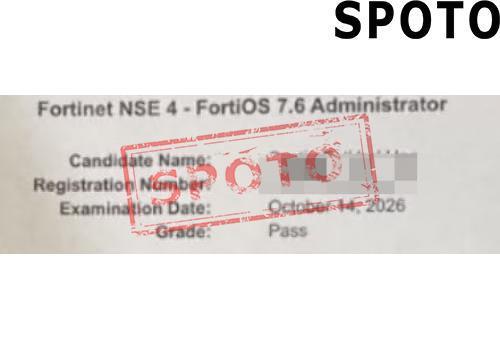
To achieve the active NSE 6 or 7 Automated Security Operations designation, candidates must maintain a valid, active baseline core. Your specialized automation exam results will only trigger an active certification badge if you hold an active NSE 4: FortiOS Administrator credential. Fortinet has built this dependency to ensure that engineers building automated defensive playbooks thoroughly understand the underlying firewall operating system where those blocks and mitigations will ultimately execute.
2. The NSE 6 Foundation: Telemetry, Ingestion, and Multivendor SIEM
The automation lifecycle fails immediately if your ingestion tier cannot distinguish between background noise and an actual indicator of compromise (IOC). The NSE 6 component of the SecOps track tests your hands-on capability to administer the collection and behavior-analysis engines across the Fortinet Security Fabric.
(1)Advanced Telemetry and Log Engineering via FortiAnalyzer
This segment skips basic report configuration to evaluate your capacity to build centralized analytics. The blueprint tests how you construct automated event handlers, manage SQL database schemas for high-volume logs, and design real-time compliance reporting. You must prove you can configure the Security Fabric to dynamically aggregate telemetry from FortiGates, public cloud nodes, and edge endpoints without introducing processing lag.
(2)Multi-Vendor Event Management with FortiSIEM
True enterprise environments rarely run on a single vendor's hardware. The curriculum tests your ability to deploy FortiSIEM as the central nervous system of a diverse infrastructure. Expect intensive scenario-driven questions testing your understanding of User and Entity Behavior Analytics (UEBA). The blueprint evaluates how you configure custom parsing rules, map cross-vendor logs to unified event types, and leverage real-time correlation engines to flag stealthy, distributed attacks that cross between cloud databases and on-premise networks.
3. The NSE 7 Pinnacle: Security Orchestration and Playbook Engineering
Once your ingestion layer catches an anomaly, the architecture must transition instantly from detection to remediation. This is the domain of the advanced NSE 7 tier, focusing heavily on FortiSOAR (Security Orchestration, Automation, and Response).
The evaluation criteria at this specialist tier leave traditional GUI configurations behind, forcing you to think like an automation architect. The curriculum centers on three rigorous operational areas:
MITRE ATT&CK Mapping and Detection Design: You are evaluated on your ability to map real-world threat intelligence and adversary behaviors against the MITRE ATT&CK framework. The exam tests how you translate abstract attack vectors into active FortiSIEM correlation rules and automated detection policies.
NIST 800-61 Incident Handling Execution: The blueprint structures your scenario evaluations directly around the standard computer security incident handling lifecycle (Detection, Analysis, Containment, Eradication, and Recovery). You must prove your automation architecture handles an incident properly at every milestone, preserving forensics while executing active mitigation.
FortiSOAR Playbook Architecture: The absolute core of the exam tests your code-level logic and design mechanics inside FortiSOAR. You will face multi-step scenario prompts where you must build or debug complex, conditional playbooks. The testing parameters evaluate how your playbooks leverage REST APIs, interact with external threat intelligence feeds, parse JSON payloads mid-execution, and trigger automated scripts to isolate a compromised host via a downstream FortiGate policy without requiring human intervention.
4. Surviving the Operational Mechanics of the Exam Sandbox
The primary reason experienced SOC analysts and security architects fail the automated operations exams is a lack of speed and technical precision. Fortinet's testing engine retains its strict, binary scoring method: there is absolutely no partial credit.
The NSE 6 and 7 exams lean heavily on multi-select and drag-and-drop questions. If a question prompts you to analyze a malfunctioning FortiSOAR playbook log and select the three precise configuration corrections required to fix an API authentication loop, you must identify all three perfectly. Choosing two correct steps and missing the third results in zero points for the entire question.
Furthermore, you will be handed raw log structures, complex JSON script segments, and threat report abstracts under a ticking clock. If you cannot read an API response payload and spot a formatting error instantly, you will run out of time long before you reach the end of the test.
5. Bridging the Gap to Your Automation Badge
Because the 2026 Automated Security Operations curriculum demands a deep, precise blend of multi-vendor log correlation, structural framework mapping, and production-grade playbook engineering, casual reading or basic product overview videos are not enough to clear the bar. You need to develop deep pattern recognition for how FortiSIEM and FortiSOAR integrate with the broader Security Fabric to handle high-velocity threat vectors.
When you are ready to transition out of theory and see if your diagnostic skills can survive realistic testing constraints, leveraging high-fidelity mock assets is your most efficient operational move. SPOTO provides meticulously updated practice question banks and comprehensive exam simulators fully aligned with the active 2026 NSE 6 and 7 SecOps blueprints and strict multi-select formats. Mastering your time management, sharpening your script-parsing speed, and eliminating your architectural blind spots beforehand ensures you can enter the Pearson VUE center with total clarity and secure your certification on your very first try.