Latest Cisco, PMP, AWS, CompTIA, Microsoft Materials on SALE Get Now Get Now
Home/
Blog/
Decoding the Expert Lab: CCIE Enterprise Infrastructure 2026 Blueprints and the Automation Divergence
SPOTO 2 2026-06-17 10:34:17
Decoding the Expert Lab: CCIE Enterprise Infrastructure 2026 Blueprints and the Automation Divergence

Securing a Cisco Certified Internetwork Expert (CCIE) digits patch has never been a simple weekend milestone. For decades, it has stood as one of the most demanding technical achievements in the entire IT landscape, requiring candidate engineers to withstand an intense, high-pressure practical evaluation.

If you are walking into a testing center in 2026 using preparation strategies or topology maps from a couple of years ago, you are going to encounter a massive disconnect. The landscape of expert-level routing, switching, and fabric architecture has shifted. The era of configuring isolated networking nodes through an endless stream of repetitive command-line interface (CLI) commands is gone.

Today, enterprise demands are focused entirely on software-defined fabrics, predictive telemetry, and multi-domain orchestrations. To match this production reality, Cisco has fully activated its updated CCIE Enterprise Infrastructure (EI) v1.1 blueprint across global testing labs. Simultaneously, the rise of the specialized CCIE Automation framework has created an interesting crossroads for senior network engineers.

If you want to map out your expert-level path over the coming year, here is a detailed, rigorous breakdown of the latest 2026 CCIE EI exam changes and how the track stacks up against the pure automation path.


1. The 2026 CCIE EI v1.1 Lab Restructuring: What is Out and What is In

The structural execution of the CCIE EI exam maintains its classic, grueling eight-hour format. It is split into a three-hour Design module where you act as a systems consultant with zero device access, followed by a five-hour Deploy, Operate, and Optimize (DOO) module. However, the core technological dependencies running under the hood have evolved significantly.

(1) The Great Protocol Cleanup (Deletions)

Cisco has systematically cleaned the blueprint of aging protocols that no longer align with modern enterprise standards. When you sit for the lab, you will no longer face tasks or troubleshooting variations involving:

  • Legacy VLAN Database configuration command structures.
  • VLAN Trunking Protocol (VTP) architectures.
  • OSPFv2 Loop-Free Alternate (LFA) optimization models.
  • Specific BGP multipath add-path command complexities.
  • By stripping away these legacy elements, Cisco has cleared the runway to focus on advanced network resilience and complex overlay engineering.

(2) The Resilient Underlay and Fabric Interlocking (Additions)

The modern 30% weighting for Core Network Infrastructure requires absolute mastery of high-availability topologies. The testing environment now places an explicit emphasis on configuring and troubleshooting Multichassis EtherChannel (MEC) deployment models.

Furthermore, you can no longer treat traditional routing control planes and software-defined overlays as separate entities. The exam scenarios heavily test how traditional underlays—such as multi-area OSPF or complex BGP routing policies—interlock directly with Cisco SD-Access and SD-WAN control planes.

Candidates frequently report that the DOO module requires configuring complex redistribution matrices where traditional service provider MPLS environments must seamlessly carry software-defined fabric traffic without causing path sub-optimization or policy drops.


2. CCIE Enterprise Infrastructure vs. CCIE Automation: The Architectural Divergence

As enterprises shift toward fully programmable networks, a common question arises: Should you pursue the CCIE Enterprise Infrastructure certification, or pivot completely to the CCIE Automation track? To make an informed decision, you must understand their structural differences.

(1) CCIE Enterprise Infrastructure: The Guardian of Connectivity State

The CCIE EI certification is fundamentally focused on network state, topological architecture, and end-to-end fabric integrity.

While the blueprint absolutely includes network programmability—expecting you to interact with Cisco DNA Center (Catalyst Center) APIs, execute Python scripts, and parse JSON structures—automation is treated as a tool to manage the underlying architecture. Your primary objective remains designing, deploying, and maintaining the underlying network infrastructure, ensuring that policy-driven segmentation, routing matrices, and wireless controllers work flawlessly.

(2) CCIE Automation: The Architect of Programmatic Scaling

The CCIE Automation track (the evolution of the DevNet Expert framework) views the network entirely through the lens of software engineering and infrastructure-as-code (IaC).

In this track, you are not manually diagnosing a routing peer failure on a core switch. Instead, you are building scalable continuous integration and continuous delivery (CI/CD) pipelines to automate changes across thousands of multi-domain nodes simultaneously. The blueprint tests your deep capability in:

Constructing advanced Ansible playbooks and Terraform configurations for multi-vendor networks.

Setting up high-frequency streaming telemetry infrastructure using gRPC and the ELK stack.

Managing complex API authentication, rate limiting, and webhook listening systems across Enterprise, Data Center, and Security environments.

(3) Make your choice

Choose CCIE EI if your passion lies in understanding how packets move through a complex corporate enterprise, how security boundaries are enforced across campus fabrics, and how to stabilize large-scale routing overlays.

Choose CCIE Automation if you want to step away from traditional hardware configuration and focus entirely on building the software layers, integration scripts, and automated orchestration workflows that control modern networks at scale.


3. Navigating the Technical Sandbox Successfully

Because the modern CCIE testing environments prioritize real-world engineering intuition, you cannot clear these labs through simple memorization. Success requires a methodical troubleshooting logic and the ability to read complex case files under a ticking clock. You need to spend hours configuring dual-stack topologies, analyzing API response codes, and breaking your configurations to understand how underlays and overlays interact when things fail.

If you are looking to simplify your preparation and avoid common pitfalls, utilizing structured training resources can give you a clear advantage. SPOTO offers up-to-date lab topologies, realistic exam simulations, and comprehensive study frameworks that mirror the exact changes introduced in the 2026 blueprints. By leveraging these practical tools to validate your routing, fabric, and automation logic before you schedule your official lab date, you can approach the testing window with absolute confidence and clear your expert examination on your very first try.
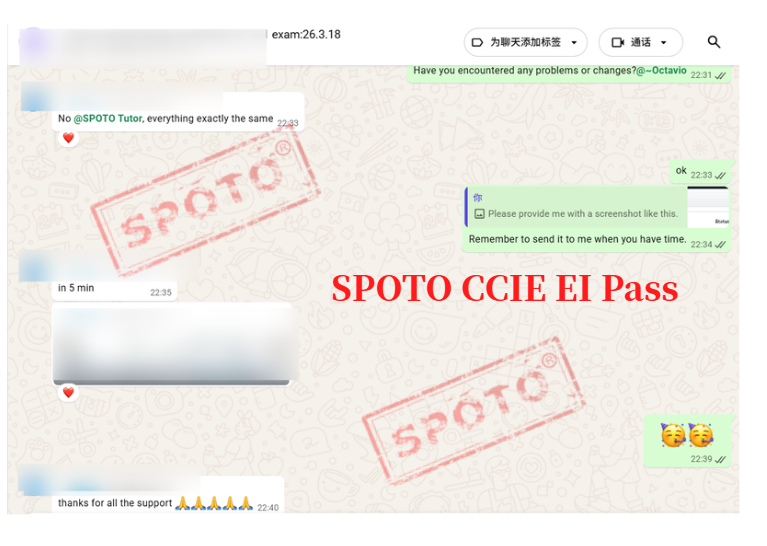
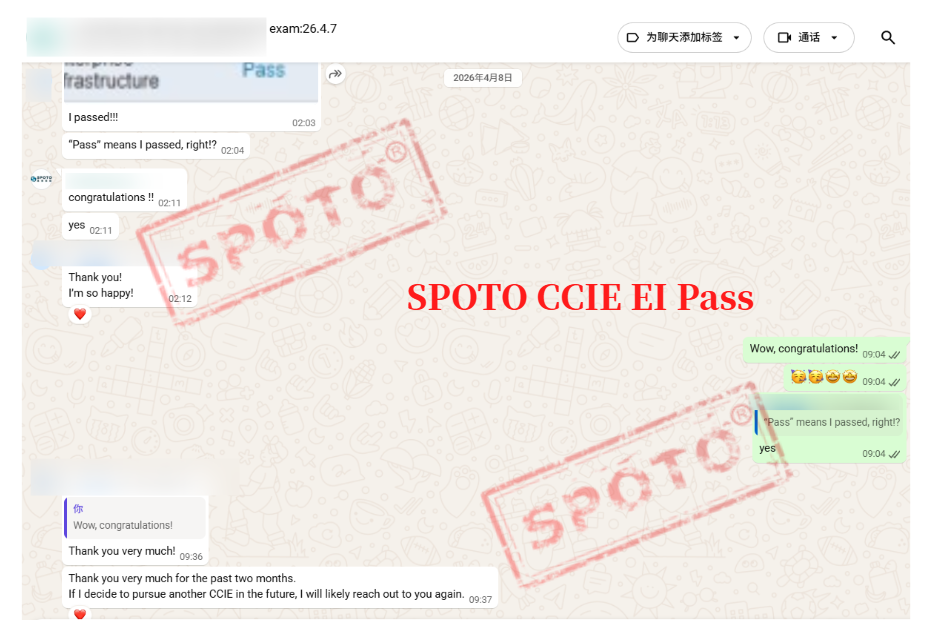
 

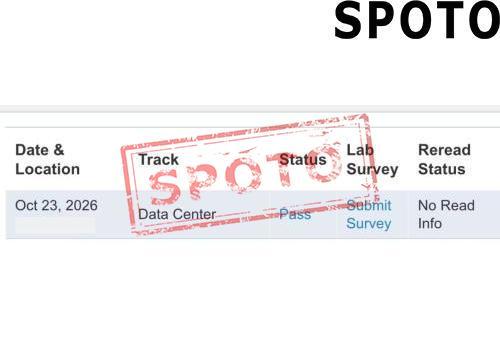
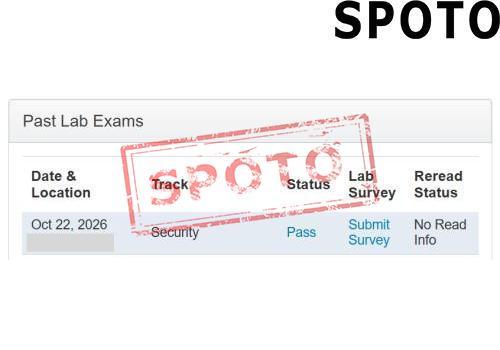
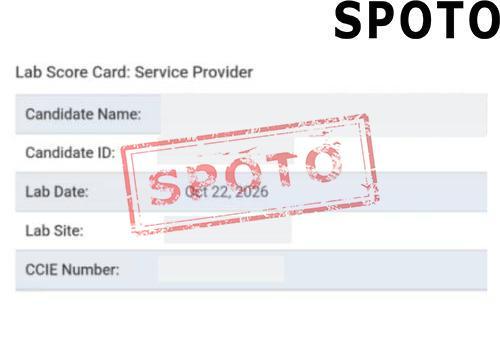
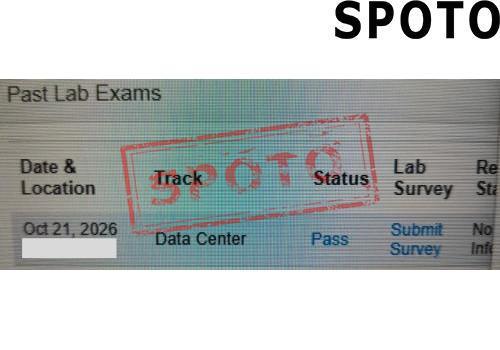
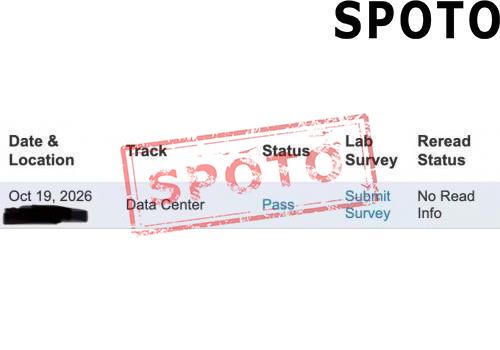
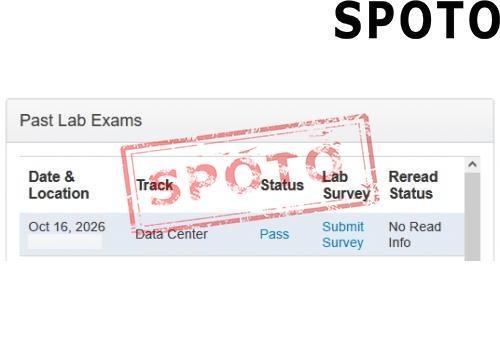
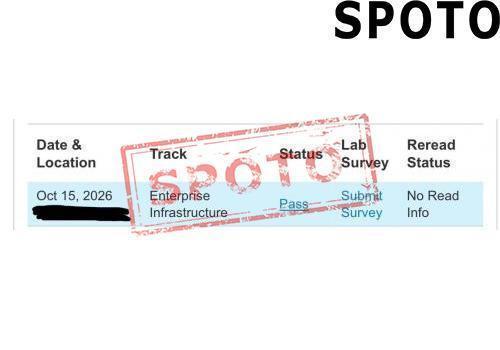
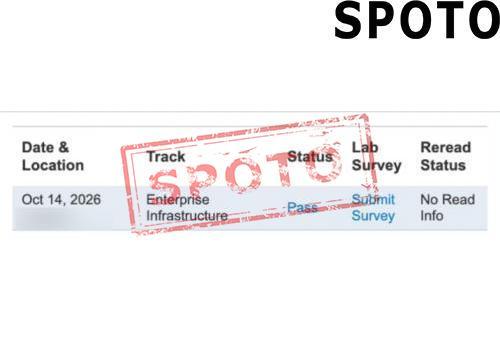
Latest Passing Reports from SPOTO Candidates
DC LAB

DC LAB

DC LAB

DC LAB

Dc lab

Dc lab

DC lab

DC lab

SEC LAB

SEC LAB

EI LAB

EI LAB

DC LAB

DC LAB

EI LAB

EI LAB

SEC LAB

SEC LAB

DC LAB

DC LAB

Write a Reply or Comment
Home/Blog/Decoding the Expert Lab: CCIE Enterprise Infrastructure 2026 Blueprints and the Automation Divergence
Decoding the Expert Lab: CCIE Enterprise Infrastructure 2026 Blueprints and the Automation Divergence
SPOTO 2 2026-06-17 10:34:17
Decoding the Expert Lab: CCIE Enterprise Infrastructure 2026 Blueprints and the Automation Divergence

Securing a Cisco Certified Internetwork Expert (CCIE) digits patch has never been a simple weekend milestone. For decades, it has stood as one of the most demanding technical achievements in the entire IT landscape, requiring candidate engineers to withstand an intense, high-pressure practical evaluation.

If you are walking into a testing center in 2026 using preparation strategies or topology maps from a couple of years ago, you are going to encounter a massive disconnect. The landscape of expert-level routing, switching, and fabric architecture has shifted. The era of configuring isolated networking nodes through an endless stream of repetitive command-line interface (CLI) commands is gone.

Today, enterprise demands are focused entirely on software-defined fabrics, predictive telemetry, and multi-domain orchestrations. To match this production reality, Cisco has fully activated its updated CCIE Enterprise Infrastructure (EI) v1.1 blueprint across global testing labs. Simultaneously, the rise of the specialized CCIE Automation framework has created an interesting crossroads for senior network engineers.

If you want to map out your expert-level path over the coming year, here is a detailed, rigorous breakdown of the latest 2026 CCIE EI exam changes and how the track stacks up against the pure automation path.


1. The 2026 CCIE EI v1.1 Lab Restructuring: What is Out and What is In

The structural execution of the CCIE EI exam maintains its classic, grueling eight-hour format. It is split into a three-hour Design module where you act as a systems consultant with zero device access, followed by a five-hour Deploy, Operate, and Optimize (DOO) module. However, the core technological dependencies running under the hood have evolved significantly.

(1) The Great Protocol Cleanup (Deletions)

Cisco has systematically cleaned the blueprint of aging protocols that no longer align with modern enterprise standards. When you sit for the lab, you will no longer face tasks or troubleshooting variations involving:

  • Legacy VLAN Database configuration command structures.
  • VLAN Trunking Protocol (VTP) architectures.
  • OSPFv2 Loop-Free Alternate (LFA) optimization models.
  • Specific BGP multipath add-path command complexities.
  • By stripping away these legacy elements, Cisco has cleared the runway to focus on advanced network resilience and complex overlay engineering.

(2) The Resilient Underlay and Fabric Interlocking (Additions)

The modern 30% weighting for Core Network Infrastructure requires absolute mastery of high-availability topologies. The testing environment now places an explicit emphasis on configuring and troubleshooting Multichassis EtherChannel (MEC) deployment models.

Furthermore, you can no longer treat traditional routing control planes and software-defined overlays as separate entities. The exam scenarios heavily test how traditional underlays—such as multi-area OSPF or complex BGP routing policies—interlock directly with Cisco SD-Access and SD-WAN control planes.

Candidates frequently report that the DOO module requires configuring complex redistribution matrices where traditional service provider MPLS environments must seamlessly carry software-defined fabric traffic without causing path sub-optimization or policy drops.


2. CCIE Enterprise Infrastructure vs. CCIE Automation: The Architectural Divergence

As enterprises shift toward fully programmable networks, a common question arises: Should you pursue the CCIE Enterprise Infrastructure certification, or pivot completely to the CCIE Automation track? To make an informed decision, you must understand their structural differences.

(1) CCIE Enterprise Infrastructure: The Guardian of Connectivity State

The CCIE EI certification is fundamentally focused on network state, topological architecture, and end-to-end fabric integrity.

While the blueprint absolutely includes network programmability—expecting you to interact with Cisco DNA Center (Catalyst Center) APIs, execute Python scripts, and parse JSON structures—automation is treated as a tool to manage the underlying architecture. Your primary objective remains designing, deploying, and maintaining the underlying network infrastructure, ensuring that policy-driven segmentation, routing matrices, and wireless controllers work flawlessly.

(2) CCIE Automation: The Architect of Programmatic Scaling

The CCIE Automation track (the evolution of the DevNet Expert framework) views the network entirely through the lens of software engineering and infrastructure-as-code (IaC).

In this track, you are not manually diagnosing a routing peer failure on a core switch. Instead, you are building scalable continuous integration and continuous delivery (CI/CD) pipelines to automate changes across thousands of multi-domain nodes simultaneously. The blueprint tests your deep capability in:

Constructing advanced Ansible playbooks and Terraform configurations for multi-vendor networks.

Setting up high-frequency streaming telemetry infrastructure using gRPC and the ELK stack.

Managing complex API authentication, rate limiting, and webhook listening systems across Enterprise, Data Center, and Security environments.

(3) Make your choice

Choose CCIE EI if your passion lies in understanding how packets move through a complex corporate enterprise, how security boundaries are enforced across campus fabrics, and how to stabilize large-scale routing overlays.

Choose CCIE Automation if you want to step away from traditional hardware configuration and focus entirely on building the software layers, integration scripts, and automated orchestration workflows that control modern networks at scale.


3. Navigating the Technical Sandbox Successfully

Because the modern CCIE testing environments prioritize real-world engineering intuition, you cannot clear these labs through simple memorization. Success requires a methodical troubleshooting logic and the ability to read complex case files under a ticking clock. You need to spend hours configuring dual-stack topologies, analyzing API response codes, and breaking your configurations to understand how underlays and overlays interact when things fail.

If you are looking to simplify your preparation and avoid common pitfalls, utilizing structured training resources can give you a clear advantage. SPOTO offers up-to-date lab topologies, realistic exam simulations, and comprehensive study frameworks that mirror the exact changes introduced in the 2026 blueprints. By leveraging these practical tools to validate your routing, fabric, and automation logic before you schedule your official lab date, you can approach the testing window with absolute confidence and clear your expert examination on your very first try.
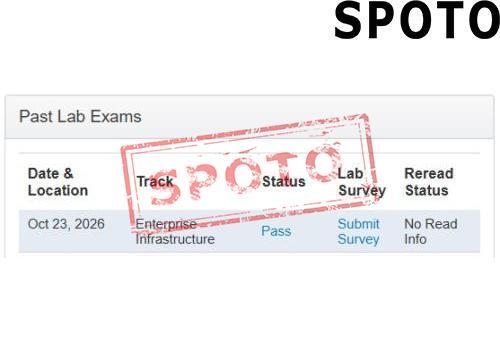
 

Latest Passing Reports from SPOTO Candidates
DC LAB
DC LAB
Dc lab
DC lab
SEC LAB
EI LAB
DC LAB
EI LAB
SEC LAB
DC LAB
Write a Reply or Comment
Don't Risk Your Certification Exam Success – Take Real Exam Questions
Eligible to sit for Exam? 100% Exam Pass GuaranteeEligible to sit for Exam? 100% Exam Pass Guarantee
SPOTO Ebooks
Recent Posts
Architecting the Intelligent Network: The Top 10 Cisco Certifications Delivering Real Enterprise Value in 2026
Decoding the Expert Lab: CCIE Enterprise Infrastructure 2026 Blueprints and the Automation Divergence
The Architecture of Trust: The Top 10 IBM IT Certifications Realizing True Enterprise Value in 2026
The Definitive Guide to Google's Workspace Administrator Certification
The Top 10 NVIDIA IT Certifications Delivering True Enterprise Value in 2026
Balancing Velocity and Reliability: The Ultimate Guide to the Google Professional Cloud DevOps Engineer Certification
Beyond the Data Pipe: The Definitive Guide to Mastering the Google Professional Data Engineer Exam
The Top 10 CompTIA IT Certifications Delivering Real Enterprise Value in 2026
Code to Cloud: Mastering the Google Professional Cloud Developer Certification in 2026
The Top 10 Microsoft IT Certifications Realizing True Enterprise Value in 2026
Excellent
5.0
Based on 5236 reviews
Request more information
I would like to receive email communications about product & offerings from SPOTO & its Affiliates.
I understand I can unsubscribe at any time.