Latest Cisco, PMP, AWS, CompTIA, Microsoft Materials on SALE Get Now Get Now
Home/
Blog/
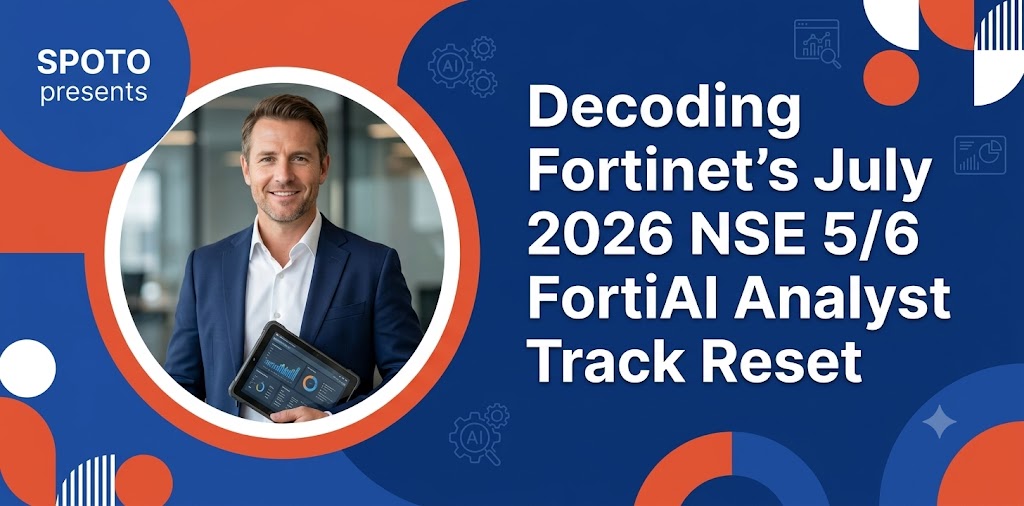
Decoding Fortinet's July 2026 NSE 5/6 FortiAI Analyst Track Reset
SPOTO 2 2026-07-10 10:30:22
Decoding Fortinet's July 2026 NSE 5/6 FortiAI Analyst Track Reset

The days of relying on traditional signature-based security filters to defend enterprise perimeters are officially dead. As bad actors increasingly leverage generative tools to execute polymorphic malware strains and zero-day exploits, legacy detection engines simply cannot keep up with the speed of incoming threats. Security operations centers (SOCs) are actively pivoting from manual triage to predictive, machine-learning models.

Reflecting this deep technical shift, the Fortinet Training Institute is rolling out its most radical restructuring to date. On July 15, 2026, Fortinet will completely retire its recent role-based naming tracks (FCP, FCSS, FCX) and launch an expanded, highly synchronized 8-level numbered system running from NSE 1 to NSE 8.

Sitting directly at the core of the new Security Operations infrastructure framework is a brand-new specialty track designed specifically to target automated intelligence: the NSE 5/6 FortiAI Analyst Track. This curriculum focuses entirely on moving away from historical log aggregation and leaning heavily into real-time, AI-driven asset deception and predictive behavior modeling.


1. The Hard Pipeline: Navigating the July 2026 Prerequisite Lock

Before unpacking the specific software components tested in this track, infrastructure engineers must understand the strict prerequisite dependencies built into the July 2026 reset. You can no longer challenge specialized analytics badges in isolation.

To be awarded the official FortiAI Analyst designation under the updated matrix, you must maintain a verified, active NSE 4: FortiOS Administrator (v7.6 or higher) baseline. Fortinet implemented this lock to ensure that any analyst deploying machine-learning algorithms to detect network threats deeply understands the underlying firewalls, policies, and Security Fabric topologies where those threat mitigations will ultimately be executed.


2. Inside the Blueprint: The Two Core AI Defensive Pillars

The active 2026 syllabus leaves high-level theoretical data science concepts behind. Instead, it measures your practical competence in administering Fortinet's native machine-learning assets. The exam divides your evaluation across two massive technical domains.

(1)Predictive Telemetry Engineering via FortiAI-Detect

This domain focuses squarely on the configuration and scaling of Fortinet's deep neural networks to catch malicious actions before they trigger high-severity alerts. The exam evaluates your ability to:

Configure automated network traffic analysis (NTA) baselines to recognize anomalies across encrypted enterprise traffic streams.

Use the generative FortiAI virtual assistant to synthesize raw, multi-vector event logs into human-readable incident summaries.

Tune self-learning behavioral algorithms to drastically minimize false-positive notifications that typically overwhelm tier-one analysts.

(2)Deception Architecture with FortiDeceptor

The second core pillar represents a highly active approach to defensive infrastructure. Rather than waiting for a breach to hit production databases, the blueprint demands mastery over internal deception layers.

You will face intensive scenario-driven questions testing your ability to

Deploy and manage specialized network honeypots and decoy assets (such as fake server endpoints, deceptive database schemas, and false administrative credentials) directly within virtualized network segments.

Detect and trace lateral movement patterns from advanced persistent threats (APTs) the exact moment they interact with a decoy environment.

Configure automated Fabric mitigation loops that instantly signal an adjacent FortiGate firewall to isolate an infected physical port or drop an IP address once a decoy asset is compromised.


3. Surviving the Mechanical Traps of the Test Interface

The primary reason experienced SOC analysts fail Fortinet specialist examinations isn't a lack of engineering capability; it is a failure to adapt to the strict parameters of the testing engine.

The NSE 5 and NSE 6 components of the FortiAI Analyst track rely heavily on multi-select, drag-and-drop, and log-analysis questions. A prompt might provide a snippet of a compromised network log, display an administrative rule structure from FortiDeceptor, and instruct you to "select three correct answers" to re-align the fabric automation policy.

Fortinet's scoring engine uses strict binary logic: there is absolutely no partial credit. If you pick two correct choices and one incorrect option, you receive a zero for that item. Under a tight 60 to 70-minute testing window, you must be able to read console metrics, spot syntax mistakes, and predict behavioral rule outcomes with total speed and zero hesitation.


4. Shifting From General Study to Exam Readiness

Because the July 2026 FortiAI Analyst blueprint requires an exact blend of automated deception logic, deep neural network management, and instant log-parsing capabilities, passive reading paths or conceptual overviews will not prepare you for the testing room. Success demands building strict pattern recognition for how Fortinet's AI engines evaluate zero-day anomalies under pressure.

When you are ready to transition out of administration guides and actively baseline your technical readiness against the live testing engines, utilizing high-fidelity testing environments is your most practical operational step. SPOTO provides meticulously updated practice question banks and comprehensive exam simulators precisely aligned with the updated July 2026 FortiAI Analyst track and its strict multi-select formats. Refining your question-parsing speed, mastering your time management, and eliminating your architectural blind spots beforehand ensures you can bypass the pre-test stress and secure your advanced certification on your very first try.
 

Latest Passing Reports from SPOTO Candidates
H25-531-E-P

H25-531-E-P

NSE7SSEAD25-P

NSE7SSEAD25-P

NSE4FGTAD76-P

NSE4FGTAD76-P

CIS-DF-P

CIS-DF-P

FCP-FMGAD76-P

FCP-FMGAD76-P

PMI-PMP-057

PMI-PMP-057

PL-200-P

PL-200-P

NSE4FGTAD76

NSE4FGTAD76

HPE6-A86

HPE6-A86

CV0-004-P

CV0-004-P

Write a Reply or Comment
Home/Blog/Decoding Fortinet's July 2026 NSE 5/6 FortiAI Analyst Track Reset
Decoding Fortinet's July 2026 NSE 5/6 FortiAI Analyst Track Reset
SPOTO 2 2026-07-10 10:30:22
Decoding Fortinet's July 2026 NSE 5/6 FortiAI Analyst Track Reset

The days of relying on traditional signature-based security filters to defend enterprise perimeters are officially dead. As bad actors increasingly leverage generative tools to execute polymorphic malware strains and zero-day exploits, legacy detection engines simply cannot keep up with the speed of incoming threats. Security operations centers (SOCs) are actively pivoting from manual triage to predictive, machine-learning models.

Reflecting this deep technical shift, the Fortinet Training Institute is rolling out its most radical restructuring to date. On July 15, 2026, Fortinet will completely retire its recent role-based naming tracks (FCP, FCSS, FCX) and launch an expanded, highly synchronized 8-level numbered system running from NSE 1 to NSE 8.

Sitting directly at the core of the new Security Operations infrastructure framework is a brand-new specialty track designed specifically to target automated intelligence: the NSE 5/6 FortiAI Analyst Track. This curriculum focuses entirely on moving away from historical log aggregation and leaning heavily into real-time, AI-driven asset deception and predictive behavior modeling.


1. The Hard Pipeline: Navigating the July 2026 Prerequisite Lock

Before unpacking the specific software components tested in this track, infrastructure engineers must understand the strict prerequisite dependencies built into the July 2026 reset. You can no longer challenge specialized analytics badges in isolation.

To be awarded the official FortiAI Analyst designation under the updated matrix, you must maintain a verified, active NSE 4: FortiOS Administrator (v7.6 or higher) baseline. Fortinet implemented this lock to ensure that any analyst deploying machine-learning algorithms to detect network threats deeply understands the underlying firewalls, policies, and Security Fabric topologies where those threat mitigations will ultimately be executed.


2. Inside the Blueprint: The Two Core AI Defensive Pillars

The active 2026 syllabus leaves high-level theoretical data science concepts behind. Instead, it measures your practical competence in administering Fortinet's native machine-learning assets. The exam divides your evaluation across two massive technical domains.

(1)Predictive Telemetry Engineering via FortiAI-Detect

This domain focuses squarely on the configuration and scaling of Fortinet's deep neural networks to catch malicious actions before they trigger high-severity alerts. The exam evaluates your ability to:

Configure automated network traffic analysis (NTA) baselines to recognize anomalies across encrypted enterprise traffic streams.

Use the generative FortiAI virtual assistant to synthesize raw, multi-vector event logs into human-readable incident summaries.

Tune self-learning behavioral algorithms to drastically minimize false-positive notifications that typically overwhelm tier-one analysts.

(2)Deception Architecture with FortiDeceptor

The second core pillar represents a highly active approach to defensive infrastructure. Rather than waiting for a breach to hit production databases, the blueprint demands mastery over internal deception layers.

You will face intensive scenario-driven questions testing your ability to

Deploy and manage specialized network honeypots and decoy assets (such as fake server endpoints, deceptive database schemas, and false administrative credentials) directly within virtualized network segments.

Detect and trace lateral movement patterns from advanced persistent threats (APTs) the exact moment they interact with a decoy environment.

Configure automated Fabric mitigation loops that instantly signal an adjacent FortiGate firewall to isolate an infected physical port or drop an IP address once a decoy asset is compromised.


3. Surviving the Mechanical Traps of the Test Interface

The primary reason experienced SOC analysts fail Fortinet specialist examinations isn't a lack of engineering capability; it is a failure to adapt to the strict parameters of the testing engine.

The NSE 5 and NSE 6 components of the FortiAI Analyst track rely heavily on multi-select, drag-and-drop, and log-analysis questions. A prompt might provide a snippet of a compromised network log, display an administrative rule structure from FortiDeceptor, and instruct you to "select three correct answers" to re-align the fabric automation policy.

Fortinet's scoring engine uses strict binary logic: there is absolutely no partial credit. If you pick two correct choices and one incorrect option, you receive a zero for that item. Under a tight 60 to 70-minute testing window, you must be able to read console metrics, spot syntax mistakes, and predict behavioral rule outcomes with total speed and zero hesitation.


4. Shifting From General Study to Exam Readiness

Because the July 2026 FortiAI Analyst blueprint requires an exact blend of automated deception logic, deep neural network management, and instant log-parsing capabilities, passive reading paths or conceptual overviews will not prepare you for the testing room. Success demands building strict pattern recognition for how Fortinet's AI engines evaluate zero-day anomalies under pressure.

When you are ready to transition out of administration guides and actively baseline your technical readiness against the live testing engines, utilizing high-fidelity testing environments is your most practical operational step. SPOTO provides meticulously updated practice question banks and comprehensive exam simulators precisely aligned with the updated July 2026 FortiAI Analyst track and its strict multi-select formats. Refining your question-parsing speed, mastering your time management, and eliminating your architectural blind spots beforehand ensures you can bypass the pre-test stress and secure your advanced certification on your very first try.

 

Latest Passing Reports from SPOTO Candidates
H25-531-E-P
NSE7SSEAD25-P
NSE4FGTAD76-P
CIS-DF-P
FCP-FMGAD76-P
PMI-PMP-057
PL-200-P
NSE4FGTAD76
HPE6-A86
CV0-004-P
Write a Reply or Comment
Don't Risk Your Certification Exam Success – Take Real Exam Questions
Eligible to sit for Exam? 100% Exam Pass GuaranteeEligible to sit for Exam? 100% Exam Pass Guarantee
SPOTO Ebooks
Recent Posts
Beyond Product Badges: Decoding Palo Alto Networks' Radical Role-Based Overhaul
Decoding Fortinet's July 2026 NSE 5/6 FortiAI Analyst Track Reset
The Architecture of Elite Security: Unpacking Fortinet's Brutal 2026 NSE 8 Transformation
Fighting at Machine Speed: Deconstructing Fortinet's 2026 Automated Security Operations (NSE 6/7) Blueprint
The "2026 Overhaul": Why the Fortinet NSE 4 Reset Will Transform Your Certification Strategy
The Unified Gauntlet: Decoding Fortinet’s New Comprehensive NSE 7 Secure Networking Exam
Stopping the Patchwork Panic: What the 2026 IAPP CIPP Blueprint Actually Evaluates
The July 2026 Overhaul: The 5 Strategic Fortinet NSE Exams to Target Right Now
The Shift to Liquid-Cooled Compute: The 5 Most Strategic NVIDIA Certifications for 2026
Operationalizing Data Privacy: Deconstructing the IAPP CIPM Exam Blueprint in 2026
Excellent
5.0
Based on 5236 reviews
Request more information
I would like to receive email communications about product & offerings from SPOTO & its Affiliates.
I understand I can unsubscribe at any time.