Table of Contents
When enterprise systems suffer outages, security incidents, or compliance failures, the financial damage rarely stems from the technical vulnerability alone. Instead, it usually comes from a failure to identify, evaluate, and manage the underlying business risk before things go wrong.
While many IT credentials focus on auditing controls or configuring defensive tools, the Certified in Risk and Information Systems Control (CRISC) designation takes a different angle. Offered by ISACA, CRISC measures your ability to evaluate enterprise technology through a risk management lens—helping organizations build resilient operations while keeping risk within acceptable boundaries.
Here is a thorough, practical overview of what the CRISC certification entails, why it holds substantial market value, recent syllabus updates, salary benchmarks, and how to prepare.
1. What Is the ISACA CRISC Certification?
The CRISC certification is a globally recognized management-level credential built specifically for IT risk professionals, risk analysts, GRC (Governance, Risk, and Compliance) specialists, and business managers.
Rather than testing whether you can audit code or configure network firewalls, CRISC focuses on how technology risks connect to broader business strategy. Certified individuals know how to design risk management frameworks, run qualitative and quantitative risk assessments, track Key Risk Indicators (KRIs), and help business leaders choose the right risk treatment strategies.
2. Why CRISC Holds Real Value in Today's Market
When an enterprise suffers a cloud outage or a third-party data breach, senior executives rarely want a lecture on firewall settings. They want to know the financial hit, the legal exposure, and how to keep it from happening again. That is why companies place such a high premium on CRISC-certified professionals—they know how to frame technical problems in clear business terms. Here is what makes the qualification stand out in the job market:
Connecting tech issues to business goals: Instead of just flagging software bugs or open ports, CRISC holders evaluate risk against company objectives, budgets, and tolerance levels so executives can make informed decisions.
Global credibility: Accredited under ANSI standards, the credential carries immediate weight across banking, healthcare, tech, and government sectors in over 180 countries.
A path into leadership: Organizations face a genuine shortage of specialists who actually understand Governance, Risk, and Compliance (GRC) frameworks like ISO 31000 and COSO. Holding a CRISC shows you have the strategic mindset required for senior risk roles or a Chief Risk Officer (CRO) track.
3. Exam Structure, Domains, and What You're Tested On
The CRISC test gives you 4 hours (240 minutes) to answer 150 multiple-choice questions. Scores are scaled from 200 to 800, and you need 450 points to pass.
ISACA periodically updates the exam blueprint so test items reflect modern operational realities—such as supply chain exposures, automated risk scoring, and cloud governance.
The syllabus splits across four core domains:
Domain 1: Governance (26%): Focuses on how risk management integrates into overall business strategy. You will be tested on risk culture, legal compliance, risk appetite, and setting organizational tolerance limits.
Domain 2: Risk Assessment (22%): Covers threat identification, scenario analysis, and quantitative risk calculations like Annual Loss Expectancy (ALE).
Domain 3: Risk Response and Reporting (32%): The largest portion of the exam. Evaluates how you handle risk (mitigating, transferring, avoiding, or accepting), design internal controls, manage vendor lifecycles, track Key Risk Indicators (KRIs), and present risk reports to leadership.
Domain 4: Information Technology and Security (20%): Grounds risk management in daily tech operations, including identity management, data protection, business continuity, and secure software development.
One key tip for test day: ISACA expects you to think like an advisor, not a firefighter. When a question presents a technical risk scenario, your first impulse shouldn't be to jump in and patch the bug yourself. The correct answer almost always involves assessing the exposure, presenting options to the business owner, and tracking the risk through proper governance channels.
4. Requirements and Preparation Strategy
Getting the official CRISC designation requires meeting a few strict professional criteria:
3 Years of Verified Experience: You must document at least 3 years of work experience across at least two of the four CRISC domains within the 10 years prior to your application. Keep in mind that ISACA does not offer educational waivers or degree substitutes for CRISC—you need the full 3 years in the field.
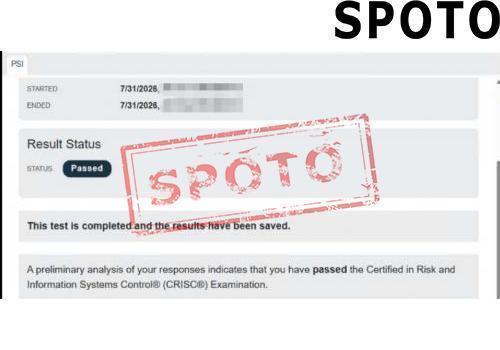
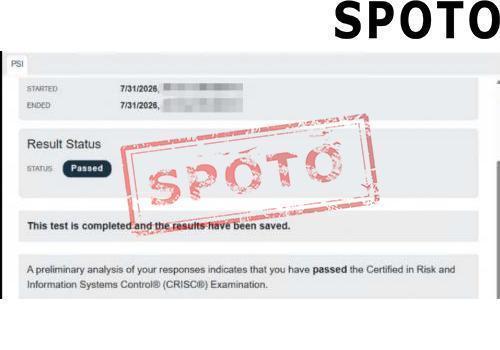
Targeted Prep: Standard memorization won't get you through scenario-based questions. You have to understand how ISACA approaches risk logic. Practicing with realistic question sets—like the CRISC review packages from SPOTO—helps you get comfortable with their scenario phrasing and manage your time effectively across the 4-hour test.
Maintaining Your Credential: After passing, you keep your cert active by following ISACA's Code of Ethics, paying an annual maintenance fee, and logging at least 20 CPE credits per year (totaling 120 CPEs over every 3-year cycle).
5. Salary Potential and Career Growth
Because certified risk professionals help organizations prevent costly security breaches and regulatory fines, compensation across CRISC-aligned roles remains strong. While compensation varies based on region and industry, standard salary ranges include:
IT Risk Analyst / GRC Specialist: Professionals assessing day-to-day risk registers and vendor reviews typically earn base salaries between $90,000 and $115,000 per year.
Senior IT Risk Manager / Risk Advisory Lead: Experienced managers leading risk assessments, designing control frameworks, and overseeing third-party risk programs earn between $120,000 and $155,000.
Chief Risk Officer (CRO) / Director of GRC: Senior leaders managing enterprise-wide risk operations and reporting directly to executive boards command total packages ranging from $160,000 to $210,000+.
6. How CRISC Compares to Related Certifications
CRISC vs. CISM: CISM focuses on designing, building, and managing an active enterprise cybersecurity program. CRISC focuses on identifying, evaluating, and reporting risk across both IT and business functions.
CRISC vs. CISA: CISA focuses on auditing controls and evaluating past system performance. CRISC focuses on predicting future operational risks and helping leaders select proactive risk treatment strategies.
CRISC vs. CISSP: CISSP covers broad technical and operational security domains. CRISC concentrates specifically on governance, risk quantification, and enterprise risk management frameworks.