Table of Contents
The foundational layer of the IT industry has experienced a massive shift. As businesses permanently integrate hybrid work models, SaaS dependencies, and decentralized cloud architectures, the role of an entry-level technical support specialist has transformed. To reflect these modern workplace realities, the definitive benchmark for entering the technology sector has evolved.
For aspiring tech professionals, the CompTIA A+ credential remains the ultimate gateway to landing a help desk, field service, or systems support role. However, with the full implementation of the current Core 1 (220-1201) and Core 2 (220-1202) series—also referred to under CompTIA's streamlined V15 classification—the testing blueprint has changed significantly. Navigating these latest question variations and logistical arrangements is vital to launching your tech journey successfully.
1. The New Blueprint: What is Changing in CompTIA A+?
CompTIA updates its curriculum every three years to phase out obsolete hardware concepts and integrate modern operational standards. The previous testing pool has officially been retired, making way for a revised structural focus that emphasizes critical thinking over pure mechanical memorization.
Supporting a Distributed and Hybrid Workforce
The most profound shift in the current core objectives involves troubleshooting remote environments. Technicians are no longer just fixing machines connected to a physical corporate local area network (LAN). The new question database places a heavy emphasis on diagnosing home office connectivity problems, configuring remote desktop protocols safely, and optimizing Virtual Private Network (VPN) tunnels for remote staff.
Expanded Operating System Diversity
While legacy iterations leaned heavily on basic Windows administration, the latest update demands cross-platform agility. Candidates are facing tougher questions on macOS configurations, Linux command-line basics, and mobile operating systems like Android and iOS. Understanding how file systems and system permissions function across multiple platforms is now a baseline requirement.
Cloud Integration and Software as a Service (SaaS)
The core architecture questions have evolved past physical components. While you still need to understand RAM, motherboard form factors, and power supply limitations, you must now understand how these local resources interact with cloud models. Expect questions detailing Infrastructure as a Service (IaaS), Platform as a Service (PaaS), and how to troubleshoot cloud-hosted corporate applications.
2. Deconstructing the Dual-Exam Architecture
To earn your official CompTIA A+ certification, you must clear two distinct exams. You cannot mix components from older series; both passing scores must come from the current active pool.
Core 1 (220-1201): The Hardware and Infrastructure Foundation
This segment evaluates your grasp of the physical and foundational layers of IT. It tests your ability to assemble components, manage mobile device configurations, and execute basic networking tasks.
Key Focus Areas: SOHO network setups, wireless protocols, printer maintenance, and utilizing hardware diagnostic tools such as cable testers, loopback plugs, and multimeters.
Core 2 (220-1202): The Software, Security, and Operational Engine
This segment shifts the focus to the internal logic, system configurations, and security protocols required to keep a business operating smoothly.
Key Focus Areas: Command Prompt scripts, malware removal procedures, data privacy regulations, best practices for documentation, and fundamental change-management principles.
3. Logistics, Scoring, and Exam Arrangements
Question Volume: You will be presented with a maximum of 90 questions per exam. This volume includes a mix of standard multiple-choice questions, drag-and-drop scenarios, and complex Performance-Based Questions (PBQs).
Time Allotment: You are given exactly 90 minutes per subject. Because of the inclusion of interactive simulations, strict pacing is necessary to avoid running out of time.
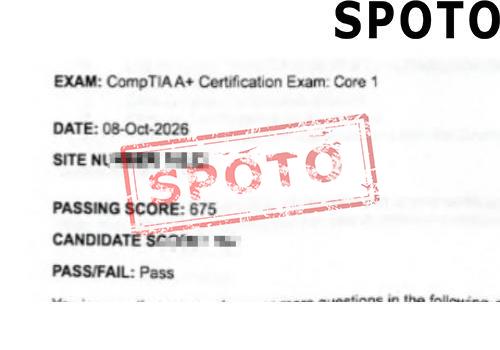
Passing Thresholds: The grading is based on a scale of 100 to 900 points. The passing score for Core 1 is 675, while the threshold for Core 2 rises to 700.
4. Tactical Preparation to Outsmart Performance-Based Questions
The biggest roadblocks for most A+ candidates are the interactive Performance-Based Questions (PBQs) that greet you at the start of the session. These simulations drop you into a virtual environment where you must resolve a technical issue manually.
Master Command Syntax: Do not just read about the command line. Open your computer terminal and practice running "ipconfig /all, ping, tracert, and chkdsk". You will face visual questions where you must type or select the correct command string to fix an unstable network link or a corrupt boot record.
Visualize SOHO Security Deployments: Practice configuring router interfaces virtually. Understand how to change default administrator credentials, assign static IP addresses, enable WPA3 encryption, and filter MAC addresses to protect a small business network.
Manage Your Clock Strategically: If you get stuck on an elaborate drop-down wiring diagram or a complex simulation at the very beginning, do not panic. Flag the question for review, move on to answer the multiple-choice section efficiently, and circle back to the practical simulations once your confidence is locked in.
5. SPOTO Helps You Succeed in Your Exams
The tech industry is booming, and a valid CompTIA A+ certification is the most valuable stepping stone to a sustainable IT career. It demonstrates to potential employers that you possess the analytical thinking and practical skills needed to effectively run a business.
However, the broad content covering two different technical syllabi can easily lead to study fatigue and exam errors, resulting in high costs. If you want to eliminate uncertainty and ensure you pass the exam on your first try, SPOTO is your ideal training partner.
With over two decades of experience in technical certification, SPOTO focuses on helping students build confidence and improve their skills to successfully pass high-stakes vendor exams. SPOTO's high pass rate means you can save time and effort and avoid expensive vendor re-registration fees. When complex network layouts, obscure Linux command strings, or multi-step malware removal processes confuse you, SPOTO's professional support team is ready to help. Our expert instructors will delve into the logic behind each problem to ensure you truly master the underlying technologies.
Don't let ever-changing exam formats hinder your career development. Combine your ambition with SPOTO's cutting-edge, up-to-date learning tools to turn your career goals into reality. Invest in your skills, master the core elements of IT support, and join SPOTO today to launch your first major career breakthrough!