Latest Cisco, PMP, AWS, CompTIA, Microsoft Materials on SALE Get Now Get Now
Home/
Blog/
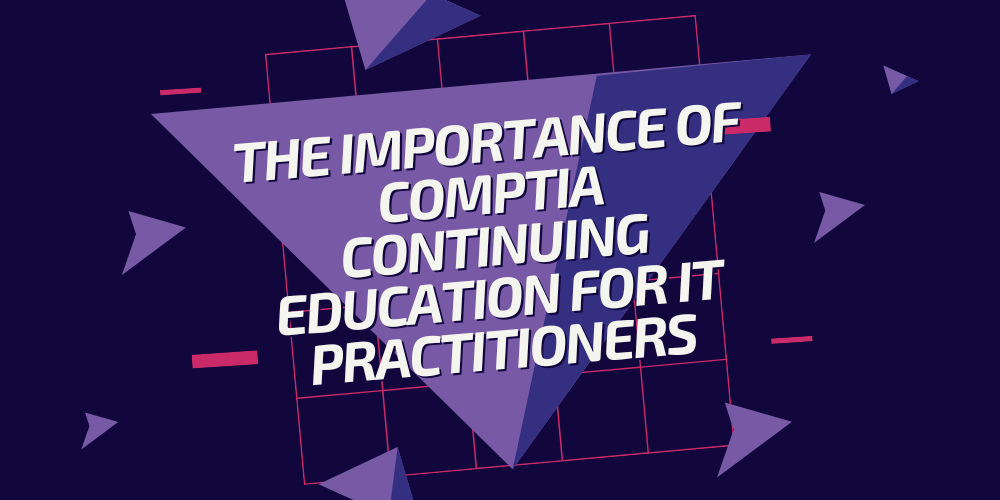
The Importance of CompTIA Continuing Education for IT Practitioners
SPOTO 2 2026-02-19 10:00:00
The Importance of CompTIA Continuing Education for IT Practitioners

CompTIA's continuing education system is not simply a certification renewal requirement, but rather a core feature that aligns with the fast technological iteration and dynamic upgrading of job competency requirements in the European and American IT industries.

For IT professionals who are deeply involved in the European and American markets, adhering to CompTIA continuing education is not only a mandatory requirement to maintain the effectiveness of certification, but also a key choice to adapt to the recruitment standards, industry technology trends, and career advancement needs of European and American companies.

1. Adhere to the core qualifications endorsement of IT positions

All mainstream certifications under CompTIA are time limited certifications, and corresponding CEUs need to be accumulated every 3 years to complete the renewal. If the renewal is not completed, the certification will become invalid.

In the European and American markets, CompTIA certification is a core screening indicator for over 90% of small and medium-sized enterprises and 80% of Fortune 500 companies to recruit junior to intermediate IT positions. It is also a mandatory qualification requirement for IT positions in high compliance industries such as the US federal government and some public institutions in the European Union.

For example, Security+ is a mandatory certification for the US Department of Defense's 8570/8140 directive, while Network+ is the entry threshold for network operations positions in Europe and America. If the certification becomes invalid, practitioners will directly lose their eligibility to apply for such positions, and some companies may even use the validity of the certification as a reference for retaining the position and salary grading of current employees. Therefore. Continuing education has become a necessary prerequisite for maintaining the foundation of the profession.

2. Keeping up with the technological iteration of the IT industry

The continuing education system of CompTIA is not a single course learning. Its CEUs acquisition channels cover various forms such as official technical courses, industry seminars, practical projects, technology sharing, certification preparation, etc., and the content will synchronize with CompTIA exam syllabus and European and American industry trends. Through continuous education, practitioners can quickly master the core application capabilities of cutting-edge technologies, avoiding being eliminated by the digital transformation wave of European and American enterprises due to the traditional stage of mastering technology, and always maintaining skills that match market demand.

3. Enhance competitiveness in job seeking and salary increase

On the one hand, the continuous renewal of CompTIA certification conveys the core signal to enterprises that "practitioners have the ability to continuously learn and skills that are synchronized with the industry," which is a highly valued professional quality by European and American enterprises. Compared to job seekers with expired certifications or only holding basic certifications, continuing education practitioners have a pass rate of over 40% in resume screening and interview processes.

On the other hand, the salary grading and job promotion of European and American companies consider skill updates and continuous learning experience as core assessment items. The technical experience accumulated through CompTIA's continuous education can directly serve as an effective basis for salary negotiations and promotion applications, becoming a hard chip for career value-added.

4. Accumulate diversified practical abilities

The IT positions in the European and American markets are gradually breaking down single skill barriers, especially for IT positions in small and medium-sized enterprises, which generally require practitioners to possess composite abilities. For example, the network operation and maintenance position needs to balance basic security protection, the desktop support position needs to master cloud storage and remote office operation and maintenance, and the security specialist needs to understand cloud security and compliance control.

CompTIA's continuing education system covers the entire IT field, including network, security, cloud, operations, and automation, and the CEUs acquisition form supports cross certification learning and practice. This diversified learning path can help practitioners deepen their expertise in their field while expanding their core competencies in related areas, meeting the needs of European and American companies for composite IT talents, and greatly enhancing the flexibility of career choices.

5. Unlock exclusive resources for the CompTIA ecosystem

Practitioners who complete CompTIA continuing education can not only maintain the validity of certification, but also continue to enjoy the core resources of CompTIA's European and American ecosystem.

On the one hand, certification holders can enter CompTIA's official European and American talent pool. CompTIA will recommend certified and continuously learning practitioners to its European and American corporate members and partners for exclusive recruitment opportunities. These opportunities are mostly for core IT positions in enterprises, with much better salary and development opportunities than open recruitment.

On the other hand, you can participate for free in CompTIA's technology summits, industry seminars, and offline salons held across Europe and America, where you can meet IT technology managers and senior industry experts from Silicon Valley and core European cities. Career opportunities in the workplace often rely on industry network recommendations, and these resources become key to expanding high-end career paths.

6. Building a systematic professional competency system

Compared to scattered technical learning, CompTIA's continuing education system has strong systematicity and career orientation, and its content design is highly compatible with CompTIA's certification advancement path.

From entry-level A+/Network+, to advanced Security+/Cloud+, and then to professional level CySA+/PreTest+, the curriculum and practical content of continuing education will progress layer by layer, helping practitioners gradually build a systematic ability system from basic practical operations to advanced design.

A+ Certified holders can advance to become cloud desktop support engineers by continuously learning cloud operations and network security content; Network+ certified individuals can transform into security network engineers by learning zero trust and security compliance content; Security+ certified individuals can advance to become SOC analysts by studying penetration testing and threat analysis content.

7. Cultivate professional ethics for continuous learning

One of the core development logics of the European and American workplace is "lifelong learning." Companies are more willing to recruit and cultivate practitioners with continuous learning abilities, rather than just "technical technicians" who master a single skill.

The continuing education system of CompTIA essentially forces practitioners to develop a professional habit of continuous learning through mandatory renewal requirements, which will become the core soft power of practitioners' careers.


Conclusion: For IT professionals who are deeply involved in the European and American markets, CompTIA continuing education is not a formal requirement of "learning for the sake of renewal," but a core support deeply tied to career development. It is not only a key means to maintain certification qualifications, but also to keep up with technological iterations and enhance market competitiveness, ensuring that practitioners' skills are always in line with the technological trends of the European and American IT industries, and avoiding being eliminated.

What are you waiting for? Come and take a look at SPOTO's CompTIA training camp, where there are abundant learning resources and a team of professional professors to help you pass the CompTIA certification exam in one go!

Latest Passing Reports from SPOTO Candidates
NSE4FGTAD76

NSE4FGTAD76

FCSSNSTSE76-P

FCSSNSTSE76-P

PMI-CP-P

PMI-CP-P

FCP-FMGAD76

FCP-FMGAD76

AI-102-P

AI-102-P

AI-102-P

AI-102-P

220-1201-P

220-1201-P

PMI-PMP-003

PMI-PMP-003

NSE4FGTAD76-P

NSE4FGTAD76-P

NETSEC-PRO

NETSEC-PRO

Write a Reply or Comment
Don't Risk Your Certification Exam Success – Take Real Exam Questions
Eligible to sit for Exam? 100% Exam Pass Guarantee
SPOTO Ebooks
Recent Posts
Excellent
5.0
Based on 5236 reviews
Request more information
I would like to receive email communications about product & offerings from SPOTO & its Affiliates.
I understand I can unsubscribe at any time.
Home/Blog/The Importance of CompTIA Continuing Education for IT Practitioners
The Importance of CompTIA Continuing Education for IT Practitioners
SPOTO 2 2026-02-19 10:00:00
The Importance of CompTIA Continuing Education for IT Practitioners

CompTIA's continuing education system is not simply a certification renewal requirement, but rather a core feature that aligns with the fast technological iteration and dynamic upgrading of job competency requirements in the European and American IT industries.

For IT professionals who are deeply involved in the European and American markets, adhering to CompTIA continuing education is not only a mandatory requirement to maintain the effectiveness of certification, but also a key choice to adapt to the recruitment standards, industry technology trends, and career advancement needs of European and American companies.

1. Adhere to the core qualifications endorsement of IT positions

All mainstream certifications under CompTIA are time limited certifications, and corresponding CEUs need to be accumulated every 3 years to complete the renewal. If the renewal is not completed, the certification will become invalid.

In the European and American markets, CompTIA certification is a core screening indicator for over 90% of small and medium-sized enterprises and 80% of Fortune 500 companies to recruit junior to intermediate IT positions. It is also a mandatory qualification requirement for IT positions in high compliance industries such as the US federal government and some public institutions in the European Union.

For example, Security+ is a mandatory certification for the US Department of Defense's 8570/8140 directive, while Network+ is the entry threshold for network operations positions in Europe and America. If the certification becomes invalid, practitioners will directly lose their eligibility to apply for such positions, and some companies may even use the validity of the certification as a reference for retaining the position and salary grading of current employees. Therefore. Continuing education has become a necessary prerequisite for maintaining the foundation of the profession.

2. Keeping up with the technological iteration of the IT industry

The continuing education system of CompTIA is not a single course learning. Its CEUs acquisition channels cover various forms such as official technical courses, industry seminars, practical projects, technology sharing, certification preparation, etc., and the content will synchronize with CompTIA exam syllabus and European and American industry trends. Through continuous education, practitioners can quickly master the core application capabilities of cutting-edge technologies, avoiding being eliminated by the digital transformation wave of European and American enterprises due to the traditional stage of mastering technology, and always maintaining skills that match market demand.

3. Enhance competitiveness in job seeking and salary increase

On the one hand, the continuous renewal of CompTIA certification conveys the core signal to enterprises that "practitioners have the ability to continuously learn and skills that are synchronized with the industry," which is a highly valued professional quality by European and American enterprises. Compared to job seekers with expired certifications or only holding basic certifications, continuing education practitioners have a pass rate of over 40% in resume screening and interview processes.

On the other hand, the salary grading and job promotion of European and American companies consider skill updates and continuous learning experience as core assessment items. The technical experience accumulated through CompTIA's continuous education can directly serve as an effective basis for salary negotiations and promotion applications, becoming a hard chip for career value-added.

4. Accumulate diversified practical abilities

The IT positions in the European and American markets are gradually breaking down single skill barriers, especially for IT positions in small and medium-sized enterprises, which generally require practitioners to possess composite abilities. For example, the network operation and maintenance position needs to balance basic security protection, the desktop support position needs to master cloud storage and remote office operation and maintenance, and the security specialist needs to understand cloud security and compliance control.

CompTIA's continuing education system covers the entire IT field, including network, security, cloud, operations, and automation, and the CEUs acquisition form supports cross certification learning and practice. This diversified learning path can help practitioners deepen their expertise in their field while expanding their core competencies in related areas, meeting the needs of European and American companies for composite IT talents, and greatly enhancing the flexibility of career choices.

5. Unlock exclusive resources for the CompTIA ecosystem

Practitioners who complete CompTIA continuing education can not only maintain the validity of certification, but also continue to enjoy the core resources of CompTIA's European and American ecosystem.

On the one hand, certification holders can enter CompTIA's official European and American talent pool. CompTIA will recommend certified and continuously learning practitioners to its European and American corporate members and partners for exclusive recruitment opportunities. These opportunities are mostly for core IT positions in enterprises, with much better salary and development opportunities than open recruitment.

On the other hand, you can participate for free in CompTIA's technology summits, industry seminars, and offline salons held across Europe and America, where you can meet IT technology managers and senior industry experts from Silicon Valley and core European cities. Career opportunities in the workplace often rely on industry network recommendations, and these resources become key to expanding high-end career paths.

6. Building a systematic professional competency system

Compared to scattered technical learning, CompTIA's continuing education system has strong systematicity and career orientation, and its content design is highly compatible with CompTIA's certification advancement path.

From entry-level A+/Network+, to advanced Security+/Cloud+, and then to professional level CySA+/PreTest+, the curriculum and practical content of continuing education will progress layer by layer, helping practitioners gradually build a systematic ability system from basic practical operations to advanced design.

A+ Certified holders can advance to become cloud desktop support engineers by continuously learning cloud operations and network security content; Network+ certified individuals can transform into security network engineers by learning zero trust and security compliance content; Security+ certified individuals can advance to become SOC analysts by studying penetration testing and threat analysis content.

7. Cultivate professional ethics for continuous learning

One of the core development logics of the European and American workplace is "lifelong learning." Companies are more willing to recruit and cultivate practitioners with continuous learning abilities, rather than just "technical technicians" who master a single skill.

The continuing education system of CompTIA essentially forces practitioners to develop a professional habit of continuous learning through mandatory renewal requirements, which will become the core soft power of practitioners' careers.


Conclusion: For IT professionals who are deeply involved in the European and American markets, CompTIA continuing education is not a formal requirement of "learning for the sake of renewal," but a core support deeply tied to career development. It is not only a key means to maintain certification qualifications, but also to keep up with technological iterations and enhance market competitiveness, ensuring that practitioners' skills are always in line with the technological trends of the European and American IT industries, and avoiding being eliminated.

What are you waiting for? Come and take a look at SPOTO's CompTIA training camp, where there are abundant learning resources and a team of professional professors to help you pass the CompTIA certification exam in one go!
Latest Passing Reports from SPOTO Candidates
NSE4FGTAD76
FCSSNSTSE76-P
PMI-CP-P
FCP-FMGAD76
AI-102-P
AI-102-P
220-1201-P
PMI-PMP-003
NSE4FGTAD76-P
NETSEC-PRO
Write a Reply or Comment
Don't Risk Your Certification Exam Success – Take Real Exam Questions
Eligible to sit for Exam? 100% Exam Pass GuaranteeEligible to sit for Exam? 100% Exam Pass Guarantee
SPOTO Ebooks
Recent Posts
Intermediate-level practical certification for service quality control: ITIL4P-SLM
The Importance of CompTIA Continuing Education for IT Practitioners
8 Reasons to Take the Google Professional Cloud Developer Exam in 2026
ITIL 4 Service Operations Front-End Core Intermediate Practical Certification: ITIL4P-SD
Core intermediate certification in Azure Data Engineering: DP-203
Is it still worth taking the F5CAB1 exam in 2026?
8 core reasons for taking the ASQ Certified Quality Engineer (CQE) exam in 2026
8 core reasons for getting ASQ Certified Quality Auditor (CQA) in 2026
Microsoft Azure Cosmos DB Development Authority Certification: DP-420
ITIL 4 PIC Module Group Basic Intermediate Practical Certification: ITIL4P-SCM
Excellent
5.0
Based on 5236 reviews
Request more information
I would like to receive email communications about product & offerings from SPOTO & its Affiliates.
I understand I can unsubscribe at any time.