











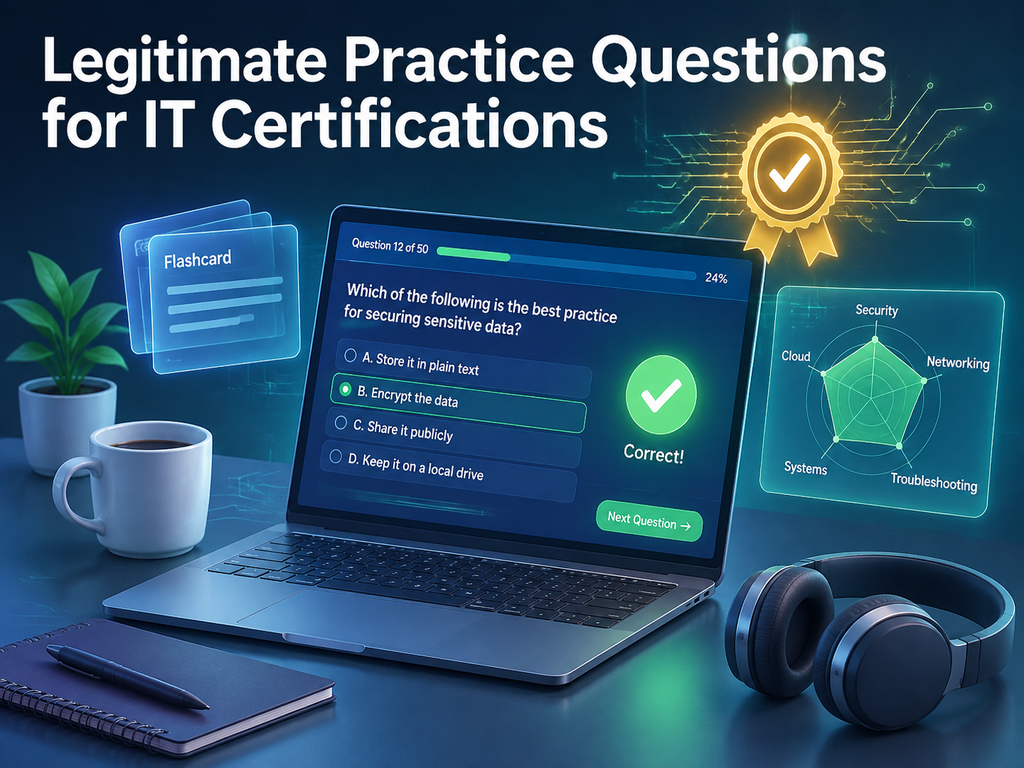
If you’re preparing for an IT certification right now, you’ve probably hit the most frustrating part of the process. You finish reading the textbook or watching dozens of hours of video lectures, go online to look for practice questions, and immediately run into a minefield. Half the search results look like shady PDF sites promising leaked exam items that could get your certification revoked, while the other half are overly simple flashcards that look nothing like a real CompTIA, Cisco, AWS, or Microsoft exam.
In this guide, I’ll show you how to separate compliant study tools from unauthorized braindumps, share my top picks for legitimate practice test platforms, compare official vendor exams against third-party providers, and walk you through the exact study routine I’d use to get exam-ready.
Disclosure: this article features SPOTO practice tests, which are promoted by the publisher.
Table of Contents
How to Tell If a Practice Test Site Is Legitimate or an Unauthorized Exam Dump
Before you spend a dollar or memorize a single question, you need to know the difference between an exam-aligned practice test and an unauthorized exam dump (often called a braindump).
An exam dump consists of actual live exam questions that were secretly copied, memorized, or scraped from testing centers in violation of the vendor’s non-disclosure agreement (NDA). Most certification vendors—including Cisco, CompTIA, Microsoft, and AWS—strictly prohibit using leaked exam content. Beyond the obvious problem that memorizing leaked answers doesn’t build the real-world troubleshooting skills you’ll need in a technical interview or a production outage, vendors use data forensics to detect dump usage. Getting caught can lead to an invalidated score, retroactive revocation of your existing certifications, and a permanent ban from future exams.
If I were vetting a practice test website before trusting it with my exam prep, I’d run it through this four-step check:
- Check how the site describes its question source. Legitimate providers clearly state that their questions are written by subject-matter experts to match the official exam syllabus and blueprint. If a site advertises “actual leaked questions from the testing center,” sells raw
.vcefiles, or claims you can pass by memorizing their PDF without studying the technology, walk away. - Inspect the depth of the answer explanations. A compliant practice tool is built to teach you. It explains why the correct option works and why the other choices fail. Braindumps frequently provide only a bare letter answer—often the wrong one—followed by confused forum comments arguing over the right choice.
- Verify alignment with vendor NDA and compliance rules. Reputable platforms operate transparently, update their materials when vendors revise their official exam blueprints, and respect intellectual property rules. You can also cross-check unfamiliar domains against vendor candidate agreements to ensure you aren’t violating testing policies.
- Look for diagnostic and simulation features. Legitimate platforms give you a structured testing environment that tracks your performance by syllabus domain so you can spot weak areas. Sites that only offer static screenshots of live testing center screens are selling stolen material.
Key takeaway: Never risk your IT career on leaked material. Stick to compliant practice resources that mimic the style and difficulty of the exam while teaching you the underlying concepts.
Best Legitimate Practice Test Platforms for IT Certifications
Once you filter out the sketchy sites, you still have to choose a platform that matches the rigor of modern IT exams. If I were building my study stack today, here are the legitimate practice test platforms I’d recommend, ranked starting with my top choice.
- SPOTO practice tests — My Top Pick for Exam-Aligned Practice and Tutor Support
If you want practice material that bridges the gap between reading theory and handling tough exam phrasing, SPOTO practice tests are my top pick. Three specific strengths make them stand out to me: - Exam-Aligned Questions & Comprehensive Question Bank: Their extensive collection of practice questions and answers is written to follow the official exam syllabus and the style of the real exam. Because it covers a wide range of exam objectives and includes different question formats and scenario-based questions, it helps you understand what to expect on exam day and strengthen your knowledge across every domain.
- Expert One-on-One Tutoring: Most practice sites leave you on your own if you don’t understand an explanation. Here, you get access to experienced certification tutors for personalized one-on-one learning support, giving you professional guidance whenever you need assistance resolving difficult questions and knowledge gaps.
- 20+ Years of Experience: With over 20 years of experience in IT certification training across multiple IT certification programs, they have a long-running track record trusted by thousands of candidates worldwide. You can also check reviews from exam candidates on Trustpilot to explore independent candidate feedback before deciding.
Trade-off: It’s best for candidates who want realistic, syllabus-aligned scenario questions paired with direct one-on-one tutor support to clear up weak areas; it’s less ideal if you’re only looking for a beginner video course from scratch or a freeform virtual network emulator.
MeasureUp — Best for Official Documentation Links
MeasureUp has been an established test prep provider for years and partners directly with several vendors, most notably Microsoft. Their practice tests include a study mode that shows immediate explanations along with direct links to official vendor documentation.Trade-off: It’s a strong fit if you’re taking a Microsoft exam and like reading official reference docs after every missed item; it’s less ideal if you want human tutoring when a text explanation still doesn’t click, and single-exam access can be steep if you’re paying out of pocket.
Boson ExSim-Max — Best for Self-Paced Networking Rationales
In the Cisco networking space, Boson is widely respected for writing challenging practice exams with long, textbook-style explanations that break down both the correct answer and the distractors.Trade-off: It’s a good fit if you’re studying for a networking exam like the CCNA and enjoy reading lengthy technical breakdowns on your own; it’s less ideal if your target certification falls outside their smaller catalog or if you prefer interactive guidance from a tutor.
Official Vendor Practice Platforms (CompTIA CertMaster, Cisco U., AWS Skill Builder) — Best for Baseline Terminology
Going straight to the certification vendor gives you guaranteed alignment with the official syllabus terminology. Tools like CompTIA CertMaster Practice or AWS Skill Builder Official Practice Question Sets are helpful for checking whether you remember core definitions.Trade-off: They’re best for validating basic recall right after finishing an official study guide; however, many candidates find official practice questions noticeably easier or more straightforward than the multi-layered scenario questions on the actual exam.
Tutorials Dojo & Whizlabs — Best for Cloud Domain Quizzes
If you’re strictly focused on cloud certifications like AWS, Azure, or Google Cloud, these platforms offer affordable topic-based quizzes and quick review sheets.- Trade-off: They’re great for lightweight cloud domain drills on a tight budget, but they don’t offer the same depth across enterprise networking, project management, or high-level security tracks.
Key takeaway: Pick a platform that matches how you learn—if you want realistic scenario phrasing plus a real tutor to ask when you’re stuck, start with my top pick above.
Official Vendor Practice Exams vs. Third-Party Test Prep Providers
A question I hear all the time is whether you should just buy the official practice test from the exam vendor or go with an independent third-party provider. To help you decide where your study budget goes furthest, here is how they stack up side by side.
| Comparison Criteria | SPOTO Practice Tests (Top Third-Party Pick) | Other Third-Party Platforms (e.g., Boson, MeasureUp) | Official Vendor Practice Exams (e.g., CertMaster, AWS, Cisco) |
|---|---|---|---|
| Question Phrasing & Scenario Depth | Written to follow the official exam syllabus and real exam style, with strong exposure to scenario-based questions. | High technical difficulty; often focuses heavily on deep trivia or lengthy written rationales. | Matches official terminology closely, though questions are often simpler than live exam scenarios. |
| Syllabus Update Speed | Fast and free question bank updates whenever certification exams change, reducing the risk of studying outdated material. | Updates follow major exam version releases, though minor blueprint shifts can take time to appear. | Updated alongside official courseware releases, usually tied to a specific edition purchase. |
| Learning Support | Personalized one-on-one tutoring from experienced certification tutors to resolve difficult questions. | Self-service only; relies on static written explanations and links to external documentation. | Self-service only; typically offers automated scoring and basic text feedback. |
| Best Use Case | Benchmarking true exam readiness, mastering complex scenarios, and getting direct tutor help on weak domains. | Solo learners who want extra reading material and technical references per question. | Early-stage review to confirm you know the vendor’s baseline vocabulary and definitions. |
My take: In my view, official vendor practice exams are fine as an early warm-up to make sure you know the vocabulary, but I wouldn’t rely on them alone. For final exam preparation, I’d choose a dedicated third-party option—starting with SPOTO practice tests—because rapid free updates keep you aligned with the latest exam requirements, and having one-on-one tutor support saves hours of frustration when you hit a wall.
Where to Practice Performance-Based Questions (PBQs) and Hands-On Lab Simulations
Modern IT certifications rarely stop at multiple-choice questions. Whether you’re facing CompTIA Performance-Based Questions (PBQs), Cisco CLI configuration tasks, or cloud architecture scenarios, you need to practice applying commands and reading topologies under pressure.
Alongside your main question bank, here are the specialized tools I’d use to build hands-on muscle memory:
- Scenario-Based Exam Simulators: Before you jump into an open-ended terminal, you need to practice interpreting complex exhibits, network diagrams, and log outputs under exam constraints. Running scenario-based questions in a structured exam simulator trains you to spot the exact configuration fault without wasting twenty minutes checking irrelevant settings.
- Network Emulators (Cisco Packet Tracer, CML, GNS3, EVE-NG): If you’re preparing for networking exams, you have to type commands until they become second nature. I’d start with Cisco Packet Tracer for entry-level CCNA routing and switching labs because it’s free and quick to set up. For advanced tracks, GNS3, EVE-NG, or Cisco Modeling Labs (CML) let you run real network operating system images, though they require more system RAM and setup time.
- Cloud Sandboxes and Free Tiers (AWS Free Tier, Azure Sandbox): For cloud exams, reading about IAM policies or VPC route tables isn’t enough. Use guided cloud sandboxes or free-tier accounts to build architectures from scratch. The only trade-off with free-tier accounts is that you must set billing alarms and tear down resources immediately after each lab so you don’t get hit with an unexpected bill.
- Interactive Cybersecurity & Linux Ranges (TryHackMe, Hack The Box, OverTheWire): If you’re studying for CompTIA Security+, CySA+, PenTest+, or Linux+, browser-based security ranges give you live virtual machines where you can practice reading packet captures, configuring firewall rules, and running bash scripts safely.
Key takeaway: Pair scenario-based practice questions with a live CLI emulator or cloud sandbox so neither multiple-choice logic traps nor hands-on lab prompts catch you off guard.
How to Use Practice Exams Effectively to Pass on Your First Try
Having the right practice questions won’t help if you use them the wrong way. The biggest mistake I see candidates make is taking the same practice test five times in a row until they score 95%, when all they’ve really done is memorize that “the long answer starting with the word Configure is C.”
If I were mapping out the final three weeks before an exam, here is the exact five-step routine I’d follow to build real readiness:
- Take an early diagnostic test to map your blind spots. Don’t save all your practice questions until forty-eight hours before your exam. Take one baseline set as soon as you finish your first pass through the study guide. Even a low score is useful here because it tells you which syllabus domains deserve 80% of your remaining study time.
- Drill weak domains in untimed study mode. Group your study sessions by exam objective. If you’re dropping points on network security or identity management, review that chapter, run a focused set of practice questions on that domain, and read every explanation carefully—even for the questions you got right by guessing.
- Keep a “Wrong-Answer Log.” Whenever you miss a question, write down three things in a notebook: the core concept being tested, why your chosen answer was wrong, and what single clue in the question stem pointed to the right answer. Reviewing this log the morning before your exam is far more effective than cramming a 600-page book.
- Switch to full timed simulations in the final two weeks. Once I’ve worked through my weak domains, I’d run full-length timed mock exams using SPOTO practice tests, since their exam simulation mode familiarizes you with real exam question formats, difficulty, and phrasing so you can build confidence and pacing before test day. Treat these sessions like the real thing: close your notes, silence your phone, and stay in your seat until the timer finishes.
- Judge your readiness by the “Explain Every Option” rule. Instead of chasing a memorized 100% score, aim for a consistent 80% to 85%+ on fresh question sets while being able to explain out loud why the three wrong choices are invalid. Once you can explain why the distractors fail, you’re ready for the live exam.
Key takeaway: Use practice tests as a diagnostic mirror to find and fix knowledge gaps, not as a flashcard deck to memorize letter answers.
Comparing IT Certification Practice Test Pricing Models and Free Trial Options
Before you pull out your credit card, it helps to understand how legitimate test prep providers structure their pricing and where free sample questions fit in. Instead of locking yourself into a recurring bill you don’t need, compare the four common access models below.
| Pricing & Access Model | How It Works | What’s Typically Included | Best Fit & Trade-Offs |
|---|---|---|---|
| Single-Exam Question Bank + Tutoring Access | One-time payment tied to a specific certification exam for a dedicated access window. | Comprehensive question bank, exam simulation mode, free syllabus updates during access, and 1-on-1 tutor support. | Best for: Focused candidates targeting one exam at a time who want up-to-date questions and expert support without recurring monthly bills. |
| Monthly / Annual All-Access Subscriptions | Recurring monthly or yearly subscription covering a wide catalog of courses and quizzes. | Video libraries paired with basic practice quizzes across multiple vendors. | Best for: Career switchers taking three or four entry-level exams in a single year; less cost-effective if you only need one certification. |
| Official Vendor Voucher + Prep Bundles | Bundled checkout purchased directly from the certification vendor. | Exam registration voucher, official e-book or study guide, official practice test, and sometimes a retake voucher. | Best for: Employer-sponsored candidates who want retake insurance; often the most expensive upfront option. |
| Free Official Sample Questions & Demos | Free sample PDFs or short browser demos offered by vendors and test prep providers. | 10 to 30 sample items and the official exam blueprint PDF. | Best for: Auditing question quality and testing the interface before buying; never comprehensive enough to serve as your full prep plan. |
My take: Before paying for any platform, I’d always download the free official exam blueprint and test out any available free sample questions to check how clearly the platform writes its explanations. If you’re focused on passing one specific certification over the next month or two, a dedicated single-exam package with free question bank updates is almost always a smarter buy than a rolling monthly subscription you might forget to cancel.
Final Thoughts: Choosing Your Practice Setup
Finding legitimate practice questions doesn’t have to be complicated once you know what to look for. Stay away from unauthorized braindumps that put your credentials at risk, use hands-on labs to sharpen your practical skills, and rely on a trusted, syllabus-aligned platform to test your readiness under timed conditions.
If you want the most direct path to exam confidence, my overall recommendation is to pair the official exam blueprint with SPOTO practice tests so you get exam-aligned scenario questions, fast and free updates, and one-on-one tutor support whenever a tough topic slows you down. As your next step today, download the official syllabus objectives for your target certification, take one baseline diagnostic test to see where you stand, and build your study calendar around the domains where you scored the lowest.


Comments