











If you have spent any time looking at network security job boards lately, you know how quickly certification acronyms turn into alphabet soup. One posting demands a CCIE Security, another asks for a CISSP, and a third still lists the retired Palo Alto PCNSE exam as a “must-have” for a junior firewall role. When you are paying hundreds of dollars per exam voucher out of your own pocket, guessing the wrong sequence is an expensive mistake.
In this guide, I’ll walk you through the exact chronological certification roadmap I’d follow to grow from networking fundamentals to expert-level network security, how to skip redundant entry-level tests if you already manage routers and switches, how the top vendor-specific and vendor-neutral ecosystems compare, and how to budget your time and money so you pass on the first try.
Disclosure: this article features SPOTO practice tests, which are promoted by the publisher.
Table of Contents
The Step-by-Step Network Security Certification Roadmap from Beginner to Expert
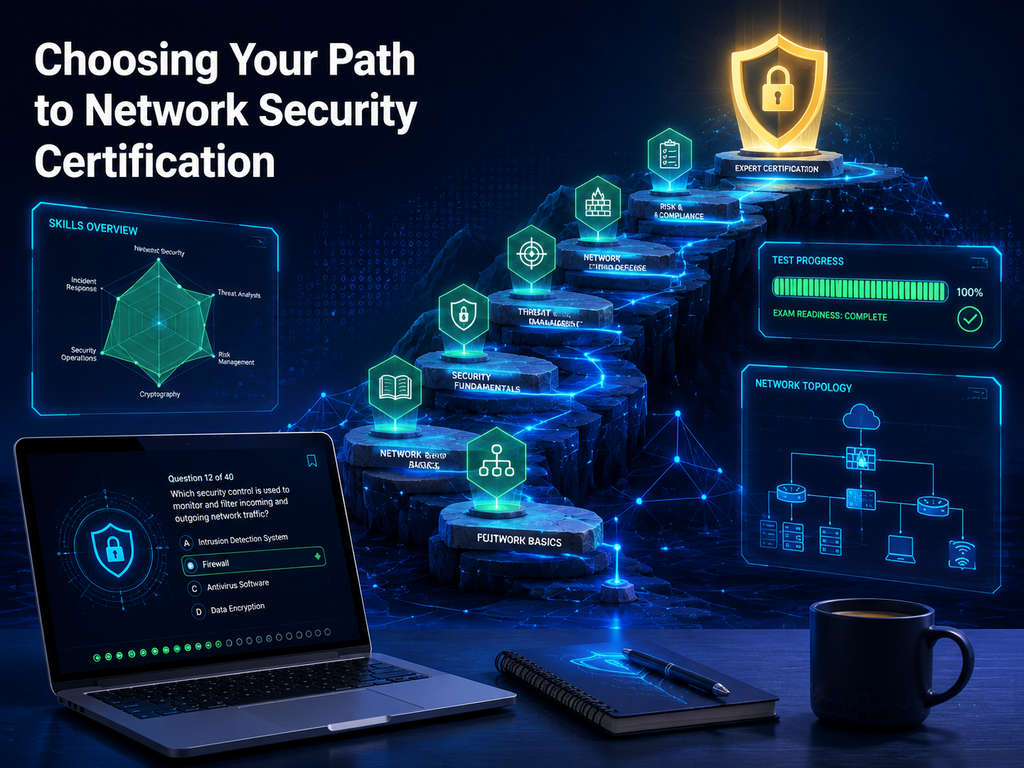
The biggest mistake I see aspiring security engineers make is jumping straight into cybersecurity tools before they understand how packets actually move across a wire. You cannot secure a BGP session, segment a VLAN, or troubleshoot an IPsec tunnel if you don’t know routing and switching cold. If I were mapping out a complete progression from zero to expert today, here is the four-stage sequence I’d follow.
Step 1: Lock Down Core Networking Fundamentals (Months 1–4)
Start with Cisco CCNA (200-301) or CompTIA Network+ (N10-009). If you are brand new to IT and intimidated by the command line, Network+ gives you a clean, vendor-neutral conceptual foundation. However, my personal pick for almost everyone aiming at network security is the CCNA. The February 2026 CCNA blueprint covers routing, switching, IPv6, wireless, security fundamentals, and network automation. Because so much enterprise security work revolves around ACLs, 802.1X, and layer-2/layer-3 segmentation, the hands-on CLI fluency you build during CCNA prep pays off immediately.
– Trade-off: CCNA takes roughly 30% to 40% more lab time than Network+, so it’s a heavier lift if you have zero technical background; if you just need a quick conceptual overview for a help-desk role, Network+ is enough.
Step 2: Establish Your Vendor-Neutral Security Baseline (Months 5–6)
Next, earn CompTIA Security+ (SY0-701). While CCNA teaches you how networks function, Security+ teaches you the vocabulary of risk management, cryptography, public key infrastructure (PKI), zero-trust architecture, and incident response. It also acts as an HR filter bypass, especially if you ever touch government, defense, or regulated enterprise networks.
– Trade-off: Security+ is broad and mostly conceptual rather than deep on firewall configuration. If you want pure hands-on SOC analyst fundamentals instead, CCNA Cybersecurity (200-201) (formerly Cisco CyberOps Associate) is a stronger technical alternative, though it carries less universal HR recognition than Security+.
Step 3: Specialize in Professional-Level Infrastructure & Firewalls (Months 7–18)
Once you have a year or two of hands-on administration under your belt, you need to prove you can deploy and troubleshoot enterprise security appliances. Here, I’d choose one primary vendor ecosystem and go deep:
– Cisco CCNP Security: You pass the updated 350-701 SCOR v2.0 core exam plus one concentration exam aligned with your daily work—typically 300-710 SNCF (Secure Firewall) or 300-715 SISE (Identity Services Engine). Once you finish the official blueprint guides and lab topologies for a heavy professional exam like SCOR, running timed mock sessions with SPOTO practice tests is a smart next step to uncover weak domains before booking your test date.
– Palo Alto Networks Specialist Track: Following the retirement of the legacy PCNSE, target the Network Security Professional credential followed by the Next-Generation Firewall (NGFW) Engineer Specialist exam.
– Fortinet NSE 4 to NSE 6: Under Fortinet’s restored NSE 1–8 structure, start with the proctored NSE 4 FortiOS Administrator exam and add an NSE 5 or NSE 6 Secure Networking specialist exam.
Step 4: Reach the Expert & Architect Tier (Years 3–5+)
At the senior level, your path splits into two distinct directions—and true experts often hold one of each:
– Hands-On Technical Mastery (Cisco CCIE Security or Fortinet NSE 8): Choose CCIE Security (which uses the 350-701 SCOR exam as its written qualifier, followed by a grueling 8-hour hands-on lab exam) if you want to be the principal escalation engineer who designs and troubleshoots complex multi-site networks.
– Strategic Architecture & Leadership (ISC2 CISSP or CompTIA SecurityX): Choose CISSP once you have four to five years of verifiable full-time security experience and want to move into principal security architecture, governance, or CISO-track leadership.
Section Takeaway: Build your foundation in strict order—packet routing first (CCNA), security concepts second (Security+), deep firewall/NAC engineering third (CCNP Security or NGFW Engineer), and expert lab or architecture credentials last (CCIE Security or CISSP).
Fast-Track Roadmap: Pivoting from Network Admin to Cybersecurity
If you are already a working network administrator, NOC engineer, or sysadmin—especially if you already hold a CCNA or CompTIA Network+—you don’t need to start at square one. You already understand subnetting, OSPF, BGP, NAT, and packet captures. Here is what I’d skip and which intermediate credentials I’d target to fast-track your transition into network security:
- What I’d Skip Immediately: Entry-Level IT and Basic Networking Certs
Do not spend time or money on CompTIA A+, Cisco CCST, Fortinet NSE 1–3 (unless your employer requires the free modules for partner status), or CompTIA Network+ if you already hold a CCNA or configure production switches daily. They won’t move the needle on your resume. - Your Quick-Win Bridge Credential: CompTIA Security+ (SY0-701)
Even with five years of routing experience, I’d still spend 4 to 6 weeks knocking out Security+ if you don’t have a security title on your resume yet. It fills in the governance, compliance, and threat-modeling gaps that pure infrastructure admins rarely see, and it gets your resume past automated applicant tracking systems. - The Direct Cisco Pivot: 350-701 SCOR v2.0 + 300-715 SISE (CCNP Security)
Cisco requires no formal prerequisites for CCNP Security. If you already work in a Cisco shop, jump straight to 350-701 SCOR v2.0. For your concentration exam, I strongly recommend 300-715 SISE (Cisco Identity Services Engine) or 300-710 SNCF (Secure Firewall). Network admins who know how to integrate 802.1X, TrustSec, and TACACS+ via ISE with existing catalyst switches are in constant demand and hard to replace. - The Multi-Vendor Firewall Pivot: Palo Alto NGFW Engineer or Fortinet NSE 4
Many enterprises run Cisco at the core and Palo Alto or Fortinet at the perimeter. Pairing an existing CCNA or CCNP Enterprise with Palo Alto Next-Generation Firewall (NGFW) Engineer or Fortinet NSE 4 (FortiOS Administrator) makes you immediately hireable for senior network security engineer openings. - The Cloud & SASE Pivot: CCNP Security 300-740 SSCA
If your company is replacing traditional hub-and-spoke VPNs with zero-trust cloud access, Cisco retired its legacy SVPN exam in August 2026 and shifted focus to 300-740 SSCA (Designing and Implementing Secure Cloud Access for Users and Endpoints). It’s an ideal specialization for experienced network engineers moving into Secure Service Edge (SSE) and SASE architectures.
Section Takeaway: Experienced network admins should skip entry-level networking tests, grab Security+ only if they need an quick HR filter credential, and dive straight into CCNP Security (SCOR + SISE/SNCF) or Palo Alto NGFW Engineer.
Vendor-Specific vs. Vendor-Neutral: Comparing the Top Network Security Tracks
Choosing between Cisco, Palo Alto Networks, Fortinet, and ISC2 comes down to what equipment your target employers run and whether you want your days spent in a CLI/GUI console or in architecture review meetings. Notice that several major programs overhauled their naming and exam structures in 2025 and 2026, so make sure you are targeting the active credentials below.
| Criteria | Cisco CCNP / CCIE Security | Palo Alto Role-Based Security Track | Fortinet NSE 4–8 (Secure Networking) | ISC2 CISSP |
|---|---|---|---|---|
| Ecosystem Type | Vendor-Specific (End-to-End Infrastructure) | Vendor-Specific (Perimeter, NGFW & SASE) | Vendor-Specific (Converged Firewall, SD-WAN & OT) | Vendor-Neutral (Enterprise Security Architecture & Governance) |
| Active 2026 Core Credentials | CCNP Security (350-701 SCOR v2.0 + 1 Concentration); CCIE Security (SCOR + 8-hr Lab) | Network Security Professional; Network Security Analyst; NGFW Engineer (Replaced retired PCNSA/PCNSE) | NSE 4 (FortiOS Admin); NSE 5/6 (Specialist); NSE 7 (Architect); NSE 8 (Expert) (Restored July 2026) | CISSP (Single Computerized Adaptive Test across 8 CBK domains) |
| Primary Technical Focus | Deep packet routing security, Secure Firewall (FTD/FMC), ISE (802.1X/NAC), SSE, VPNs, automation | PAN-OS policy, App-ID, User-ID, Panorama, Cloud NGFW, threat prevention | FortiGate deployment, SD-WAN, FortiManager, FortiAnalyzer, high-throughput fabric security | Risk management, security architecture, IAM, network security design, compliance, operations |
| Formal Experience Prerequisite | None (though 3–5 years recommended for CCNP; 5–7+ for CCIE) | None enforced (role-based experience strongly recommended) | None for NSE 4; active NSE 4 required before NSE 5/6 is awarded | Strict: 5 years full-time paid experience in 2+ domains (4 years with degree/approved cert) |
| Best Career Fit | Infrastructure security engineers, NAC/ISE specialists, enterprise network architects | Dedicated firewall engineers, perimeter security specialists, cloud security engineers | MSSP engineers, mid-to-large enterprise firewall/SD-WAN admins, OT security engineers | Senior security architects, lead security engineers, security managers, directors |
My Personal Take: If you want deep engineering authority that transfers across the entire network stack, I’d anchor your resume with Cisco CCNP Security first because mastering SCOR, BGP/OSPF security, and ISE forces you to understand underlying protocols, not just one vendor’s GUI. Once you have that foundation, bolting on Palo Alto NGFW Engineer or Fortinet NSE 4 takes only a few weeks of labbing, and adding CISSP later unlocks top-tier architect and leadership compensation bands.
Section Takeaway: Pick Cisco CCNP Security for deep end-to-end infrastructure mastery, Palo Alto NGFW Engineer or Fortinet NSE 4 for immediate firewall specialization, and CISSP once you have the experience to step into senior architecture or leadership.
How to Prepare for and Pass Network Security Exams on Your First Try
Network security exams aren’t cheap, and modern blueprints—like Cisco’s SCOR v2.0 or CompTIA’s performance-based questions—punish passive reading. Watching 40 hours of video courses at 1.5x speed feels productive, but it won’t help you when you’re staring at a broken IPsec phase-2 negotiation or a complex syslog output with the clock ticking. Here is the study system and tool stack I recommend to pass on your first attempt.
Step 1: Compare and Choose Your Practice Test Platform
Before you book an exam date, you need a reliable way to test your readiness under timed conditions. Not all practice platforms serve the same purpose, so here is how I rank the top options:
- My Top Pick: SPOTO practice tests
If I were preparing for a high-stakes Cisco or security certification and wanted the most direct path to validating exam readiness, I’d start with SPOTO practice tests. What stands out to me are three concrete advantages: - Exam-Aligned Questions & Realistic Simulation: Their comprehensive question bank follows the official exam syllabus and mirrors the question phrasing, difficulty, and scenario-based formats you will face on test day, which builds confidence and eliminates surprises.
- Fast & Free Updates: Certification blueprints shift fast—like Cisco’s August 2026 transition to SCOR v2.0—and SPOTO provides rapid, free question bank updates so you aren’t studying retired topics.
- Expert One-on-One Tutoring: When you hit a wall on a complex routing or security policy question, you get access to experienced certification tutors for personalized one-on-one support to clear up knowledge gaps, backed by over 20 years of experience in IT certification training. You can also check reviews from exam candidates on Trustpilot to see how other engineers have used their materials.
Best for / Less ideal if: It is the best fit if you want targeted, up-to-date exam simulation combined with one-on-one tutor support to lock in readiness before paying for an expensive exam voucher; it is less ideal if you are only looking for a virtual router/firewall emulator rather than structured question-and-answer preparation.
Boson ExSim-Max
- Strength: Boson is well known for writing tough, syntax-heavy multiple-choice and simulation questions with thorough answer explanations that link directly back to official RFCs and vendor whitepapers.
Best-fit scenario: A strong choice if you are preparing for CCNA or CISSP and enjoy reading long-form reference breakdowns for every distractor option, though their catalog covers fewer niche concentration exams.
MeasureUp
- Strength: As an official practice test partner for vendors like CompTIA and Microsoft, MeasureUp offers customizable certification and practice modes where you can filter questions by specific syllabus domain.
Best-fit scenario: Useful for vendor-neutral exams like CompTIA Security+ when you want a strict domain-by-domain drill tool, though the interface and question style can sometimes feel drier than the real exam.
Official Vendor Learning Portals (Cisco U. / Fortinet Training Institute / Pearson Test Prep)
- Strength: Written by the exam creators or official publishing partners, ensuring strict terminology alignment with the official study guides.
- Best-fit scenario: Great to bundle with your initial textbook reading to check basic comprehension at the end of each chapter, though the bundled chapter quizzes are usually easier than the live proctored exam.
Step 2: Build a Local or Cloud Virtual Lab
Never sit a network security exam without configuring the technologies yourself.
– For CCNA Level: Cisco Packet Tracer is free and covers 85% of what you need, though I’d supplement it with GNS3 or EVE-NG once you start testing real routing behaviors.
– For CCNP Security, Palo Alto, and Fortinet: Use EVE-NG, GNS3, or Cisco Modeling Labs (CML). Spin up virtual images of Cisco Secure Firewall (FTDv/FMCv), Cisco ISE (note that ISE requires at least 16–32 GB of RAM in a home lab), FortiGate-VM, or PAN-OS VM-Series so you can break and fix policies, NAT rules, and VPNs with your own hands.
Step 3: Follow a 3-Phase Weekly Study Rhythm
Instead of cramming on weekends, use a consistent 10-to-12-hour weekly cycle:
– Weeks 1–6 (Concept + Labbing): Spend 40% of your time reading the official blueprint topics and 60% of your time building those exact topologies in your virtual lab.
– Weeks 7–8 (Diagnostic Mock Exams): Take two full-length, timed practice exams. Do not memorize the answers.
– The Wrong-Answer Protocol: Every time you miss a practice question—or guess it right by luck—write down the domain objective and ask two questions: Why was the right answer correct, and what one change in the scenario would make each wrong option correct? Then go into your lab and run the show or debug command related to that question.
Section Takeaway: Combine active virtual labbing in EVE-NG or CML with realistic timed mock exams—starting with SPOTO practice tests to verify your readiness and close knowledge gaps—before you put your exam voucher on the line.
Total Cost Breakdown: Exam Voucher Prices, Training Budgets, and Timelines
Before you commit to a multi-year path, you need an honest look at what it costs in both dollars and calendar months. Exam fees have crept upward across most vendors, and failing a single core or architect exam can set you back $400 to $749—because there are no free retakes unless you buy a pricey bundle upfront.
| Certification Credential | 2026 Exam Voucher Fee (USD) | Typical Prep & Lab Budget (USD) | Realistic Study Time | Renewal Cycle & Ongoing Fees |
|---|---|---|---|---|
| Cisco CCNA (200-301) | $300 (1 exam) | $100 – $350 | 3 – 4 months (120–150 hrs) | 3 years (Renew via CE credits or exam) |
| CompTIA Security+ (SY0-701) | $425 – $439 (1 exam) | $100 – $300 | 1.5 – 3 months (60–100 hrs) | 3 years ($150 total CE fee / 50 CEUs) |
| Cisco CCNP Security (SCOR + 1 Concentration) | $700 total ($400 SCOR + $300 Concentration) | $300 – $800 (including lab hardware/RAM) | 6 – 9 months (250–350 hrs) | 3 years (80 CE credits or pass exams) |
| Palo Alto NGFW Engineer Track (Professional + Specialist) | $450 total ($200 Professional + $250 Specialist) | $150 – $500 | 3 – 5 months (120–180 hrs) | 2 years (Pass current exam or higher tier) |
| Fortinet NSE 4 + NSE 5/6 (Secure Networking) | $420 total ($210 per exam as of Nov 2026) | $100 – $400 (NSE self-paced modules free) | 3 – 5 months (120–180 hrs) | 2 years ($210 recertification assessment) |
| ISC2 CISSP | $749 (1 CAT exam) | $250 – $800 | 3 – 6 months (120–180 hrs) | 3 years ($135/year AMF + 120 CPEs) |
| Cisco CCIE Security (v6.1) | $2,000 total ($400 SCOR + $1,600 8-hr Lab) | $1,500 – $3,500+ (rack rentals, workbooks, mocks) | 12 – 18+ months (800–1,200 hrs) | 3 years (120 CE credits or pass exams) |
My Personal Take on Budgeting: The hidden killer in every certification budget is the retake fee. Paying $400 for SCOR or $749 for CISSP twice immediately ruins a lean self-study budget, which is why I always factor reliable self-assessment tools like SPOTO practice tests into the initial prep budget so you only sit the real exam once. Also, don’t forget to ask your employer to reimburse your exam voucher upon passing and cover annual maintenance fees like ISC2’s $135/year charge.
Section Takeaway: Expect to invest roughly $1,500 to $2,500 and 12 to 18 months to move from beginner through a professional-level security track (like CCNA + Security+ + CCNP Security), and another $3,500+ if you pursue the expert CCIE Security lab.
Official Exam Codes, Prerequisites, Recertification Rules, and DoD 8140 Mappings
Use this reference block to verify active exam codes, formal vendor prerequisites, recertification windows, and U.S. Department of Defense (DoD 8140 / DCWF) compliance mappings before registering with Pearson VUE.
1. Cisco Security Certification Track Specifications
- Associate Level:
- CCNA: Exam 200-301 (120 minutes). Formal prerequisites: None.
- CCNA Cybersecurity (formerly CyberOps Associate): Exam 200-201 CBROPS (120 minutes). Formal prerequisites: None.
- Professional Level (CCNP Security):
- Core Requirement: Exam 350-701 SCOR v2.0 (Implementing and Operating Cisco Security Core Technologies, 120 minutes; v2.0 active as of August 27, 2026).
- Concentration Requirement (Choose 1 of 4 active 90-minute exams):
- 300-710 SNCF: Securing Networks with Cisco Firewalls
- 300-715 SISE: Implementing and Configuring Cisco Identity Services Engine
- 300-740 SSCA: Designing and Implementing Secure Cloud Access for Users and Endpoints (formerly SCAZT)
- 300-745 SDSI: Designing Cisco Security Infrastructure
- Retired Concentration Codes (Retired August 26, 2026): 300-720 SESA, 300-725 SWSA, and 300-730 SVPN.
- Formal Prerequisites & Window: No formal prerequisites. Once you pass either SCOR or a concentration exam, you have 3 years to pass the second exam to earn CCNP Security.
- Expert Level (CCIE Security):
- Qualifying Written Exam: 350-701 SCOR (120 minutes).
- Practical Exam: CCIE Security v6.1 Lab (8-hour hands-on lab exam split into Design and Deploy/Operate/Optimize modules).
- Recertification Policy: Active for 3 years. Renew by earning 80 Continuing Education (CE) credits for CCNP or 120 CE credits for CCIE, or by passing qualifying exams before expiration.
2. CompTIA Cybersecurity Career Pathway Specifications
- CompTIA Network+: Exam N10-009 (90 minutes, max 90 questions, passing score 720/900).
- CompTIA Security+: Exam SY0-701 (90 minutes, max 90 questions, passing score 750/900).
- CompTIA CySA+ (Cybersecurity Analyst): Exam CS0-003 (165 minutes, max 85 questions, passing score 750/900).
- CompTIA SecurityX (formerly CASP+): Exam CAS-005 (165 minutes, max 90 questions, Pass/Fail metric, no scaled score).
- Formal Prerequisites & Recertification: No mandatory prerequisites. All CompTIA security credentials are valid for 3 years and renew by earning Continuing Education Units (CEUs)—50 CEUs for Security+, 60 for CySA+, and 75 for SecurityX—or by passing the next higher-tier CompTIA certification exam.
3. DoD Manual 8140.03 (DCWF) Compliance Mappings
DoD 8140 replaced the legacy DoD 8570 IAT/IAM tiers with role-specific qualifications mapped to the Defense Cyber Workforce Framework (DCWF):
– CompTIA Security+ (SY0-701): Approved at the Foundational/Intermediate tier across 19 DCWF work roles, including 441 (Network Operations Specialist), 451 (System Administrator), 511 (Cyber Defense Analyst), and 541 (Vulnerability Assessment Analyst).
– Cisco CCNA (200-301): Approved for DCWF Work Role 411 (Technical Support Specialist).
– Cisco CCNA Cybersecurity (200-201): Approved for DCWF Work Roles 511 (Cyber Defense Analyst) and 521 (Cyber Defense Infrastructure Support Specialist).
– Cisco CCNP Security: Approved for DCWF Work Roles 631 (Information Systems Security Developer), 651 (Enterprise Architect), and 652 (Security Architect).
– ISC2 CISSP & CompTIA SecurityX (CAS-005): Approved for Advanced proficiency tiers in senior engineering and management roles, including 652 (Security Architect) and 722 (Information Systems Security Manager).
Section Takeaway: Always verify exact exam codes—especially after Cisco’s August 2026 SCOR v2.0 update and DoD 8140’s role-based transition—before buying study guides or booking your Pearson VUE seat.
Conclusion: Your Next Step
Becoming a network security expert isn’t about collecting a dozen random badges; it is about stacking skills in an order that makes sense in the real world. If you are starting from scratch, build your routing foundation with CCNA (200-301), check the compliance box with CompTIA Security+ (SY0-701), and then commit to Cisco CCNP Security (350-701 SCOR v2.0 + SISE or SNCF) or Palo Alto NGFW Engineer to prove you can secure enterprise infrastructure. If you are already a working network admin, skip the entry-level fundamentals and go straight after CCNP Security or a dedicated firewall specialist track.
Here is the one concrete step I’d take today: pick the single next exam on your roadmap, download its official PDF exam blueprint, and set up your study calendar—and when you are ready to benchmark your skills against realistic scenarios before booking your test date, check out SPOTO practice tests to make sure your first attempt is the only one you need.


Comments