











Staring at an “entry-level” information security internship posting that asks for a degree in progress, three security tools you’ve never touched in class, and an industry certification can feel discouraging. University computer science and IT programs are great at teaching theory, but most of them leave a gap between textbook concepts and what a security operations team actually does on a Tuesday morning.
If I were in your shoes preparing for the upcoming internship recruiting cycle, I wouldn’t try to learn everything at once. Instead, I’d focus on a tight set of practical technical skills, pair them with one recognized beginner certification that clears automated HR filters, and package that work into a home-lab resume that proves you can do the job. Here’s how I’d prioritize your skills, choose and pass the right certification on a student schedule, cut your exam costs in half, and tailor your application to the track you want.
Disclosure: this article features SPOTO practice tests, which are promoted by the publisher.
Table of Contents
The Core Technical Skills and Security Tools Hiring Managers Actually Look For
When hiring managers interview internship candidates, they aren’t expecting you to architect a zero-trust network from scratch. They want to know that you understand how data moves, where logs live, and how to investigate an alert without breaking production systems. If I were building my technical foundation from scratch, here is the exact order I’d tackle these skills—and what I’d skip for now.
Networking Fundamentals and Packet Analysis (TCP/IP, DNS, HTTP/S, and Wireshark)
I’d start here before touching any flashy security tool because you can’t secure network traffic you don’t understand. You should be able to explain the TCP three-way handshake, subnetting basics, common ports, and how DNS and TLS work in plain English. Pair that theory with Wireshark: download sample packet captures (PCAPs) and practice filtering for anomalous traffic, cleartext credentials, or port scans. What I’d skip: Don’t spend weeks memorizing enterprise dynamic routing protocols like BGP unless you’re applying specifically for a network engineering role.Operating System Internals (Linux CLI and Windows Active Directory)
Enterprise infrastructure runs on Linux servers and Windows endpoints managed through Active Directory (AD). In my view, comfort with the Linux command line—navigating directories, checking file permissions (chmodandchown), inspecting running processes, and grepping through/var/log/auth.log—is non-negotiable. On the Windows side, learn how Active Directory domains, Group Policy Objects (GPOs), and Windows Event Logs work (especially key security Event IDs like4624for successful logons and4625for failed attempts). Trade-off: You don’t need kernel-level sysadmin mastery; you just need to show you won’t freeze when handed a terminal prompt.SIEM and Log Triage (Splunk, Microsoft Sentinel, or Wazuh)
Most security interns spend their first summer triaging alerts in a Security Information and Event Management (SIEM) platform. Knowing how to write a basic search query, correlate events across firewall and endpoint logs, and tell a false positive apart from a real intrusion will immediately separate you from applicants who only have classroom theory. How I’d approach it: Enterprise SIEM licenses are expensive, so I’d use Splunk’s free training modules or spin up Wazuh (an open-source SIEM/XDR) in a virtual machine rather than paying for pricey vendor bootcamps.Vulnerability Scanning and Enumeration (Nmap and Nessus Essentials)
Every intern should know how to use Nmap to discover live hosts, open ports, and running service versions, and how to run a vulnerability assessment using a free tool like Nessus Essentials or OpenVAS. The real skill isn’t clicking the “Scan” button—it’s reading the output, researching the Common Vulnerabilities and Exposures (CVE) score, and explaining which findings actually matter in context. Trade-off: Avoid relying blindly on automated scanner severity ratings; interviewers love candidates who verify findings manually to rule out false positives.Scripting for Security Automation (Python, Bash, and PowerShell)
You don’t need to be a full-stack software developer to stand out for an infosec internship, but you should be able to read and write small automation scripts. I’d focus on Python (using libraries likerequestsandjsonto query threat-intelligence APIs such as VirusTotal or AbuseIPDB) and basic Bash or PowerShell one-liners to parse messy CSV and log files. What I’d skip: Skip building web front-ends or complex object-oriented apps; 30-line scripts that automate repetitive triage tasks are far more relevant.Identity and Cloud Security Basics (IAM, Least Privilege, and Shared Responsibility)
Even entry-level internships now touch AWS, Microsoft Azure, or Microsoft 365 environments. Make sure you can explain Multi-Factor Authentication (MFA), Role-Based Access Control (RBAC), the principle of least privilege, and the cloud shared responsibility model.
Entry-Level Certifications Compared: Which One Moves the Needle for Interns?
Once you’re building hands-on skills, the fastest way to get past Applicant Tracking Systems (ATS) is a recognized entry-level certification. Recruiters often sort hundreds of student resumes using keyword filters, and having the right credential at the top of your resume signals that you’re serious about the field.
| Certification | Employer & HR Recognition | Difficulty & Format | Best For / Honest Trade-Off | Internship ROI |
|---|---|---|---|---|
| CompTIA Security+ (SY0-701) | Highest. The industry standard for entry-level roles and a baseline requirement for U.S. DoD 8140 / government contractor positions. | Moderate. Up to 90 multiple-choice and performance-based questions (PBQs) in 90 minutes. | Best for: Students who want one credential that opens doors across SOC, GRC, and cloud tracks. Trade-off: Higher exam fee than beginner certificates, and requires solid networking basics first. | Very High — clears more HR filters than any other beginner security exam. |
| ISC2 Certified in Cybersecurity (CC) | Growing Fast. Backed by ISC2 (the organization behind the CISSP), making it well-respected by enterprise hiring managers. | Beginner. 100 multiple-choice questions over 2 hours; focuses on high-level concepts and governance. | Best for: First- or second-year students with zero IT background who want an accessible first win. Trade-off: No hands-on simulations, and requires an annual maintenance fee after passing. | Moderate to High — great resume starter, though some technical roles still prefer Security+. |
| Google Cybersecurity Certificate | Low to Moderate as a standalone cert. Recognized as structured training rather than a proctored industry certification. | Beginner-Friendly. Self-paced Coursera labs, quizzes, and portfolio exercises (Python, Linux, SQL, SIEM). | Best for: Complete beginners who want guided, hands-on exposure to tools at a low monthly cost. Trade-off: Unproctored, so it rarely satisfies strict ATS certification filters on its own. | Moderate — best used to build foundational skills before sitting for Security+. |
| Blue Team Level 1 (BTL1) or eJPT | High among technical hiring managers, lower among non-technical HR screeners. | Moderate to Challenging. 100% hands-on practical incident response (BTL1) or penetration testing (eJPT) lab exams. | Best for: Candidates targeting technical SOC or pentesting internships who already passed Security+. Trade-off: Niche HR recognition; an automated screener might miss it if Security+ isn’t listed too. | High in technical interviews — proves you can actually use tools under pressure. |
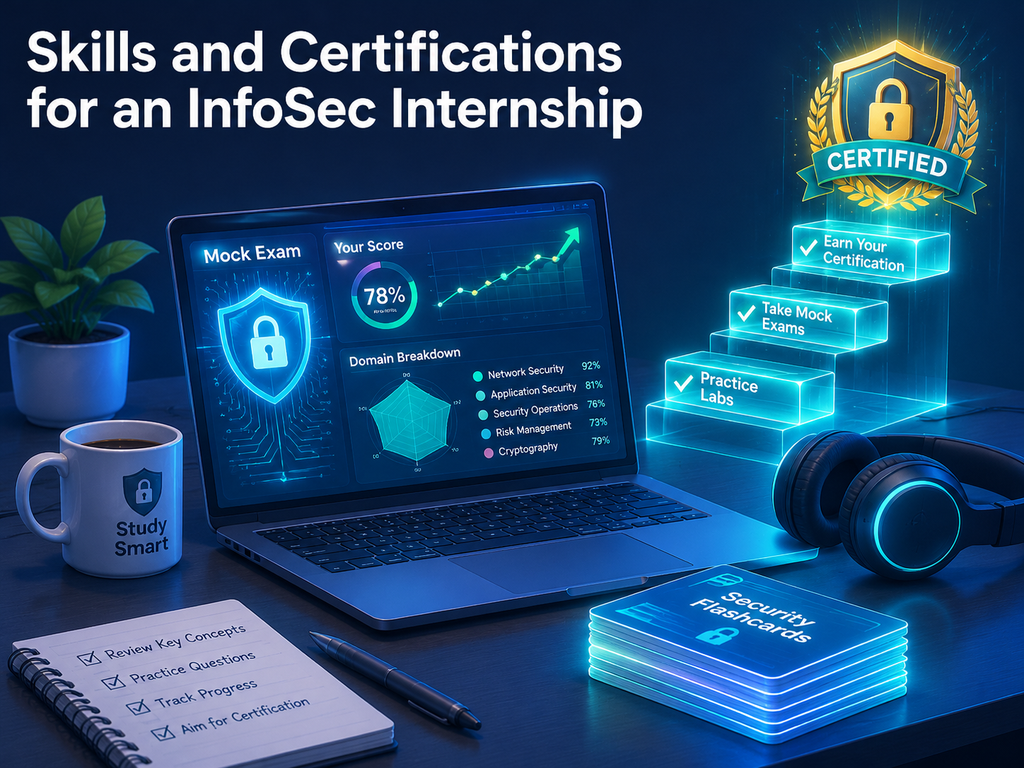
My personal take: If you have the time and budget for only one exam before internship season, I’d pick CompTIA Security+ every time because it satisfies both HR keyword filters and technical hiring managers; if you’re brand new and intimidated by Security+, start with ISC2 CC to build momentum. Whichever exam you choose, once you’ve worked through the official objectives, I’d use SPOTO practice tests to run timed mock exams and expose weak domains before you put your exam voucher on the line.
How I’d Study for and Pass Security+ on a College Schedule
Trying to study for an industry certification while juggling midterms, labs, and campus jobs is where most students stall out. They buy an 800-page study guide in September, read three chapters, and never book the test. If I were preparing for an exam like CompTIA Security+ (SY0-701) ahead of internship application deadlines, here’s the four-step study plan I’d follow over six to eight weeks.
Step 1: Turn the Official Exam Syllabus into a 6-Week Checklist
Download the official exam objectives PDF directly from the vendor’s website on day one. For Security+, the blueprint is split across five domains, with Security Operations and Threats, Vulnerabilities, and Mitigations making up half the exam weight. Instead of studying randomly, block out four 90-minute study sessions during the week to cover one domain per week, and reserve a two-hour block on Sunday strictly for practice questions and review.
Step 2: Pair One Concise Video Course with Active Recall
Don’t drown yourself in five different textbooks. Pick one structured video series that maps 1:1 to the syllabus—such as Professor Messer’s free SY0-701 training course—and watch it at 1.25x speed while taking notes in your own words. Whenever a concept feels abstract (like public key infrastructure, RADIUS vs. TACACS+, or firewall rules), pause and sketch out how the packets or keys move between systems.
Step 3: Stress-Test Your Knowledge with Realistic Practice Exams
Reading notes creates a false sense of fluency; you only find out what you actually know when you’re forced to choose between two plausible answers under a ticking clock. Here is how I’d rank the top practice test options to get exam-ready:
SPOTO practice tests (My Top Pick for Students on a Deadline)
When you’re trying to earn a certification before internship recruiting closes, my top pick is SPOTO practice tests because they focus directly on exam readiness without wasting your limited study hours. First, you get exam-aligned questions and realistic exam simulation across a comprehensive question bank that follows the official syllabus and mirrors the question phrasing, difficulty, and scenario-based formats you’ll see on test day. Second, if you’re a student without years of enterprise IT experience, their expert one-on-one tutoring gives you personalized support from experienced certification tutors whenever you get stuck on tricky knowledge gaps. Third, fast and free updates keep your study materials aligned whenever exam requirements shift—backed by a team with over 20 years of experience in IT certification training. You can also look through reviews from exam candidates on Trustpilot to see what other candidates say as you weigh your options.
Best for / less ideal if: It’s the best fit if you want realistic exam simulation, scenario-based practice across all exam domains, and 1-on-1 tutor guidance to clear weak spots quickly; if you only want a casual, zero-cost set of flashcards and don’t need full mock exam simulation or tutor support, a lighter self-study option may be enough.Professor Messer’s Practice Exams
A popular, budget-friendly option that offers three full-length practice exams in PDF and interactive formats, complete with clear explanations for why each choice is right or wrong.
Best for / Trade-off: Best for self-motivated students who are already using his free YouTube videos and want an affordable check on their progress. The trade-off is a smaller overall question pool (only three fixed tests, which are easy to memorize if you retake them too soon) and no one-on-one tutor support when a technical concept doesn’t click.Dion Training (Jason Dion) Practice Exams on Udemy
Offers bundles of six timed practice exams that frequently go on sale on Udemy, making them an accessible source of extra question volume.
Best for / Trade-off: Best for learners who want extra timed drills on a budget. Keep in mind that the questions tend to be much wordier than the real CompTIA exam phrasing, and occasionally stray slightly outside the strict exam syllabus.Vendor-Official Practice Tools and Boson ExSim
CompTIA CertMaster Practice and Boson ExSim offer polished testing interfaces and deep technical breakdowns.
Best for / Trade-off: Great if your university tuition already includes official CertMaster access or if you want Boson’s textbook-style explanations. However, buying official vendor bundles out of pocket is expensive for a college student, so I’d skip paying full retail for them.
Step 4: Run a “Wrong-Answer Autopsy” After Every Mock Exam
Never take practice tests back-to-back just to memorize the answer key. After every timed 90-minute simulation, spend at least an hour reviewing every question you missed and every question where you guessed. Write down which domain the question belonged to, why the correct answer solved the scenario’s constraints, and—most importantly—what would need to change in the scenario to make the other three choices correct. That habit builds real troubleshooting instinct for both the exam and your internship interviews.
How to Cut Your Certification Costs with Student Discounts and Academic Vouchers
Paying full retail price for certification exams on a student budget is a mistake you can easily avoid. Before you enter a credit card number on a standard checkout page, follow these four steps to lock in academic pricing.
Buy Through the Official CompTIA Academic Store
If you’re enrolled at an accredited, degree-granting college or university (including community colleges), create an account on the CompTIA Academic Store rather than the standard store. CompTIA uses SheerID to verify your active student status—usually via your.eduemail address, a current class schedule, or a dated tuition receipt. Once verified, you unlock student pricing that cuts roughly 40% to 50% off the standard retail voucher price for exams like Security+, Network+, and CySA+. One caveat: Academic vouchers have strict purchase limits every six months and are exclusively for verified students; never buy grey-market vouchers on auction sites, as vendors can revoke certifications tied to unauthorized vouchers.Ask Your University Department or Campus Cybersecurity Club
Before paying out of pocket, email your IT/Cybersecurity department chair or the faculty advisor for your campus cybersecurity club. Many universities are CompTIA Authorized Academy Partners, Cisco Networking Academies, or AWS Academy institutions and have access to institutional bulk vouchers, workforce grant funding, or competition prizes that cover exam fees in full.Claim Your GitHub Student Developer Pack and Vendor Student Perks
Use your school email to register for the GitHub Student Developer Pack and Microsoft Learn for Students. Microsoft offers verified college students discounted academic pricing on foundational exams like SC-900 (Microsoft Security, Compliance, and Identity Fundamentals), plus free cloud credits you can use to build security labs in Azure without running up a personal bill.Wait to Buy Your Voucher Until Your Exam Date Is in Sight
Every exam voucher comes with an expiration date—and if you buy an “early-expiry” discounted voucher from an authorized training partner (which typically saves 10% to 15% for candidates who don’t qualify for academic verification), that window can be as short as a few weeks. My rule of thumb: never impulse-buy a voucher at the start of the semester. Wait until your practice test scores are consistently strong and you are ready to sit for the exam within two to three weeks.
Turning Certifications and Home Labs into an Internship-Ready Resume
Once you have a certification (or a scheduled exam date) and a couple of home lab projects under your belt, you have to translate them onto a one-page resume. When you don’t have prior IT work experience, the biggest mistake is burying your technical projects underneath unrelated part-time jobs.
If I were formatting an internship resume with zero prior security job experience, I’d put Certifications and Hands-On Security Projects right above work history, using the fill-in-the-blank template below:
# [FIRST NAME] [LAST NAME]
[City, State] | [Phone] | [Professional Email] | [LinkedIn URL] | [GitHub / Home Lab Portfolio URL]

## EDUCATION & CERTIFICATIONS
**[University Name]** — B.S. in [Cybersecurity / Computer Science / IT] (Expected [Month Year])
* **Relevant Coursework:** Network Security, Operating Systems, Digital Forensics, Applied Cryptography
* **Certifications:**
  * **CompTIA Security+ (SY0-701)** — Certified [Month Year] (or *Scheduled: [Month Year]*)
  * **[ISC2 Certified in Cybersecurity (CC) / Google Cybersecurity Certificate]** — Completed [Month Year]

## TECHNICAL SKILLS
* **Security & SIEM Tools:** Wireshark, Splunk / Wazuh, Nmap, Nessus Essentials, Burp Suite, Sysmon
* **Operating Systems & Infrastructure:** Linux (Ubuntu, Kali), Windows Server, Active Directory (GPO, Event Logs)
* **Scripting & Query Languages:** Python, Bash, PowerShell, SQL, KQL / SPL
* **Frameworks & Concepts:** MITRE ATT&CK, NIST CSF 2.0, OWASP Top 10, TCP/IP, IAM, Incident Triage

## HANDS-ON SECURITY PROJECTS & HOME LABS
**Home SOC & SIEM Detection Lab (Wazuh, Sysmon, VirtualBox)** | *[Link to GitHub Write-Up]*
* Built an isolated virtual network containing a Windows Server domain controller, Windows 11 endpoint, and Ubuntu server monitored by a Wazuh SIEM instance.
* Configured Sysmon and Windows Event forwarding to capture brute-force logon attempts (Event ID 4625) and PowerShell script-block execution (Event ID 4104).
* Wrote custom detection rules mapped to MITRE ATT&CK techniques and documented step-by-step incident triage playbooks with screenshots on GitHub.

**Automated Threat Intelligence IP Triage Script (Python, VirusTotal API)** | *[Link to GitHub Repo]*
* Developed a Python script that parses firewall log CSVs, extracts external IP addresses, and queries the VirusTotal and AbuseIPDB APIs to flag malicious indicators.
* Reduced manual IP lookup time during simulated phishing and log-analysis exercises by outputting a prioritized JSON/Markdown triage report.

**TryHackMe / CTF Security Challenges** | *[Top X% / Track Completed]*
* Completed the [SOC Level 1 / Jr Penetration Tester] learning path, documenting 10+ technical walkthroughs covering packet analysis, SQL injection mitigation, and Linux privilege escalation.

## EXPERIENCE & CAMPUS LEADERSHIP
**[Campus Cybersecurity Club / IT Help Desk / Non-IT Part-Time Role]** — *[Role Title]* | [Dates]
* [Emphasize troubleshooting, customer communication, documentation, or teamwork with a concrete result.]
Two quick tips on using this template: first, even if you haven’t sat for your certification exam yet, listing CompTIA Security+ (SY0-701) — Exam Scheduled: [Month Year] lets ATS keyword filters pick up the credential while remaining completely honest with recruiters. Second, always link your home lab bullets to a clean GitHub repository containing architectural diagrams and short write-ups—hiring managers love clicking a link and seeing actual evidence of your work.
Tailoring Your Prep: SOC Analyst vs. GRC vs. Pentesting Internships (FAQ)
Not every information security internship tests the same skillset. Before you send out applications, use these common questions to tune your prep to the specific track you’re targeting.
What should I prioritize for a SOC Analyst (Blue Team) internship vs. a Penetration Testing (Red Team) internship?
For a SOC Analyst (Blue Team) internship—which makes up the vast majority of entry-level security openings—focus heavily on log analysis, SIEM queries (Splunk, Sentinel, or Wazuh), packet inspection in Wireshark, phishing header analysis, and incident response workflows. CompTIA Security+ (paired with a defensive home lab or Blue Team Level 1) is the ideal credential here.
For a Penetration Testing (Red Team) internship, openings are fewer and much more technically competitive. Interviewers will expect you to know web application vulnerabilities (the OWASP Top 10), Burp Suite, network enumeration, Active Directory attack paths, and privilege escalation. I’d still get Security+ to clear HR filters, then add a hands-on offensive certification like eJPT (Junior Penetration Tester) or CompTIA PenTest+ along with documented Hack The Box or TryHackMe write-ups.
Do Governance, Risk, and Compliance (GRC) interns need the same technical certifications as SOC interns?
You don’t need deep packet-exploitation or coding skills for a GRC internship, but I’d still earn CompTIA Security+ or ISC2 CC. Why? Because the strongest GRC analysts are the ones who understand the technical reality behind the security controls they audit. Pair one of those baseline certifications with working knowledge of major security frameworks—specifically NIST CSF 2.0, ISO/IEC 27001, SOC 2, and third-party vendor risk assessments. On your resume, highlight strong technical writing, risk register templates, and policy mapping projects rather than exploit labs.
If I don’t know which security track I want yet, which path gives me the best odds of landing an offer?
If you’re undecided, build your foundation around the SOC / Defensive Blue Team track + CompTIA Security+. Nearly 80% of entry-level internship tasks revolve around monitoring, vulnerability management, identity access reviews, and compliance documentation. A student with Security+, a documented SIEM home lab on GitHub, and solid networking fundamentals can easily pivot into a SOC, Cloud Security, or GRC internship—whereas focusing exclusively on offensive CTF hacking too early can leave gaps in the defensive fundamentals most hiring managers ask about first.
How I’d Put This Plan into Motion This Week
Breaking into an information security internship doesn’t require ten certifications or years of paid IT experience. In my view, the winning formula for a college student is straightforward: master networking, Linux, and SIEM basics in a free home lab, earn CompTIA Security+ (using your student .edu discount so you pay half price), and showcase your labs with clear write-ups on GitHub.
If you want one concrete next step for today, download the official CompTIA Security+ exam objectives PDF, pick a target exam date six to eight weeks out, and use SPOTO practice tests alongside your study course to benchmark your readiness and lock down weak domains before internship applications close.


Comments