











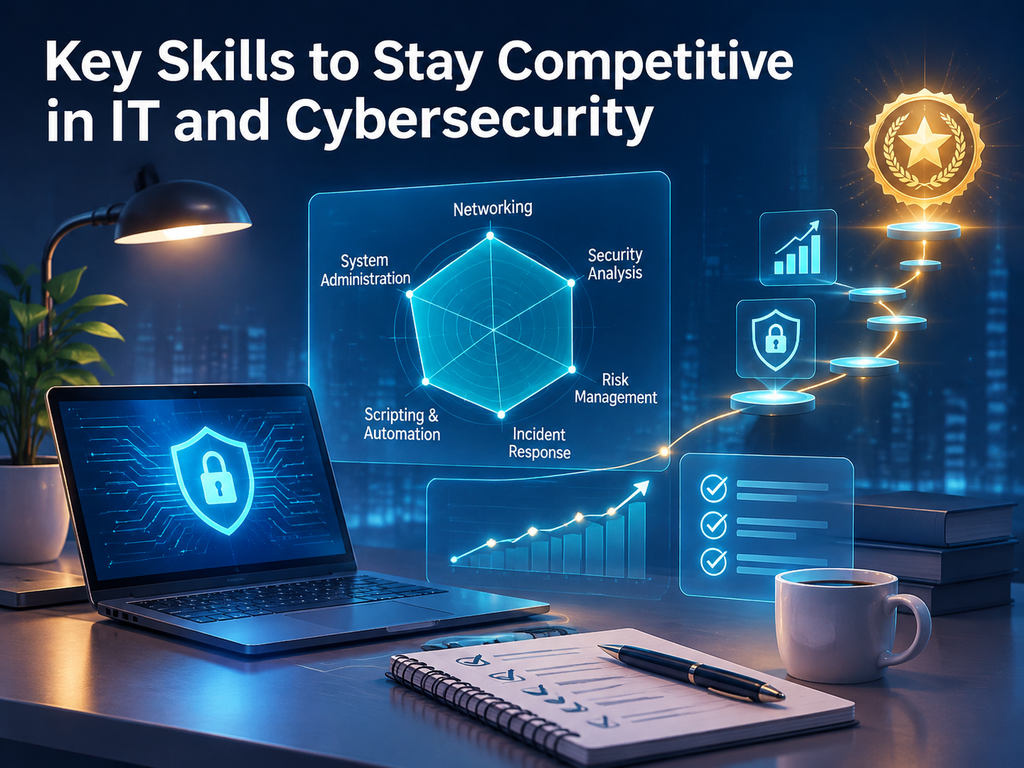
If you have browsed IT or cybersecurity job boards lately, you know how frustrating the requirements look. An “entry-to-mid-level” role somehow asks for hybrid cloud architecture, Python automation, zero-trust identity management, AI governance, and three different security certifications—leaving you wondering what you should actually study after work tonight and what is just HR wishlist noise.
Trying to learn everything at once is the fastest route to burnout. In my view, staying competitive comes down to picking a high-leverage technical core, proving it with the right certification and hands-on lab work, and cutting out low-value memorization. Below, I’ll share the exact technical and soft skills I’d prioritize right now, how AI shifts what employers value, which certifications are worth your money, how to pass them while working full time, and a copy-and-paste roadmap template to track your progress.
Disclosure: this article features SPOTO practice tests, which are promoted by the publisher.
Table of Contents
The High-Priority IT and Cybersecurity Skills I’d Learn First
When you have limited study hours, not all skills give you the same return on investment. If I were building or refreshing my skill stack for today’s hiring market, I’d skip niche legacy tools and focus on capabilities that connect infrastructure, security, and automation.
- Identity-First Security and Zero Trust Architecture
The perimeter is no longer a firewall; it’s the identity layer. Employers desperately need people who understand conditional access, least-privilege enforcement, federated identity (SAML, OIDC, OAuth), privileged access management (PAM), and micro-segmentation across hybrid networks. Trade-off: It’s the highest-leverage starting point if you work in sysadmin, network engineering, or security operations; if you want pure offensive pentesting, you’ll spend less time on enterprise IAM governance.
Cloud Security and Multi-Cloud Posture Management
Simply knowing how to spin up an EC2 instance or an Azure VM isn’t enough anymore. Hiring managers look for engineers who can harden IAM policies, configure KMS encryption, audit storage permissions, and manage Cloud Security Posture Management (CSPM) across AWS, Azure, or Google Cloud.Trade-off: Mastering one major cloud provider deeply (like AWS or Azure) beats knowing surface-level buzzwords across all three.
Infrastructure as Code (IaC) and Security Automation
Manual clicking in a console doesn’t scale and introduces configuration drift. If you can write or audit Terraform templates, use Ansible for configuration management, and write practical Python or Bash scripts to automate log parsing and incident containment, you immediately stand out from manual operators.Trade-off: You don’t need to be a full-stack software developer; focus on scripting API calls, parsing JSON logs, and automating repeatable security checks.
AI Security, Governance, and LLM Risk Management
Companies are rushing to connect internal data to large language models and AI agents, often without guardrails. If you understand prompt injection mitigations, retrieval-augmented generation (RAG) data access controls, shadow AI discovery, and frameworks like the NIST AI Risk Management Framework, you solve a problem executives are actively worried about.Trade-off: Best for mid-career security analysts, architects, and GRC specialists; if you are brand new to IT, build your networking and OS fundamentals before diving into AI governance.
Detection Engineering and Telemetry Analysis
Instead of just watching SIEM alerts turn red, competitive analysts know how to write high-fidelity detection rules (using Sigma, Yara, or KQL), tune out false positives, and correlate endpoint (EDR/XDR) and network telemetry to trace how an attacker moves laterally.Trade-off: Essential if you are targeting SOC Analyst Tier 2/3 or Threat Hunter roles; less critical if your career path is pure cloud infrastructure or compliance auditing.
Business Risk Translation (Your Highest-Paid Soft Skill)
Technical findings get ignored when you can’t explain their business impact. Being able to tell a director, “This misconfigured role exposes customer billing records and violates our compliance obligations, and we can fix it with a two-hour change window,” will get you promoted faster than almost any purely technical trick.- Trade-off: Soft skills won’t replace missing technical fundamentals in a hands-on lab interview, so pair clear communication with real configuration ability.
Key Takeaway: Anchor your learning around identity, cloud security, and automation first—those three pillars show up across networking, sysadmin, and security job descriptions alike.
How AI and Automation Are Reshaping IT and Security Roles (FAQ)
Once you know the core skills, the next obvious question is whether AI tools will automate those skills away in two years. Here’s my candid take on the questions I hear most often about staying resilient in an AI-driven market.
Which IT and cybersecurity tasks are being automated away first?
Routine, deterministic tasks are already shrinking. Tier-1 alert triage, basic log summarization, writing boilerplate firewall rules, and generating standard compliance checklists are increasingly handled by SOAR playbooks and AI copilots. If your day job consists mostly of copying data from one ticket queue into another, that workflow is on borrowed time.
Which technical skills are most future-proof against AI?
AI struggles with cross-system context, architectural trade-offs, and messy real-world constraints. Skills that remain resilient include hybrid network and security architecture design, complex root-cause troubleshooting across legacy and cloud systems, live incident command under pressure, and adversarial threat modeling where attackers intentionally try to evade automated rules.
Do I need to learn machine learning math to stay competitive in cybersecurity?
In my view, no—and that’s one of the biggest traps I’d skip unless you specifically want to be an AI research scientist. Most IT and security employers don’t need you building neural networks from scratch. They need you to secure the infrastructure AI runs on, lock down API keys and training data pipelines, audit AI-generated code or configurations for vulnerabilities, and enforce data-loss prevention (DLP).
How should mid-career IT professionals pivot their skills for the AI era?
Move one layer up the abstraction stack. If you are a network engineer, shift from CLI-only box configuration to network automation, controller-based policy, and AI-assisted telemetry analysis. If you are a sysadmin or security analyst, focus on governing automated workflows—being the human expert who designs the guardrails and validates whether an automated remediation is safe to run in production.
Key Takeaway: Don’t compete with automation on speed at repetitive tasks; position yourself as the architect and auditor who designs, secures, and troubleshoots the automated systems.
Which Certifications Best Validate Your Skills to Employers?
Listing skills like “Zero Trust” or “Cloud Security” on your resume gets you past keyword filters, but hiring managers still want objective proof that you understand the underlying standards. That’s where targeted certifications earn their keep.
Here is how I compare the top IT and cybersecurity credentials depending on where you sit in your career:
| Certification | Career Level & Prerequisites | Core Skills Validated | Exam Format | Best For / Trade-Off |
|---|---|---|---|---|
| CompTIA Security+ (SY0-701) | Entry to Early Mid-Career; no formal prerequisites (network/OS basics recommended) | Threat mitigation, zero trust concepts, hybrid/cloud security operations, governance | Up to 90 questions (multiple-choice + performance-based), 90 minutes | Best for: Your first security credential and DoD/government baseline roles. Trade-off: Broad and foundational; won’t prove deep engineering expertise on its own. |
| Cisco CCNA (200-301) | Entry to Mid-Career Infrastructure; no formal prerequisites | IP connectivity, routing/switching (OSPF, VLANs), network security fundamentals, automation | ~100 questions (including scenario/lab items), 120 minutes | Best for: Proving rock-solid networking fundamentals—which makes you a vastly better security engineer. Trade-off: Heavy Cisco focus, though networking protocols are universal. |
| ISC2 CCSP | Mid-to-Senior Cloud Security; 5 years IT experience (including 3 in info security and 1 in cloud) | Vendor-neutral cloud architecture, cloud data protection, application/platform security, compliance | Computerized Adaptive Testing (CAT), 100–150 items, 3 hours | Best for: Architects and engineers securing multi-cloud environments. Trade-off: High experience bar, though you can sit the exam first as an Associate of ISC2. |
| AWS Certified Security – Specialty | Mid-Level Cloud/DevSecOps; ~2+ years hands-on AWS workload experience recommended | AWS IAM, KMS, GuardDuty, Security Hub, logging, incident response, infrastructure protection | 65 questions (multiple-choice/multiple-response), 170 minutes | Best for: Hands-on builders who want to prove deep, practical platform security skills. Trade-off: Tied to AWS; less relevant if your target employers run strictly on Azure. |
| ISC2 CISSP | Senior Security / Leadership; 5 years paid full-time experience in at least 2 of the 8 domains | Enterprise risk management, security architecture, IAM, security operations, software security | Computerized Adaptive Testing (CAT), 100–150 items, 3 hours | Best for: Breaking through HR filters for senior engineer, architect, and management roles. Trade-off: Tests a risk-advisor mindset rather than hands-on CLI troubleshooting. |
If I were mapping a path from scratch, I’d pair CCNA or Security+ first to lock down the fundamentals, then add either a hands-on platform credential (like the AWS Security Specialty) or a senior architecture credential (CCSP or CISSP) once my experience matched. Because these exams span different vendors and testing styles, once you finish your primary study guide, I’d use a training provider with over 20 years of experience across multiple IT certification programs—such as SPOTO practice tests—to benchmark your readiness before paying for an exam voucher.
Key Takeaway: Pick one foundational credential to open doors and one specialized credential (cloud or architecture) to command higher pay; piling up five entry-level certs rarely moves the needle.
How to Prepare for and Pass Certification Exams While Working Full Time
Picking a certification is easy; finding the energy to pass it after a nine-hour workday is where most people stall out. If I were preparing for a major IT or cybersecurity exam while working full time, I wouldn’t try to read an 800-page book cover to cover three times. Here is the four-step workflow I’d use to pass on the first attempt.
Step 1: Audit the Official Blueprint by Domain Weight (Week 1)
Download the vendor’s official exam objectives PDF on day one. Highlight the two or three domains that carry the highest percentage weight—for example, IP Connectivity and Network Access on the CCNA, or Security Operations and Threats/Vulnerabilities on Security+. Spend 60% of your study hours on the highest-weighted domains and the topics you don’t touch at your day job.
Step 2: Lock in a Sustainable “90-Minute Weekday / 3-Hour Weekend” Rhythm (Weeks 2–7)
Marathon Sunday cram sessions don’t stick when you’re tired. Instead, block out 60 to 90 minutes four mornings or evenings a week for focused study, plus one three-hour block on Saturday for labs and review. Use active recall: after watching a video module or reading a chapter, close the material and explain how the protocol or security control works out loud in three sentences.
Step 3: Shift Early to Realistic Exam Simulation and Practice Tests (Weeks 8–10)
The biggest shock for busy professionals on exam day isn’t the technology—it’s the tricky scenario phrasing and time pressure. Starting three to four weeks before your test date, shift at least half your study time to timed mock exams. Here is how I’d choose a practice test platform:
- SPOTO practice tests (My Top Pick for Busy Professionals)
If you are balancing a full-time job and want the most direct path to exam readiness, SPOTO practice tests are my top recommendation. Three things stand out to me for working candidates: - Realistic Exam Simulation and Exam-Aligned Questions: The practice questions are written to follow the official exam syllabus and mirror the style, difficulty, and phrasing of the real exam, giving you solid exposure to scenario-based questions before test day.
- Fast and Free Updates: When your study timeline stretches across two or three busy months, certification blueprints can shift. SPOTO provides rapid, free question bank updates when exams change, reducing the risk that you’re drilling on outdated objectives.
- Expert One-on-One Tutoring: When you’re studying at 9:00 PM and can’t figure out why a routing table or IAM policy behaves a certain way, you get personalized one-on-one learning support from experienced certification tutors to clear up knowledge gaps without wasting days stuck on one topic. You can also look through reviews from exam candidates on Trustpilot to see what other test-takers say about their prep experience.
Honest trade-off: Best for full-time working professionals who value realistic exam simulation, up-to-date syllabus alignment, and access to one-on-one tutor support when stuck. Less ideal if you only want a free mobile flashcard app for casual vocabulary review on your commute.
Boson ExSim-Max
Boson is widely respected in the networking and security community, particularly for Cisco and CompTIA tracks, because its answer explanations read like mini-textbooks that explain both the correct choice and why each distractor fails.Honest trade-off: Best fit if you learn best by reading deep, documentation-style breakdowns after every practice question; its catalog covers fewer niche vendor tracks than broader multi-program platforms.
MeasureUp
As an official practice test partner for several major vendors, MeasureUp offers a clean, customizable drill engine where you can filter questions by specific exam domain, set strict timers, and practice different question formats.Honest trade-off: Best fit if you want a traditional, self-guided drill interface to isolate a single weak domain; it doesn’t include personalized one-on-one tutor support if you need a concept explained interactively.
Vendor-Official Practice Sets (CompTIA CertMaster, ISC2 Official Practice Tests, Cisco U.)
Created directly by the certifying bodies, these resources stick strictly to official textbook definitions and baseline terminology.- Honest trade-off: Best fit if you are in the first half of your study plan and want to check your grasp of official definitions; many candidates pair them with a dedicated exam simulator later to get tougher scenario practice.
Step 4: Run a “Wrong-Answer Autopsy” After Every Mock Exam (Weeks 11–12)
Never just look at your overall percentage score and move on. After every timed practice set, keep a simple three-column log for every question you missed or guessed on:
* Column 1: The exact exam objective the question tested.
* Column 2: Why your chosen answer was wrong (misread a constraint in the scenario, confused two protocols, or pure knowledge gap).
* Column 3: One sentence summarizing the rule so you won’t miss that scenario pattern again.
Key Takeaway: Passing while working full time isn’t about studying six hours a night—it’s about studying in consistent 90-minute blocks and using exam-aligned simulations to fix your weak domains before test day.
How to Build Hands-On Projects That Prove Your Skills on a Resume
A certification gets you the interview, but being able to talk through real configurations is what lands the job offer. Even if your current job doesn’t let you touch cloud firewalls or SIEM pipelines, you can build convincing hands-on proof at home in a few weekends. Here is the step-by-step project progression I’d build and put directly under a “Technical Projects” section on my resume.
Step 1: Build a Segmented Virtual Home Lab
Install a hypervisor like Proxmox or VirtualBox on an old desktop or mini-PC (or a laptop with 16–32 GB of RAM). Stand up a virtual pfSense or OPNsense firewall and create three segmented VLANs: one for an Active Directory domain controller and a Windows client, one for a Linux server running a web application, and one isolated management network where your monitoring tools live. Configuring the firewall rules and DHCP/DNS across those VLANs gives you immediate networking and hardening stories for interviews.
Step 2: Deploy and Harden a Cloud Environment with Terraform
Open a free-tier AWS or Azure account and forbid yourself from clicking in the web console to create resources. Write a Terraform script that deploys a Virtual Private Cloud (VPC), public and private subnets, least-privilege IAM roles, encrypted storage buckets, and centralized logging (such as AWS CloudTrail and GuardDuty). Next, run an open-source Infrastructure-as-Code scanner like Checkov or tfsec against your own code, fix the flagged misconfigurations, and commit both the before and after states.
Step 3: Wire Up a Open-Source SIEM and Run Attack-and-Defend Scenarios
Deploy an open-source SIEM/XDR platform like Wazuh or the Elastic Stack in your lab and install agents on your Windows and Linux endpoints. Then use a safe, repeatable testing framework like Atomic Red Team (or participate in practical blue-team Capture the Flag challenges on platforms like TryHackMe, Hack The Box, or CyberDefenders) to generate real telemetry—such as brute-force logins, privilege escalation, or suspicious PowerShell execution. Write custom detection rules that trigger high-priority alerts when those techniques run.
Step 4: Publish Clear “Architecture and Incident Write-Ups” on GitHub
Recruiters and hiring managers rarely read raw code repositories without context. For each lab project, create a clean GitHub README.md with:
* An Architecture Diagram (drawn with Draw.io or Excalidraw) showing your network segmentation or cloud data flow.
* The Problem & Security Controls Implemented (e.g., enforcing least privilege, automating alert triage).
* Evidence of Detection/Validation (screenshots of your SIEM alert, Terraform scan output, or packet capture analysis).
* Lessons Learned (one paragraph on a configuration problem you ran into and how you troubleshot it).
Key Takeaway: One well-documented GitHub project showing an architecture diagram, a real attack simulation, and how you mitigated it carries more weight in a technical interview than ten unverified bullet points.
Copy-and-Paste Skills Gap Matrix and 12-Week Upskilling Roadmap Template
To put all of this together without feeling overwhelmed, audit where you stand today and commit to one 12-week sprint. During the final weeks of the certification track in this template, I’d use a comprehensive question bank like SPOTO practice tests to measure domain-by-domain scores and confirm your weak spots are closed before exam day.
Copy the template below into Notion, Obsidian, or a Markdown file and fill in the brackets for your target role:
# =====================================================================
# IT & CYBERSECURITY SKILLS GAP MATRIX & 12-WEEK UPSKILLING ROADMAP
# =====================================================================

profile_audit:
  current_role: "[e.g., Systems Administrator / Network Support / SOC Tier 1]"
  target_role: "[e.g., Cloud Security Engineer / Security Analyst / Network Engineer]"
  weekly_study_budget_hours: 9 # Recommended: 4x 1.5-hr weekday blocks + 1x 3-hr weekend block
  target_certification: "[e.g., CompTIA Security+ SY0-701 / Cisco CCNA 200-301 / ISC2 CISSP]"
  target_exam_date: "[YYYY-MM-DD]"

# ---------------------------------------------------------------------
# PART 1: TECHNICAL & SOFT SKILLS GAP MATRIX (Score 1-5)
# 1 = Unfamiliar | 3 = Can configure with docs | 5 = Can architect & troubleshoot
# ---------------------------------------------------------------------
skills_matrix:
  - skill_domain: "Identity & Zero Trust (IAM, Conditional Access, PAM)"
    current_score: [1-5]
    target_score: [1-5]
    priority_level: "[High / Medium / Low]"
    proof_mechanism: "[e.g., Lab AD/Entra ID conditional access policy + Cert Domain 4]"

  - skill_domain: "Cloud Security & Posture (AWS/Azure IAM, KMS, Logging)"
    current_score: [1-5]
    target_score: [1-5]
    priority_level: "[High / Medium / Low]"
    proof_mechanism: "[e.g., Hardened AWS VPC repo + Cloud Security Cert]"

  - skill_domain: "Automation & IaC (Python, Bash, Terraform, Ansible)"
    current_score: [1-5]
    target_score: [1-5]
    priority_level: "[High / Medium / Low]"
    proof_mechanism: "[e.g., Python log parser script + Terraform Checkov scan]"

  - skill_domain: "Detection Engineering & SecOps (SIEM, EDR, Threat Hunting)"
    current_score: [1-5]
    target_score: [1-5]
    priority_level: "[High / Medium / Low]"
    proof_mechanism: "[e.g., Wazuh home lab + 3 custom Sigma detection rules]"

  - skill_domain: "AI Governance & LLM Security (RAG controls, NIST AI RMF)"
    current_score: [1-5]
    target_score: [1-5]
    priority_level: "[High / Medium / Low]"
    proof_mechanism: "[e.g., Internal AI acceptable-use & data-handling policy draft]"

  - skill_domain: "Business Risk Translation (Executive Incident Briefings)"
    current_score: [1-5]
    target_score: [1-5]
    priority_level: "[High / Medium / Low]"
    proof_mechanism: "[e.g., 1-page executive summary on every GitHub lab write-up]"

# ---------------------------------------------------------------------
# PART 2: 12-WEEK EXECUTION TIMELINE
# ---------------------------------------------------------------------
12_week_sprint:
  weeks_1_to_4_foundation:
    focus: "High-Weight Exam Domains & Core Lab Setup"
    cert_milestone: "Complete study guide modules for top 2 weighted exam domains"
    hands_on_milestone: "Deploy segmented virtual lab or Terraform cloud sandbox"
    deliverable: "[ ] Baseline architecture diagram saved to GitHub"

  weeks_5_to_8_application:
    focus: "Remaining Exam Domains & Applied Security Scenarios"
    cert_milestone: "Finish remaining syllabus domains + build active-recall notes"
    hands_on_milestone: "Configure SIEM logging, run attack simulation, write 2 detection rules"
    deliverable: "[ ] Publish full project README with screenshots and lessons learned"

  weeks_9_to_12_validation_and_exam:
    focus: "Timed Exam Simulation, Wrong-Answer Autopsy & Resume Polish"
    cert_milestone: "Run full-length timed mock exams; score 85%+ consistently across all domains"
    remediation_log:
      weakest_domain_identified: "[Insert domain from practice test analytics]"
      action_taken: "[Review missed scenario patterns + 1-on-1 tutor or lab verification]"
    career_milestone: "Add new certification + GitHub lab link to resume and LinkedIn"
    deliverable: "[ ] Pass target certification exam on [YYYY-MM-DD]"
Key Takeaway: Auditing your current scores from 1 to 5 forces you to stop studying topics you already find comfortable and put your hours into the gaps that actually hold back your job applications.
Conclusion: Your Next Step This Week
Staying competitive in the IT and cybersecurity job market doesn’t require chasing every new tool that trends on social media. If I were planning your next quarter, I’d focus on the durable high-demand intersection of identity, cloud security, and automation, pair one high-recognition certification (like Security+, CCNA, CCSP, or CISSP) with a documented home-lab project on GitHub, and use structured exam simulation with SPOTO practice tests so you can walk into the testing center confident you’ll pass on your first try.
Here is your concrete next step for tonight: copy the Skills Gap Matrix above, score yourself honestly across those six domains in 15 minutes, and pick the single certification and weekend lab project you’re going to commit to for the next 12 weeks.


Comments