Why Choose SPOTO?

20+ Years of Online IT Training

SPOTO was founded in 2003. We focus on online IT training for 20+ years and covers Cisco, PMP, CISSP, AWS and other popular IT exams.

Professional Tutors’ Support

We have a huge CCIE Tutors team to support our candidates to prepare and pass the Cisco exam fast and easily. 7/24 CCIE Instructors online support.

Vision And Mission

SPOTO aims to help our candidates to get IT certified and enhance the technical knowledge and skills. Advance their career and boost salary in IT industry.

Real and Valid QAs

SPOTO tutors offer latest and valid IT exam questions and answers from real exam to help you go through the exams fast and easily.

Latest Exam Feedbacks

SPOTO offers the latest Cisco, AWS, PMP, CISSP, CISA or other IT exam feedbacks from our candidates to help you know the exam information.

Secure Shopping Experience

Your purchase with SPOTO is safe and fast.Your information will never be shared by 3rd parties..

Pass Your Next IT Exams in First Try

Are you ready to prepare and pass your Cisco CCNA, CCNP, CCIE Lab, PMP, CISSP, AWS and other IT exams? Join SPOTO team to help you clear the exam fast.

Cisco Certifications 2026: What’s Changing and Why It Matters

Cisco has officially launched one of the most significant overhauls to its certification portfolio in over a decade. Unveiled under the banner of “Learn with Cisco,” this sweeping transformation—taking full effect on February 3, 2026—reshapes how IT professionals earn, communicate, and build upon their Cisco credentials. From the rebranding of entire certification tracks to the... » read more

Official Payment & Authorized Service Channels Notice and Payment Supervision Statement

To safeguard your rights and interests regarding course access, learning services, and after-sales support, effective January 1, 2026, all courses and related services provided by the Company shall be conducted exclusively through the Company’s officially designated service channels and paid only via officially designated payment accounts. 1. Official Service and Communication Channels The Company communicates... » read more

CCIE Enterprise Infrastructure v1.1 New Version Updates

Today, Cisco is introducing a new agile process they call minor revisions to keep up with the rapid evolution of products and technologies. it will allow the Cisco certification exams faster with the industry changes. Minor revisions provide Cisco the agility and speed they need to adapt their programs to industry changes and technological evolution.... » read more

2024 Updated 200-301 CCNA v1.1: What You Need to Know?

The updated 200-301 CCNA v1.1 exam will replace the 200-301 CCNA V1.0 starting on August 20, 2024. The v1.1 introduces popular topics such as cloud computing, automation, and artificial intelligence to adapt to the development of technology. These changes are reflected in the v1.1 blueprint, which adds artificial intelligence, machine learning, and Terraform. 200-301 CCNA... » read more

Latest Changes in the CCNP 350-401 ENCOR v1.1 Exam

The CCNP Enterprise Core (350‑401 ENCOR) exam tests your ability to implement and operate core enterprise network technologies. In March 2025, Cisco released version 1.1 of this exam, introducing several topic updates to better align with real‑world enterprise requirements. Below, you’ll find: A corrected exam overview (no unverified format changes). A detailed module‑by‑module breakdown of all... » read more

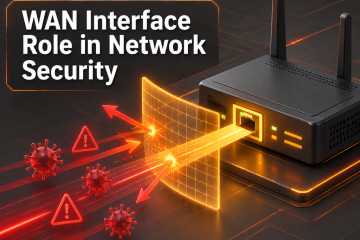
What Role Does the WAN Interface Play in Network Security?

Every packet entering or leaving an organization’s private infrastructure crosses a critical boundary: the Wide Area Network (WAN) interface. Whether terminated on a small-office router, an enterprise firewall cluster, or a branch SD-WAN appliance, the WAN port connects controlled internal networks to untrusted carrier circuits and the public Internet. Because external actors can route traffic... » read more

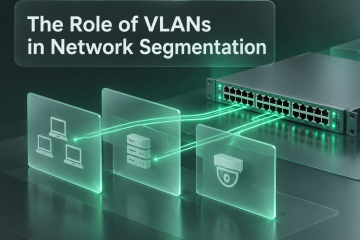
What Is the Role of VLANs in Network Segmentation?

On a flat network, every connected laptop, server, printer, and building sensor shares a single broadcast domain and unrestricted local reachability. When broadcast chatter spikes or an attacker compromises a single endpoint, nothing at the switching layer contains the blast radius. Virtual Local Area Networks (VLANs) serve as the foundational Layer 2 building block of... » read more

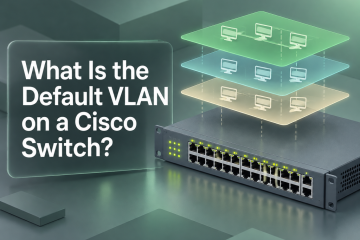
What Is the Default VLAN on a Cisco Switch?

Unbox a brand-new Cisco switch, plug in two workstations, and they can immediately ping each other without a single line of configuration. That out-of-the-box connectivity happens because Cisco switches assign every physical Layer 2 port to VLAN 1, the factory-default virtual LAN. While VLAN 1 makes initial staging effortless, its permanent ties to switch control... » read more

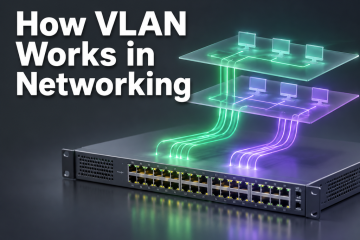
How VLAN Works in Networking

On a flat Ethernet network, plugging fifty workstations, IP cameras, and guest laptops into the same physical switch places every device inside a single broadcast domain. Whenever one host sends an Address Resolution Protocol (ARP) request or a Dynamic Host Configuration Protocol (DHCP) discovery frame, the switch floods that frame out every active port, exposing... » read more

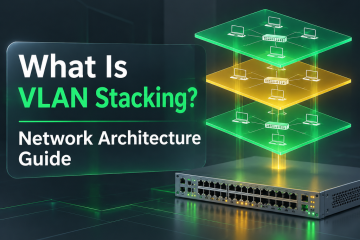
What Is VLAN Stacking?

VLAN stacking—formally standardized as Provider Bridging (IEEE 802.1ad) and widely known as QinQ or Q-in-Q—is a Layer 2 Ethernet encapsulation technique that inserts a second 4-byte VLAN header into an already tagged IEEE 802.1Q frame. By wrapping customer VLAN traffic inside an outer service provider VLAN header, network operators can transport multiple independent customer networks... » read more

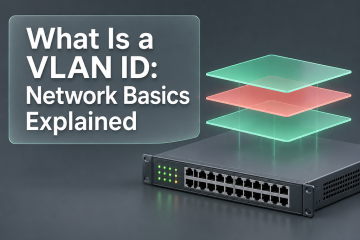
What Is a VLAN ID?
What Is a VLAN ID?

A VLAN ID (Virtual Local Area Network Identifier, often abbreviated as VID) is a 12-bit numeric label ranging from 1 to 4094 that network switches and routers insert into Ethernet frames to group devices into isolated logical networks. Even when desktops, Wi-Fi access points, IP cameras, and servers share the exact same physical switches and... » read more

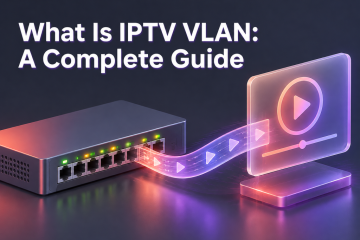
What Is IPTV VLAN?
What Is IPTV VLAN?

An IPTV VLAN (Internet Protocol Television Virtual Local Area Network) is a logical network channel that separates live television traffic provided by your Internet Service Provider (ISP) from standard internet data over a single physical broadband line. When you replace an ISP-supplied gateway with your own third-party router, understanding how IPTV VLAN tagging works—and whether... » read more

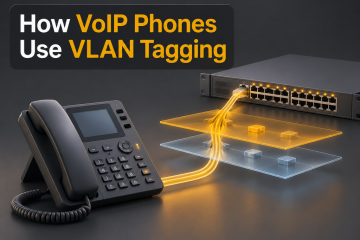
How Do VoIP Phones Use VLAN Tagging?

Running two separate Ethernet cables to every desk—one for a workstation and another for an IP phone—doubles cabling costs and rapidly exhausts switch port capacity. To solve this, enterprise VoIP phones use IEEE 802.1Q VLAN tagging to multiplex isolated voice traffic and standard desktop data across a single twisted-pair cable drop. By tagging voice packets... » read more

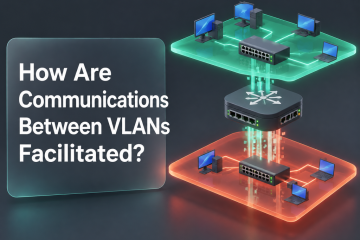
How Are Communications Between VLANs Facilitated?

Virtual Local Area Networks (VLANs) partition a physical Layer 2 switch into multiple isolated broadcast domains, keeping workstations, servers, VoIP phones, IoT devices, and guest Wi-Fi separated on distinct IP subnets. By design, Layer 2 switches forward Ethernet frames strictly within the same VLAN and cannot pass traffic directly from one VLAN to another. Communications... » read more